Fanatics’ Hometown Remix Investment Case
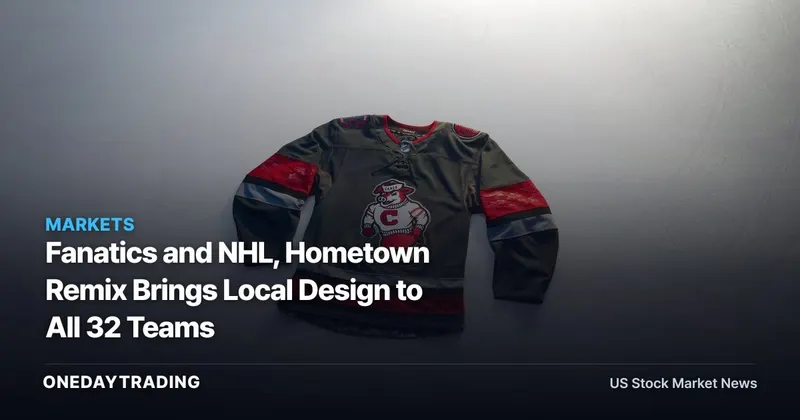
Fanatics and the NHL debuted Hometown Remix on 2026-11-02, extending the merchandise company’s role from producing uniforms to shaping a league-wide design program. Covering all 32 NHL teams, the collection gives investors a concrete sign of deeper responsibility within the partnership, though CNBC reported no sales targets or available quantities that would establish its financial scale.
Hometown Remix is a special-edition uniform and apparel program designed around each club’s city and supporters. It is the first league-wide jersey program designed and developed by Fanatics for one of its league partners, making execution and fan reception more relevant than the breadth of the announcement alone.
How the NHL Partnership Expanded
Fanatics has partnered with the NHL since 2005. The relationship expanded in 2023 to include on-ice uniforms and authentic jerseys after the Adidas jersey deal lapsed, with the expanded arrangement beginning in the 2024-25 season.
The Hometown Remix collection process began in 2024, according to CNBC. That sequence matters because the program reflects work conducted under the expanded partnership rather than a stand-alone apparel release: Fanatics works with the NHL and its clubs on both the designs and their execution.
The operating distinction is clearest when compared with Fanatics’ roles elsewhere. Fanatics manufactures NFL consumer jerseys, while Nike manufactures and designs the uniforms NFL players wear on the field. Fanatics also manufactures MLB player jerseys while Nike designs them. Hometown Remix therefore places more of the visible creative responsibility with Fanatics than those established divisions of labor do.
Pricing Tests the Value of Special-Edition Design
Fanatics priced a Hometown Remix premium jersey with custom lettering and numbering at $275. Its authentic jersey with custom lettering and numbering costs $500 and corresponds to the version worn on the ice by players.
Those prices define the offer, not its likely commercial result. The jerseys are described as limited supply, but the quantity available is unknown. Without unit availability or a specific sales target, investors cannot calculate potential revenue from the launch or determine how much scarcity contributes to purchasing behavior.
The collection instead creates an observable test of whether city- and club-specific design can support demand across an entire league. A favorable response could validate the broader design role Fanatics has assumed; an uneven response could show that league-wide reach does not eliminate the importance of individual team preferences. Fan response to each design remains unknown.
The Design Debate Is Also an Execution Test
Every NHL team will wear its Hometown Remix jersey for a set of games during the remainder of the 2026-2027 season. That places the products on players as well as in the merchandise channel, linking the consumer offer directly to the on-ice presentation.
Brian Jennings framed local identity as the creative premise: “Each market and city is unique … we love to celebrate that uniqueness.” The approach gives every club a distinct point of connection, while also making reception dependent on whether supporters recognize and accept the interpretation of their city and team.
Andrew Low Ah Kee described Fanatics as secondary to that relationship: “The protagonists in the story are the fan and their team; we're the supporting actor.” The comment also captures the commercial tension. Fanatics gains greater design visibility, but the club and its supporters remain the final arbiters of whether a jersey feels credible.
What the Launch Establishes—and What It Does Not
- Confirmed scale: The Hometown Remix program covers all 32 NHL teams and is set for the 2026-2027 season.
- Confirmed responsibility: Fanatics designed and developed its first league-wide jersey program for a league partner while working with the NHL and its clubs.
- Unmeasured demand: Specific sales targets, supply quantities and design-by-design fan responses have not been disclosed.
- Unsettled extension: It is unknown whether any colors, logos or designs will become future alternate jerseys or appear on other products.
The evidence supports a strategic milestone, not a quantified earnings catalyst. Greater responsibility may strengthen the importance of Fanatics within the NHL relationship, while simultaneously concentrating accountability for garment design, manufacturing and quality. The facts supplied do not establish how that responsibility will affect revenue, costs or profitability.
Related Apparel and Uniform Read-Throughs
- Fanatics: The company is the direct subject because it designed and developed the league-wide program and supplies the premium and authentic products.
- NHL: The league supplies the all-team platform, and each club will put its design on the ice during the remainder of the season.
- Adidas: Its previous NHL jersey agreement provides the immediate partnership context; that deal lapsed in 2023 before Fanatics’ role expanded.
- Nike: Its design and manufacturing responsibilities in the NFL and its design role in MLB illustrate that Fanatics does not hold the same creative remit across every sports partnership.
- Apparel: The relevant sector exposure lies in special-edition uniforms and merchandise, though the fact sheet provides no listed-company financial impact or public-market ticker directly tied to the launch.
Hometown Remix Checkpoints
- On-ice schedule: Check which games feature each team’s jersey once the exact schedules are supplied; those dates are not included in the available facts.
- Product availability: Monitor whether Fanatics specifies the quantity behind “limited supply,” because scarcity cannot be assessed without that disclosure.
- Fan response: Compare reception across individual designs rather than treating all 32 NHL teams as a single demand signal.
- Design reuse: Watch whether the NHL and Fanatics confirm that any Hometown Remix elements will appear in future alternate jerseys or other merchandise.
Balanced Outlook for Fanatics and the NHL
The constructive case rests on scope and responsibility. Fanatics has moved from a partnership dating to 2005 into a program where it designed and developed special-edition uniforms for every NHL club, with premium and authentic products offered alongside their on-ice use.
The risk is that strategic prominence is easier to verify than commercial success. Limited supply has not been quantified, sales targets are undisclosed, and supporters may respond differently to each local design. Until availability, reception or subsequent product decisions provide harder evidence, Hometown Remix is best viewed as a meaningful test of Fanatics’ expanded NHL role rather than a proven financial outcome.
📊 Analysis
Signal Neutral
Why The league-wide launch expands Fanatics’ design role, while undisclosed sales targets, limited-supply quantities and uncertain fan response prevent a directional conclusion.
This article was independently written by OneDayTrading from public reporting. Read the original (CNBC)