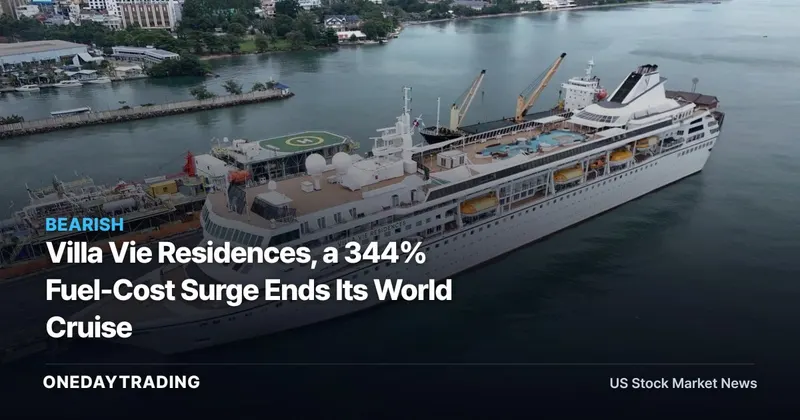
Villa Vie Odyssey’s Cost Shock Breaks the Residential-Cruise Model
Villa Vie Residences is confronting a cost problem that pricing and itinerary changes could not absorb. CNBC reported that the U.S.-based operator ended the Villa Vie Odyssey’s round-the-world cruise in Cambodia and said it would disembark passengers and crew, arrange temporary accommodation, and restructure its business. For travel investors, the important signal is the gap between what residents can be charged and what prolonged operation now costs.
A residential cruise is an extended voyage marketed as a home at sea while traveling among destinations. The Villa Vie Odyssey had sailed for two years since departing Belfast, Northern Ireland, and was marketed around visits to hundreds of destinations. Rooms cost as much as $11,000 per month, according to CNBC, placing the offering at the luxury end of travel even before fuel pressure reached the cabin economics.
The ship can carry 650 passengers, Villa Vie Residences said, although the number of passengers and crew aboard when the voyage stopped is unknown. Its amenities include three restaurants and five bars and lounges. Those details show the scale of the onboard proposition, while the interruption shows that a premium customer offer does not by itself protect the operator from a steep input-cost mismatch.
From $1,800 to $8,000: The Cabin Economics
The decisive figure is fuel cost per cabin. Villa Vie Residences said the monthly amount had risen from $1,800 before the increase to as much as $8,000 in parts of Asia; CNBC calculated that change at 344%. The operator said it could not transfer an increase of that magnitude to residents, leaving the current operating model under unsustainable financial pressure.
That statement identifies the transmission mechanism. Fuel expense rose on a per-cabin basis, while the company judged that resident pricing could not rise enough to close the shortfall. Even rooms priced at up to $11,000 per month do not answer the operating question without evidence that customers would accept higher charges or that the company could remove enough cost elsewhere.
Villa Vie Residences said it had slowed the itinerary and increased time in port to consume less fuel. Those measures did not offset what the operator called “Extraordinary increases.” The sequence matters: management first changed how the voyage operated, then moved to end the cruise and pursue restructuring after the savings proved insufficient.
Villa Vie Residences Enters a 60-Day Restructuring Test
Villa Vie Residences said it needed a 60-day period to restructure and recapitalize the business, while warning that “No outcome is assured.” Restructuring means changing the business or its finances; recapitalization means revising how it is funded. The available evidence does not specify the proposed terms, funding sources, or the conditions required for the voyage to restart.
The immediate passenger obligations are clearer than the financial plan. The operator said passengers and crew would leave the vessel and receive temporary accommodation, although it did not provide the number of people affected or the accommodation arrangements. Those unanswered items matter because they sit alongside the restructuring rather than resolving the underlying fuel-cost gap.
The route disruption is also substantial. Before stopping, the Villa Vie Odyssey had been scheduled to travel from Phu Quoc to destinations including India, South Africa, Brazil and Australia, then dock in Gibraltar in August 2030. Whether or when that itinerary will resume is unknown, so the scheduled route should not be treated as a revised forecast.
Investor Checkpoints After the Cambodia Stop
The bearish read applies to the disclosed operating model, not to a named U.S.-listed stock: the fact sheet establishes no public parent or directly affected listed company, so assigning a ticker would manufacture an equity link. The evidence supports a narrower travel-sector lesson. A high monthly room price can coexist with financial stress when a major operating input rises faster than the operator believes residents will pay.
- Restructuring terms: The next concrete checkpoint is Villa Vie Residences’ disclosure of how it intends to restructure and recapitalize during the stated 60-day period.
- Fuel cost per cabin: Investors should test any revised model against the reported move from $1,800 per month per cabin to as much as $8,000 in parts of Asia, rather than relying on a general claim that expenses have stabilized.
- Passenger arrangements: Details of temporary accommodation and the number of passengers and crew disembarked would clarify the immediate operational scope of the shutdown.
- Voyage status: A restart should require an explicit company update; the previous schedule through Gibraltar in August 2030 does not establish that the journey will resume.
The counter-scenario is straightforward but unproven: a recapitalized business with a workable cost structure could preserve the residential-cruise proposition. The risk is equally concrete. Cost-saving itinerary changes already failed to bridge the disclosed fuel gap, and the operator has offered neither a restart timetable nor an assured restructuring outcome. CNBC’s report, with Celia Fernandez contributing, therefore leaves the next investable evidence in the company’s restructuring terms and updated per-cabin economics.
📊 Analysis
Signal Bearish
Why The cruise ended after fuel expenses overwhelmed the operating model, while the planned restructuring has no assured outcome.
This article was independently written by OneDayTrading from public reporting. Read the original (CNBC)