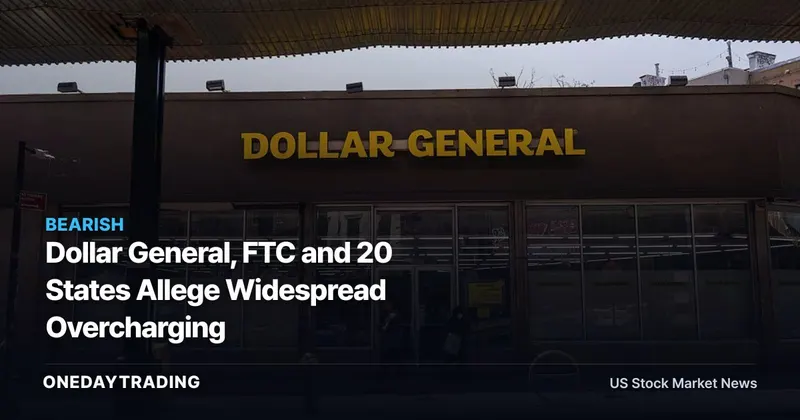
Dollar General Faces a Pricing-Control Test
Dollar General now carries a legal and consumer-trust risk centered on the most basic retail promise: the price displayed to a shopper should match the amount charged. In an article dated 2026-10-26, CNBC reported that the Federal Trade Commission and 20 states filed a lawsuit accusing the retailer of charging more than prices shown on shelves, price tags and advertisements.
For investors, the initial signal was negative: Dollar General shares dropped about 4% after the Federal Trade Commission announced the lawsuit, according to CNBC. That move shows the market treated the filing as relevant to the company rather than as a routine headline, although the facts provided do not establish how much legal, operational or financial exposure the stock move reflects.
The alleged practice is straightforward: a higher-than-advertised price occurs when the amount charged to a customer exceeds the price presented on a shelf, tag or advertisement. This dispute therefore reaches beyond an isolated transaction question. It tests whether the retailer had adequate safeguards to keep displayed and charged prices aligned across its store base.
Why the Complaint Reaches Beyond Individual Transactions
The complaint alleges that thousands of Dollar General stores extracted millions of dollars in unlawful overcharges without sufficient safeguards. Those are allegations, not a final finding, and the fact sheet provides neither the precise number of implicated stores nor the precise dollar value. Even with those limits, the asserted breadth makes store-level pricing controls the central investor issue.
The complaint also argues that Dollar General received tens of thousands of consumer complaints about higher-than-advertised prices and failed to implement policies addressing the problem. This is potentially more consequential than the existence of complaints alone. If proven, notice without an adequate policy response could frame the dispute as a control failure extending across multiple locations rather than as unrelated checkout errors.
That distinction matters to the investment case because retail execution occurs transaction by transaction. A mismatch can impose a direct cost on the shopper; a repeated mismatch across thousands of stores could indicate that the systems or procedures intended to prevent errors were insufficient. The available evidence does not identify which systems, procedures or personnel were involved, so attributing the allegations to any specific operational cause would go beyond the record.
Christopher Mufarrige, director of the FTC's Bureau of Consumer Protection, said Dollar General had betrayed the trust of millions of American consumers and caused financial harm to people already struggling to make their paychecks last. His statement presents the government's theory of consumer harm. Dollar General did not immediately respond to a request for comment, leaving the company's answer to the allegations outside the available evidence.
The Scope of the Federal Trade Commission Lawsuit
The participating states are Alabama, Arizona, Arkansas, California, Connecticut, Florida, Illinois, Iowa, Kansas, Louisiana, Michigan, Mississippi, Nebraska, New Jersey, North Carolina, Ohio, Oklahoma, Tennessee, Utah and Wisconsin. Their participation gives the case a broad geographic footprint, though the fact sheet does not specify how the alleged conduct was distributed among those states.
The central debate is scale. The complaint uses large but non-precise measures—thousands of stores, millions of dollars and tens of thousands of complaints. Those descriptions support scrutiny of companywide safeguards, while leaving unanswered how frequently mismatches occurred, how large each alleged overcharge was and what portion of Dollar General's transactions was affected.
A second debate is remediation. The complaint contends that policies were not implemented despite the complaints, which puts the existence and adequacy of internal responses at issue. Investors should distinguish that allegation from proof: the lawsuit's outcome is unknown, and no Dollar General response is included in the supplied facts.
A third debate is what the share decline has already discounted. The about 4% drop followed the announcement, but the record does not reveal whether investors priced in litigation exposure, corrective measures, reputational damage or some combination. Assigning the move to any single channel would create a causal conclusion that the evidence does not establish.
What Dollar General Investors Should Check Next
- The company's formal response: Dollar General had not immediately commented. Its eventual position is the next source needed to evaluate whether it disputes the alleged pricing mismatches, their scale, the claimed absence of safeguards, or all of those points.
- Evidence defining scope: The complaint refers to thousands of stores, millions of dollars and tens of thousands of complaints without precise totals. More exact figures would help investors judge how concentrated or widespread the alleged conduct was.
- Policies addressing price accuracy: Because the complaint specifically alleges an inadequate policy response, any disclosed safeguards or corrective procedures would be relevant. The key question is whether displayed and charged prices can be kept aligned consistently across stores.
- The lawsuit's outcome: No resolution is established. Investors should keep allegations, the government's interpretation and any later adjudicated findings separate rather than treating the filing itself as proof of liability.
The bearish reading rests on a concrete combination: a multi-state government action, alleged overcharges across thousands of stores, asserted complaints numbering in the tens of thousands and an immediate decline of about 4% in Dollar General shares. The counterweight is equally important—the supplied record contains no company response, precise exposure or outcome. The next change in the investment picture must come from evidence that narrows those gaps, especially Dollar General's answer and verified detail on the scale of the alleged pricing failures.
Market data check: Dollar General Corporation
Dollar General Corporation last traded near $125.35 (-5.53%). Our composite signal — blending price momentum and news flow — reads 🟡 neutral. Price momentum scores 6/100 (soft).
Data as of publication. Price via market feeds; for reference only, not investment advice.
📊 Analysis
Signal Bearish
Why The lawsuit raises pricing-control and consumer-trust risks, while the absence of Dollar General's response and a legal outcome leaves the ultimate impact uncertain.
This article was independently written by OneDayTrading from public reporting. Read the original (CNBC)