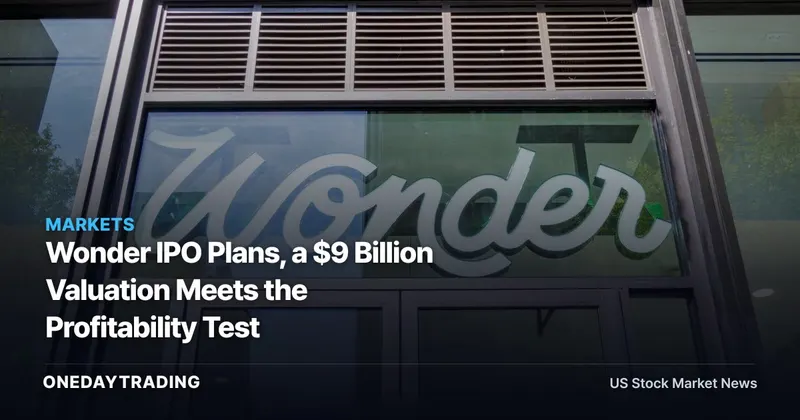
Wonder’s IPO Ambition Meets a Profitability Test
Wonder is preparing for a potential IPO while expanding into Texas, launching Wonder Create and automating food operations, CNBC reported on 2026-10-25. For prospective public-market investors, the central question is whether Marc Lore can convert a heavily funded consumer platform into durable economics without weakening food quality.
Wonder, created by Marc Lore in 2018, is a vertically integrated food technology platform that owns Grubhub and controls multiple parts of food preparation and delivery. That structure creates several potential sources of value, while also concentrating execution demands inside one company.
The scale of the funding sets a high bar. Wonder has raised $3.3 billion to date, and its Series D fundraising round earlier this year established a $9 billion pre-money valuation, according to CNBC. Those figures make operating evidence more important than the size of the vision: investors will need financial disclosure before they can judge whether expansion creates economic value.
Texas Will Test Wonder’s Storefront Model
Wonder has opened 170 storefronts from Virginia to Massachusetts over the last three years. It plans to enter Texas next year and targets at least 100 locations in the state by the end of 2027, turning one regional rollout into the clearest operating test disclosed so far.
The investor case depends on what those locations demonstrate. A larger footprint could extend Wonder’s reach and provide more outlets for its acquired brands. It could also increase the capital and operating burden before the company has disclosed current revenue, net loss or a timetable to profitability.
Wonder’s portfolio includes Grubhub, Relay, Blue Apron, Blue Ribbon Fried Chicken and Salt Hank's. It has spent more than $1 billion on disclosed acquisitions to date, excluding transactions whose financial terms were not disclosed. The breadth gives management assets across food and delivery, though acquisition spending alone does not establish that the combined platform produces attractive returns.
Dabba Indian Kitchen, Tejas Barbecue and Pop Salad are also part of the company’s collection of food concepts. Bobby Flay, Michael Symon and Marcus Samuelsson are associated with named concepts in the wider Wonder ecosystem, while the fact sheet does not provide concept-level revenue or profitability.
Wonder Create Adds a New Platform Experiment
Wonder plans to start Wonder Create on Nov. 17 for $10 per month. The service is intended to let influencers, entrepreneurs and brands build restaurant concepts, with artificial intelligence supporting elements such as branding, pricing and recipes.
Marc Lore said the creator could be a restaurant for friends or an influencer with a following. The investment significance is conditional: Wonder Create could broaden participation in the platform, but the supplied evidence contains no subscriber target, order forecast or revenue-sharing detail with which to value it.
The $10-per-month price establishes a clear entry point, not proof of adoption. The most useful subsequent evidence would be disclosed participation, repeat ordering and the contribution of creator concepts to Wonder’s financial performance. Until such metrics appear, Wonder Create is better treated as a product test than as an established earnings stream.
MEL is a separate proprietary AI initiative that can use health information from sources including Oura, Whoop and blood biomarkers to prepare meals. MEL is not currently available to Wonder customers, and no launch date is known, so it should not be included in a near-term operating case.
Automation Must Improve Economics Without Eroding Demand
Wonder aims to make food preparation and delivery fully autonomous by 2040. That is a long-term target rather than a demonstrated outcome, and the available facts do not establish whether the company will achieve it.
The economic proposition is straightforward but unproven: automation could become more valuable if it supports consistent execution across a larger network. The countercondition is equally important. Investment in automation can precede measurable benefits, and the fact sheet provides no current cost data or timetable for profitability.
Customer response remains the binding constraint. Wonder collects thousands of daily reviews using a 1-to-10 scale and evaluates taste, temperature and portion size. Marc Lore said taste scores and Google reviews improved over the last 12 months and expects food quality to improve with scale, but the underlying score series was not supplied.
A late-2025 review illustrates the risk of a price-value mismatch without establishing a companywide trend. Amir Ings, then 27 years old, reviewed three tacos priced at about $16 and said they should have cost no more than $8. Investors need aggregated retention and financial data before treating either an individual complaint or management’s quality assessment as decisive.
The Evidence for Repeat Demand Is Promising but Incomplete
- Retention: Indagari transaction data indicated that Wonder had a higher weighted average retention rate and lifetime value than Cava and Sweetgreen. The fact sheet supplies no absolute values, measurement period or methodology, limiting the strength of the comparison.
- Food quality: Management tracks daily customer feedback, and Marc Lore reports improvement over the last 12 months. Publication of the underlying ratings would allow investors to assess the size and consistency of that progress.
- Expansion: The Texas target supplies a concrete checkpoint: at least 100 locations by the end of 2027. The unanswered question is whether those openings produce attractive store-level and consolidated economics.
- Capital intensity: More than $1 billion of disclosed acquisitions has assembled a broad platform. Current revenue, net loss and the path to profitability remain unknown.
Public-Market Read-Through for Food and Delivery
- Wonder: The potential IPO would expose a private food-and-delivery platform to public-market scrutiny, though neither the offering timing nor the amount of capital sought is known.
- Grubhub: Wonder’s ownership makes the delivery business part of the prospective investment case rather than an independent listed-stock exposure.
- DoorDash: DoorDash invested in Wonder. The supplied evidence does not quantify the investment or establish a measurable effect on DoorDash.
- Alphabet: Alphabet’s venture arm GV invested in Wonder. No valuation of that holding or financial contribution to Alphabet is provided.
- Food & Beverage: Wonder’s combination of storefront expansion, acquired food brands, creator-built concepts and automation makes operating execution more relevant than a simple technology label.
What an IPO Filing Would Need to Resolve
Wonder hired Gabrielle Scheibe Rabinovitch as chief financial officer in March as it prepares to go public. She previously worked at Worldpay, but the appointment does not establish that an offering will occur or determine its timing.
Marc Lore has declined to specify the IPO schedule. Fortune previously reported his statement about readiness, while the fact sheet confirms only that Wonder is considering a potential initial public offering. The amount of capital the company may seek is also unknown.
The financial question is more immediate. The Information reported that Wonder has operated at a financial loss since acquiring Blue Apron and Grubhub. A filing would need to supply the missing revenue, net-loss and profitability information before investors could test the $9 billion pre-money valuation against business performance.
Marc Lore’s earlier transactions provide founder context, not evidence of Wonder’s economics. Amazon acquired the parent company of Diapers.com for $545 million in 2010, and Walmart acquired Jet.com for $3 billion six years after 2010. Lore remained at Walmart until 2021.
His other investment history includes the Minnesota Timberwolves: Marc Lore and Alex Rodriguez agreed to buy the team for $1.5 billion in 2021, and the purchase was finalized in 2025. None of those outcomes resolves the present questions around Wonder’s margins, cash needs or public valuation.
Wonder’s Next Investable Checkpoints
- Nov. 17: Check whether Wonder Create starts as planned at $10 per month and whether management later discloses participation, repeat demand or financial contribution.
- Texas expansion: Track entry next year and progress toward at least 100 locations by the end of 2027, alongside any financial evidence tied to the rollout.
- Customer metrics: Look for absolute taste scores on Wonder’s 1-to-10 scale, retention data and lifetime-value figures rather than directional descriptions alone.
- IPO disclosure: The decisive evidence would be current revenue, net loss, acquisition economics, capital sought and a credible path to profitability. No IPO timing is confirmed.
The Balanced Case on Wonder
The constructive case rests on real scale: $3.3 billion raised to date, a $9 billion pre-money valuation, 170 storefronts built over the last three years, ownership of Grubhub and a defined Texas target. Wonder Create and automation add potential avenues for the platform to expand beyond its current configuration.
The risk case is just as concrete. Wonder remains financially loss-making according to The Information, has spent more than $1 billion on disclosed acquisitions and has not supplied the financial statements needed to evaluate its valuation. Its 2040 autonomy goal and potential IPO are plans, not completed outcomes.
The next shift in the investment debate will not come from a broader slogan. It will come from evidence that Texas locations retain customers, Wonder Create generates durable activity, food scores support repeat demand and an IPO filing connects growth to a credible financial model.
📊 Analysis
Signal Neutral
Why Wonder's funded expansion and integrated platform offer growth potential, while continuing financial losses and undisclosed IPO timing prevent a directional conclusion.
This article was independently written by OneDayTrading from public reporting. Read the original (CNBC)