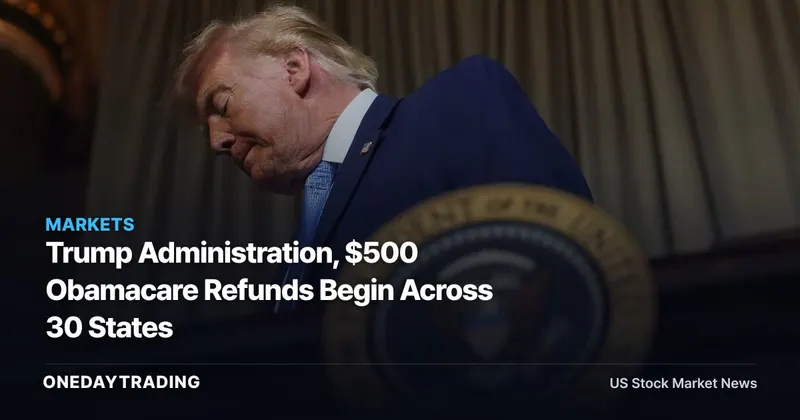
Trump Administration Refunds: The Investor Read
The Trump administration began sending $500 refunds to qualifying Obamacare enrollees on 2026-09-30, creating a direct consumer payment event without establishing a measurable earnings catalyst for any listed healthcare company. The relevant market distinction is between confirmed cash distributions and an unsupported assumption that the program changes insurer revenue, medical demand, or sector profitability.
CNBC reported that the Treasury Department is releasing payments to more than 950,000 Americans across 30 states. That breadth makes the distribution relevant to household healthcare finances, while the absence of company-level evidence keeps the defensible equity-market conclusion neutral.
How the $500 Obamacare Payments Work
Obamacare is the informal name for the Affordable Care Act, and these refunds apply only in states that use the federal ACA exchange. An administration official said eligible people will receive $500 by check or direct deposit; families with more than one affected person may receive multiple payments.
Recipients will also receive a presidential letter dated Sept. 30 from Donald Trump. The White House had previously announced October as the start of issuance, while the confirmed record now says the checks began on 2026-09-30.
The Trump administration says the money comes from a surplus of user fees collected by the Biden administration. The Centers for Medicare and Medicaid Services collects those fees from insurers participating in the ACA marketplace, making the funding source an exchange-administration mechanism rather than evidence of a new charge disclosed for a particular recipient or company.
Who Qualifies for the Trump Administration Refund
The primary recipients will have income above 400% of the federal poverty line, according to the administration official cited by CNBC. The stated reference points are roughly $63,000 for an individual and $129,000 for a family of four.
The same official said some people between 100% and 400% of the federal poverty line will also receive a refund. That qualification matters because the stated income bands do not amount to a complete eligibility formula; readers cannot determine entitlement from income alone using the available facts.
The geographic boundary is clearer. Refunds are limited to the 30 states using the federal ACA exchange, excluding states that operate their own marketplaces from this distribution.
Texas and Florida Lead the Disclosed Recipient Counts
Federal data shared with CNBC put Texas at 139,000 people and Florida at 127,900 people, the largest recipient totals specifically disclosed. Those figures identify where the program has its greatest stated reach, not where it will produce the largest aggregate payment or strongest commercial response.
A complete state-by-state recipient count was not provided. The disclosed Texas and Florida figures therefore cannot support comparisons with every other participating state, and the available evidence does not establish how many qualifying families will receive more than one payment.
Why the Healthcare Stock Signal Is Unproven
The immediate mechanism is narrow: eligible enrollees receive cash, while the program draws on a stated surplus of marketplace user fees. Nothing in the confirmed record quantifies a change in insurer enrollment, premium collections, claims, medical utilization, operating costs, or earnings.
That gap blocks a company-specific investment thesis. A household payment could affect personal healthcare affordability, but no supplied evidence shows how recipients will use the money or whether it will alter coverage decisions. Assigning a beneficiary or victim among U.S.-listed insurers, providers, pharmacies, or medical-device companies would exceed the facts.
The funding explanation also requires discipline. The Trump administration attributes the refunds to excess user fees collected under the Biden administration, while the confirmed facts establish only that the Centers for Medicare and Medicaid Services collects such fees from participating insurers. They do not quantify the surplus, the fees contributed by individual insurers, or any resulting balance-sheet effect.
For investors, neutrality is not a claim that the policy has no economic significance. It means the evidence supports a direct transfer to qualifying enrollees, while withholding the operating data needed to map that transfer into revenue, margins, cash flow, or valuation for a listed company.
Policy Claims and the Evidentiary Divide
Donald Trump wrote that the Biden administration had overcharged enrollees to fund HealthCare.gov and described the refunds as an effort to “restore Affordability, protect your hard-earned money, and lower the Cost of Healthcare.” Those are attributed presidential claims and objectives; the confirmed record does not demonstrate that a $500 payment has lowered a recipient’s ongoing healthcare costs.
Jonathan Oberlander of the University of North Carolina at Chapel Hill characterized the announcement as “damage control.” He also argued that it was more connected to the 2026 Congressional elections than to health policy. His assessment supplies a political counterinterpretation, not evidence of a financial outcome for enrollees or healthcare companies.
The useful analytical separation is therefore between payment, policy framing, and effect. The payment has begun; the White House has stated its rationale; the ultimate consequences for affordability and commercial healthcare remain unquantified in the supplied evidence.
Investor Checkpoints After Payments Begin
- Eligibility detail: Look for a complete formula explaining why people within the stated income ranges qualify, because the current disclosure identifies broad recipient groups without defining every condition.
- Distribution completion: Check for confirmation of when every eligible recipient has received a check or direct deposit; no universal payment date is stated.
- Geographic disclosure: Seek a complete count across all 30 participating states rather than extrapolating from Texas and Florida.
- Funding transparency: Monitor any disclosure of the total refunds and the size of the user-fee surplus. Neither amount is available in the confirmed facts.
What Would Change the Neutral Healthcare View
A more constructive sector interpretation would require evidence that the refunds produce a measurable change in enrollment, premium payment behavior, or another disclosed operating metric. A negative interpretation would likewise require evidence of a new cost, fee burden, or adverse financial effect for a named listed company.
Until such data appear, the strongest conclusion stays bounded: more than 950,000 Americans in 30 states are set to receive $500 refunds from the Treasury Department, with some affected families eligible for multiple payments. The next investable signal is not the political language surrounding the checks; it is any verified link between the distribution and healthcare-company economics.
📊 Analysis
Signal Neutral
Why The refunds provide direct relief to eligible enrollees, but the available evidence does not establish a directional impact on any U.S.-listed company or healthcare subsector.
This article was independently written by OneDayTrading from public reporting. Read the original (CNBC)