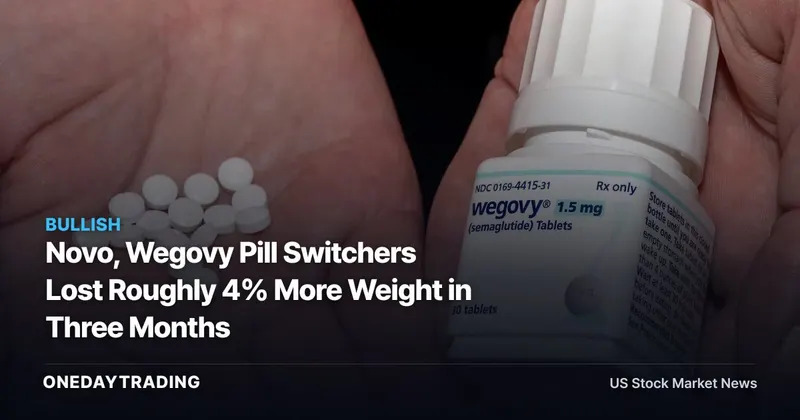
Novo’s Wegovy Pill Data Changes the Formulation Debate
Novo’s most consequential finding is not simply that patients lost weight on the Wegovy pill. CNBC reported on 2026-09-30 that patients who switched from obesity injections and remained on the pill for three months continued losing weight, giving investors an early signal that an oral option could extend treatment rather than merely preserve prior progress.
The evidence is directionally favorable for Novo because it links the pill to a clinically relevant outcome after patients had already used injections. It also places Eli Lilly’s Zepbound inside the comparison pathway: Half of the patients had started with Novo’s Wegovy injection, while the remainder had initially taken the rival injection.
Wegovy is Novo’s obesity treatment, and semaglutide is its active ingredient. The investment question is whether the pill can broaden how patients move through obesity treatment; this analysis offers an encouraging association, not proof that switching formulations produced the additional weight loss.
What Novo Found in Ro’s Patient Data
Novo’s analysis drew on Ro’s telehealth platform and covered 194 patients with obesity or who were overweight, around 56% of whom were female, according to CNBC. Among those who switched and stayed on pill treatment for three months, average weight loss was roughly 4% of body weight, equal to an additional 8.8 pounds from an average weight of around 221 pounds before taking the pill.
The distribution matters alongside the average. CNBC reported that 2 in 5 participants achieved weight loss of 5% or more three months after switching. The share of people with a body mass index at or above 30 also fell by more than 21% during that three-month period; a BMI of 30 marks the boundary between overweight and obesity.
Patient-reported measures point in the same direction. Among patients with available data, around 82% reported at least one improvement during pill treatment, including almost 70% who cited better-fitting clothes and around 51% who said they pursued healthier eating. Novo also reported that around 75% of patients in the analysis were satisfied with the switch.
Why Oral Preference Could Matter for Novo and Eli Lilly
The analysis frames treatment format as part of the competitive contest, not a cosmetic distinction. Martin Holst Lange summarized Novo’s interpretation directly: “We clearly see a preference for orals.” That view is supported by the reported satisfaction and continuation outcomes, although the dataset does not establish how that preference would translate across a broader population.
For Novo, a Wegovy pill creates a route between formulations within the same obesity-treatment franchise. Patients in the dataset moved from either the Wegovy injection or Eli Lilly’s Zepbound to oral Wegovy, so the evidence touches both retention within Novo’s treatment family and switching from a rival product.
The commercial mechanism is conditional. If patients value an oral option and continue treatment after switching, formulation choice could strengthen demand for Novo’s portfolio. The analysis supplies no revenue, market-share, pricing or prescription data, so investors cannot infer the size or timing of any financial effect from these findings alone.
The Evidence Gap Behind the Positive Signal
Real-world studies identify associations and cannot determine causality. This analysis therefore does not show that moving to the Wegovy pill caused the reported weight loss, and the exact number of patients who completed three months of pill treatment was not provided.
The dataset also carried practical constraints: timing and completeness varied across routine telehealth records, self-reported information could introduce bias, and the results may not generalize to the broader population. Those limitations are particularly important because the strongest interpretation would require separating the pill’s effect from prior treatment, patient selection and continued engagement.
The right reading is narrower. Patients who switched and remained on oral treatment continued losing weight in the observed data. That is a constructive signal for further evaluation, while any claim of equivalent outcomes across populations or proof of a switch-driven effect would run beyond the evidence.
CagriSema Extends Novo’s Obesity Pipeline Narrative
Alongside the Wegovy analysis, Novo announced findings on Wednesday from a yearlong functional magnetic resonance imaging study of CagriSema. CagriSema combines semaglutide with cagrilintide, adding a separate pipeline program to the company’s effort to address obesity and diabetes.
Novo said CagriSema reduced harmful fat around abdominal organs in adults with Type 2 diabetes. The company also said early findings suggested bone health was maintained despite substantial weight loss, while the brain-imaging work examined responses in areas linked to cravings, pleasure and self-control.
Martin Holst Lange said, “The signal in the brain changes in a way that actually is associated with improved quality of life.” The findings were among datasets being presented at the European Association for the Study of Diabetes, giving investors distinct evidence streams to assess: real-world switching data for Wegovy and yearlong imaging findings for CagriSema.
Stock Read-Through and Investor Checkpoints
- Novo: The positive read-through rests on continued weight loss after the formulation switch, reported satisfaction around 75%, and evidence of oral preference. The counterweight is that none of those observations establishes causality or quantifies a commercial outcome.
- Eli Lilly: Zepbound is directly relevant because the remainder of patients who did not begin with the Wegovy injection initially used Eli Lilly’s product. The analysis does not disclose separate outcomes by starting injection, preventing a supported comparison between the two patient groups.
- Wegovy follow-up: Investors need the exact number completing three months on the pill, more consistent timing and completeness of patient records, and evidence showing whether the findings extend beyond the analyzed population.
- CagriSema follow-up: The next stated window is an expected launch early next year. A higher-dose version is expected in 2028, while the exact launch dates for CagriSema and standalone cagrilintide remain unspecified.
What Would Strengthen or Weaken the Novo Thesis
The bullish case is that oral Wegovy may give patients another way to continue obesity treatment after injections while still pursuing additional weight loss. The observed roughly 4% average reduction over three months, the 8.8-pound average decline and the satisfaction data make that case testable rather than purely promotional.
The risk is that a selected group remaining on treatment may not represent the wider patient population. Incomplete records, self-reporting and the absence of causal evidence leave open whether the pill itself, prior injection use or other unmeasured factors account for the outcome.
The next decisive evidence should narrow those uncertainties: completion counts, outcomes separated by prior Wegovy or Zepbound use, and more complete follow-up. Until then, the data support a favorable signal for Novo’s oral strategy, while the durability, generalizability and financial magnitude remain unproven.
Market data check: Novo Nordisk A/S
Novo Nordisk A/S last traded near $38.31 (-1.03%). Our composite signal — blending price momentum and news flow — reads 🟡 neutral. Price momentum scores 42/100.
Data as of publication. Price via market feeds; for reference only, not investment advice.
📊 Analysis
Signal Bullish
Why Continued weight loss and reported patient satisfaction support the Wegovy pill’s potential, though the observational evidence cannot establish causality or broad applicability.
This article was independently written by OneDayTrading from public reporting. Read the original (CNBC)