Moderna Leads a Broader Biotech Repricing
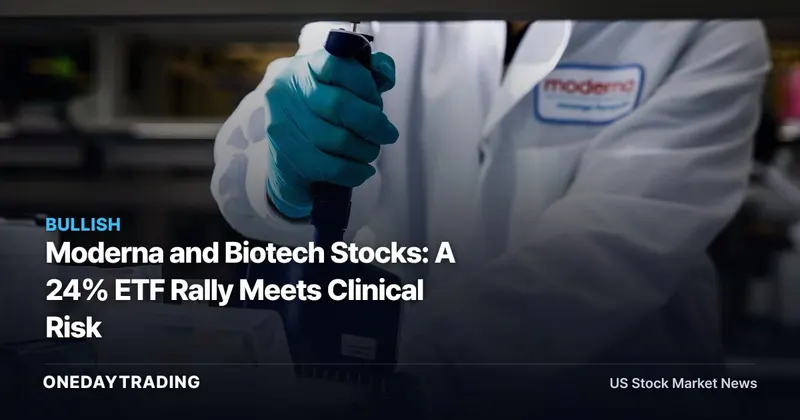
Moderna and biotech stocks are being repriced around clinical evidence, dealmaking and new drug technologies. CNBC reported on 2026-10-24 that the iShares Biotechnology ETF had gained 24% through October 23 after advancing 28% in 2025. The investor question is no longer whether the sector has momentum, but how much of that momentum rests on evidence that can survive regulatory review.
Moderna illustrates both sides of that trade. The stock was up 587% year-to-date even after an 18% Thursday decline. That combination signals powerful enthusiasm alongside acute sensitivity to clinical information—a defining feature of biotechnology, where one data release can alter the perceived value of an entire development program.
Clinical Results Are Carrying More Weight Than the Narrative
Biotechnology is the development of medicines and research tools through biological processes, including modalities such as mRNA and genomics. The present rally spans drug developers, sequencing companies and laboratory-instrument providers, but those businesses do not share the same evidence standard or commercial timetable.
Moderna and Merck’s melanoma drug produced a 42% reduction in cancer recurrence or death in Phase 3 when used with Keytruda. The companies said they aim to launch the drug in 2027. The result supports the case for mRNA beyond preventive vaccination, while the launch remains conditional on regulatory approval and execution against the companies’ stated timeline.
Other programs broaden the clinical base. AstraZeneca and Amgen released positive Phase 3 results for another use of Tezspire, and the FDA approved Roche’s Enspryng for adults with thyroid eye disease. Eli Lilly said retatrutide generated 28%-30% weight loss at the highest doses in clinical trials over the summer; the company plans to submit it for FDA approval in the first quarter of 2027.
The approval environment supplies another reference point. The FDA approved about a dozen novel biologic drugs among 46 approvals in 2025, while roughly 66 novel drugs are in its pipeline for potential approval. Pipeline size indicates opportunity, not probability: the fact sheet does not establish whether any cited candidate will secure approval.
Biopharma M&A Adds a Second Valuation Channel
Clinical progress can affect biotechnology valuations directly through perceptions of a candidate’s prospects and indirectly by making development assets more relevant to potential partners or acquirers. Biopharma dealmaking reached $134 billion in the first half of 2026, compared with $112 billion for all of 2025, according to CNBC’s account of BTIG data.
The strategic demand is tied to a defined pipeline problem. RTW Institute estimates that products representing $180 billion of revenue will lose exclusivity by 2030. That creates an incentive for established drugmakers to seek novel programs, though it does not establish which assets will attract transactions or what prices buyers might accept.
Eli Lilly completed 10 acquisition deals worth $25 billion in 2026. For investors, this separates the current cycle from a thesis based solely on future approvals: credible clinical assets may also gain strategic value before commercialization. Acquisition activity is still not proof that a program will succeed.
Genomics and AI Expand the Investable Supply Chain
Illumina sits on the infrastructure side of precision medicine. Bristol-Myers Squibb, Merck and Kura are working with Illumina to develop precision oncology solutions. Piper Sandler set a $305 target for Illumina, implying 14% gains from a recent price around $267, though an analyst target is an opinion rather than an achieved return.
10x Genomics, whose shares gained more than 300%, provides laboratory instruments used in research, while its Atera platform helps produce data sets for training artificial-intelligence models. Piper Sandler assigned 10X an $80 target against a recent price around $70. The sharper analytical question is whether demand for those research tools persists beyond the sector’s current enthusiasm.
Twist Bioscience connects synthetic DNA, sequencing tools and AI partnerships. It partnered with Eli Lilly’s AI and machine-learning platform and linked up with Anthropic in August to test Claude for protein development. Expected revenue rises from $572 million in 2027 to $833 million in 2029, with an EPS profit expected in 2029; analysts’ $168 average target implied 21% returns from a recent price around $138.
Towards Health forecasts that the global AI-in-drug-discovery market will expand from $20 billion in 2025 to more than $160 billion in 2035. That forecast frames the size of the opportunity, not the share any listed company will capture. AI may lower the capital required to reach clinical trials, as Guidant BioTherapeutics’ Shreefāl Mehta argued, but clinical and regulatory validation remain the decisive filters.
How the Biotech Rally Spreads Across Stocks and Funds
- iShares Biotechnology ETF: Its 233 holdings provide broad exposure, with Gilead Sciences, Amgen, Vertex Pharmaceuticals and Moderna among the companies leading its market-cap-weighted structure.
- State Street SPDR S&P Biotech ETF: Its equal-weight approach gives greater exposure to small- and mid-cap companies; Moderna, Natera, Twist Bioscience and Halozyme Therapeutics are listed among its top holdings.
- Monte Rosa Therapeutics: Its partnership with Novartis covers a drug for inflammatory conditions and autoimmune diseases, and the companies announced a Phase 2 clinical study in September. Piper Sandler’s $37 target compares with a recent price around $10.70.
- Faeth Therapeutics: The clinical-stage company had not brought a drug to market, despite a 93% year-to-date share gain and a trading price around $18. BTIG assigned a $55 target, leaving the valuation dependent on clinical progress rather than an established commercial product.
- Kymera Therapeutics: The company says its drug is distinct from Dupixent and is neither a biosimilar nor a biologic copy. Dupixent is made and co-developed by Regeneron Pharmaceuticals and Sanofi; Kymera represents 4.2% of the T. Rowe Price Biotechnology ETF portfolio.
The Bull Case and the Clinical-Risk Counterweight
The bullish case rests on several independent supports: confirmed trial results, FDA approvals, a larger pool of potential regulatory decisions, substantial biopharma dealmaking and technology investment across mRNA, genomics and AI. John Hall of the T. Rowe Price Biotechnology ETF described the backdrop to CNBC as a “powerful innovation cycle.” If evidence continues to validate new modalities, capital could remain available to both drug developers and the infrastructure companies serving them.
The bear case begins with how far some shares and the sector fund have already moved. Moderna’s 587% year-to-date gain, 10x Genomics’ increase of more than 300% and the iShares Biotechnology ETF’s 24% advance through October 23 raise the penalty for results that fail to support expectations. Price targets for Illumina, 10X, Twist Bioscience, Monte Rosa Therapeutics and Faeth Therapeutics are not assured outcomes.
Binary risk remains central. The approval status of the cited candidates, the planned regulatory submissions and the proposed launch timing are unknown. The specific leaked Moderna clinical data and the source of that leak are also not established in the fact sheet, so the 18% Thursday decline cannot support a more precise inference.
Investor Checkpoints After the Rally
- Moderna and Merck: Examine the next regulatory step for the melanoma program and whether the companies remain on course for their stated 2027 launch objective.
- Eli Lilly: Track whether retatrutide is submitted to the FDA in the first quarter of 2027 and whether the regulatory package supports the clinical weight-loss result.
- Twist Bioscience: Compare reported revenue progress with the $572 million expectation for 2027 and the $833 million expectation for 2029, while monitoring the expected path to EPS profit in 2029.
- Sector positioning: Distinguish the market-cap-weighted iShares Biotechnology ETF from the equal-weight State Street SPDR S&P Biotech ETF; their holdings create different exposure to established companies and smaller clinical-stage names.
The next leg of the biotech cycle will depend less on slogans around innovation and more on regulatory decisions, reproducible clinical outcomes and delivery against stated milestones. Investors now have evidence of momentum; the remaining task is to determine which valuations are supported by programs that keep clearing those gates.
📊 Analysis
Signal Bullish
Why Clinical progress, FDA approvals, expanding dealmaking and investment in genomics, mRNA and artificial intelligence provide positive catalysts, tempered by regulatory and trial risk.
This article was independently written by OneDayTrading from public reporting. Read the original (CNBC)