AARP Caregiver Poll: 3-Line Investor Briefing
- AARP found that likely voters age 50 and older across 43 competitive congressional districts favored candidates supporting unpaid family caregivers.
- Among those older voters surveyed from Oct. 1-5, 77% were more likely to support an advocate for a caregiver tax credit, while 75% favored a candidate backing help for caregivers who keep loved ones at home.
- The investable signal is policy attention, not a confirmed earnings catalyst: election outcomes, enactment and the provisions affecting individual caregivers remain unknown.
AARP’s polling turns the cost of unpaid family care into a 2026 midterm issue, but investors do not yet have enough evidence to assign a directional effect to any U.S.-listed company or healthcare subsector.
What the AARP Poll Changes in the 2026 Midterms
Unpaid family caregiving means providing care to a loved one without receiving pay for that work. CNBC identified AARP as the source of a recent report estimating that 59 million Americans care for an adult family member, neighbor or friend, establishing a large constituency around an expense that often sits directly on household budgets.
The new information is the concentration of voter preference in contested races. Most surveyed likely voters age 50 and older in 43 competitive congressional districts said they were more likely to support candidates who backed policies for unpaid caregivers. The poll does not establish how those voters will cast ballots, so it measures stated policy preference rather than election outcomes.
Matt Hogan, a partner at Impact Research, said voters in this age group “are going to be the deciders in the election.” That is a view about their potential political importance, not a reported result. For investors, the distinction matters because support for a candidate, passage of a policy and a measurable financial effect are separate checkpoints.
The Household Balance-Sheet Pressure Behind the Vote
Edward Jones found that Americans caring for aging family members spend an average of $8,737 per year out of pocket. The figure gives the polling an economic foundation: caregiver support is not only a social-policy preference, but also a response to expenses borne by families.
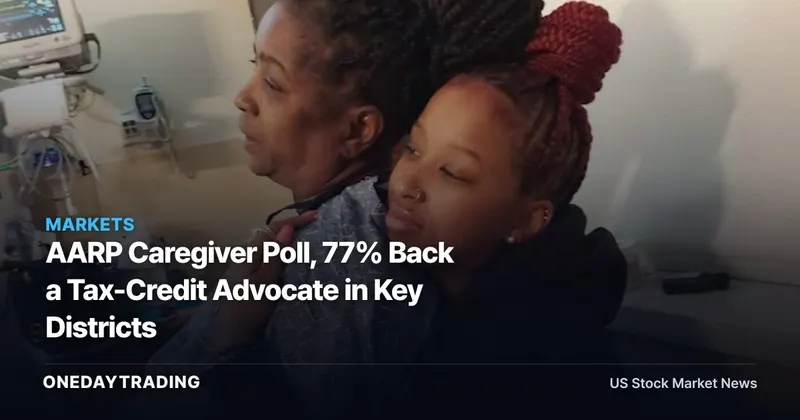
Brittney Saunders Graves said she spends an average of $600 per month caring for her mother, Tracey Saunders, who had a debilitating stroke in 2020. Graves said that after necessities, excluding medication and doctor’s appointments, her mother has about $400 for food. The example shows how care expenses and basic household spending can compete within the same budget.
Sarah Smitley, who cares for her daughter and also helps her aging parents, described the difficulty of finding another $50 when medical costs and unpaid time pressures already exist. Her account adds a second channel to the burden: families may face both direct costs and constraints around time away from work, though the supplied evidence does not quantify the career effect.
AARP Survey Results and Sample Boundaries
Fabrizio Ward and Impact Research interviewed 1,368 likely voters age 18 and older for AARP from Oct. 1-5, including 848 voters age 50 and older. The margin of error for the 1,368-person sample was plus or minus 2.7 percentage points, and the results were weighted to represent voters across the targeted districts.
AARP reported that 77% of surveyed likely voters age 50 and older would be more likely to vote for a candidate advocating a tax credit for unpaid family caregivers. Another 75% said the same about a candidate supporting unpaid caregivers who help loved ones remain at home. These are candidate-preference responses; the exact wording and methodology of every survey question are not provided in the fact sheet.
The two readings point in the same direction across different forms of support, strengthening the case that caregiving has political salience in the surveyed districts. They do not show which proposal voters prefer when forced to choose, what either policy would cost, or whether it would become law.
Caregiving, Savings and Debt: The Financial Transmission
The Employee Benefit Research Institute’s 2026 Retirement Confidence Survey found that 34% of caregivers had less than $10,000 in savings and investments, compared with 25% of non-caregivers. It also found that 69% of caregivers viewed debt as a problem, versus 57% of non-caregivers.
Those comparisons frame the relevant balance-sheet mechanism. Out-of-pocket care spending can coincide with lower assets and greater reported debt pressure, leaving less financial capacity for other household needs. The survey establishes an association between caregiver status and financial strain; it does not prove that caregiving alone caused every difference.
Keesha Middlemass, a political science professor at Howard University, said, “The sandwich generation is only going to get larger.” Her observation connects the policy debate to people supporting aging relatives while managing other family responsibilities, although the fact sheet supplies no projection for the size or timing of that change.
Who Could Benefit—and Why No Stock Call Is Justified
- Unpaid caregivers: A tax credit or support for keeping loved ones at home could address expenses identified in the polling, conditional on a proposal being enacted and on its final eligibility rules.
- Care-dependent households: Paula Bussard said her family spends $5,000 to $7,000 annually caring for her son, Alex, at home, including accommodations and supplies not covered by Medicaid.
- Healthcare-related businesses: The evidence does not identify any listed company, revenue stream, reimbursement change or contract opportunity. Assigning winners among insurers, providers or medical suppliers would therefore exceed the record.
- Household finances: Support could ease pressure only if policy moves beyond campaign advocacy. The size, timing and funding of any benefit are unknown.
Medicaid Timing Raises the Policy Stakes
Some Medicaid cuts under Donald Trump will take effect in January, though the fact sheet does not identify the year. Middlemass said additional Medicaid and Medicare cuts would occur in 2027 and affect lower-income people and workers in the care economy. The specific provisions affecting each caregiver are not supplied.
Bussard said she worries that fewer doctors, home health agencies and medical-equipment providers will accept Medicaid. She argued that Medicaid “helps their families take care of them in the home.” Her concern describes a possible access risk rather than a confirmed change in provider participation.
This creates a two-sided policy setup. Candidate support for caregivers could move toward financial relief, while the cited cuts could increase pressure on households relying on public assistance. The net effect cannot be calculated without the final caregiver policies, the detailed Medicaid and Medicare provisions, and evidence of how providers respond.
Risk Check and the Next Observable Signals
- Election risk: The outcomes in the 43 competitive congressional districts are unknown, and stated policy preference does not determine a ballot result.
- Enactment risk: The survey tests support for candidates advocating caregiver policies; it does not show that a tax credit or home-care support will pass.
- Design risk: No benefit amount, eligibility standard, funding mechanism or implementation schedule is available in the supplied evidence.
- Investment-evidence risk: No listed company is linked to a quantified revenue, cost or demand effect, preventing a defensible ticker-level conclusion.
The next meaningful checks are concrete: the results from the surveyed districts, whether winning candidates advance the cited policies, the final terms of any enacted support, and the detailed provisions attached to Medicaid changes in January and the Medicaid and Medicare cuts described for 2027.
Bottom Line: Political Relevance Before Market Relevance
AARP’s poll shows a clear voter preference inside 43 competitive districts, supported by evidence that caregivers face substantial out-of-pocket costs, weaker asset positions and more reported debt problems than non-caregivers. That may elevate unpaid family caregiving during the 2026 midterms. The market conclusion stays neutral until political support becomes enacted policy with identifiable financial consequences for households, healthcare providers or listed companies.
📊 Analysis
Signal Neutral
Why Strong voter support makes caregiver policy politically relevant, but election results, enactment prospects and company-level financial effects are unknown.
This article was independently written by OneDayTrading from public reporting. Read the original (CNBC)