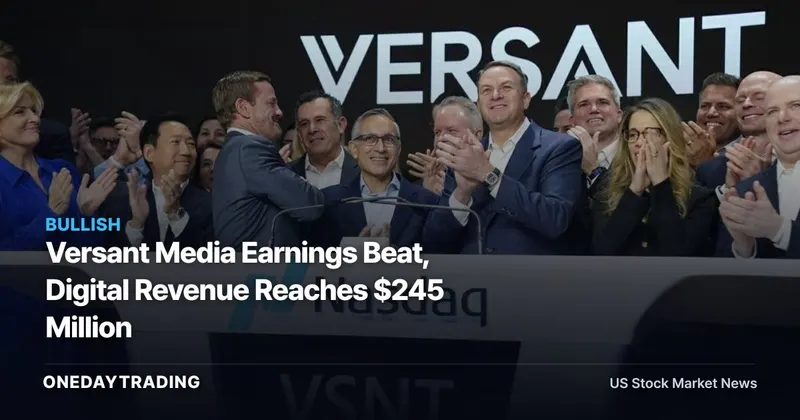
Versant Media Earnings Put the Transition Thesis to a Numerical Test
Versant Media’s third-quarter 2026 earnings beat and reaffirmed guidance strengthen the investment case for its digital transition, even as declining total revenue and advertising expose the work still required. CNBC reported the results on 2026-11-03, with digital platforms providing the clearest growth signal and linear television remaining the larger revenue engine.
The key distinction is between progress and scale. Digital platforms including Fandango generated $245 million in third-quarter 2026 revenue, nearly 10% more than a year earlier, according to CNBC. Linear TV revenue was still $935 million despite decreasing 5.8%, leaving the faster-growing operation considerably smaller than the declining one.
Versant’s EBITDA Beat Was Stronger Than Its Revenue Trend
Versant reported $353 million of adjusted EBITDA for the third quarter of 2026, above the $305 million Wall Street estimate supplied by StreetAccount. Adjusted EBITDA is the company’s earnings measure before interest, taxes, depreciation and amortization; here, it provides the clearest disclosed comparison with market expectations.
Total revenue moved in the opposite direction. CNBC reported that Versant’s third-quarter 2026 revenue fell to $1.59 billion from $1.66 billion in the year-ago period. The company said the reported figure incorporated its acquisition of Full Swing and sale of SportsEngine, while the purchase and sale prices were not provided.
Net income also declined. For the period ended Sept. 30, Versant recorded $47 million, or 34 cents per share, compared with $80 million, or 56 cents per share, in the year-prior period. That combination makes the adjusted EBITDA outperformance important, though it does not erase the weaker comparisons in reported revenue and net income.
The exact revenue and earnings expectations from the LSEG analyst survey were not disclosed. Investors therefore can verify the broad earnings beat and the StreetAccount adjusted EBITDA comparison, but cannot reconstruct every headline estimate from the supplied figures.
Fandango Growth Meets a Softer Advertising Business
Versant attributed its performance to portfolio strength and growth in platforms revenue. Fandango recorded its highest third-quarter ticketing revenue since the pandemic, supporting the nearly 10% year-over-year increase across digital platforms that include the business.
Advertising presented the counterweight. Versant Media advertising revenue was $373 million in the third quarter of 2026, down 5.3% year over year, CNBC reported. The divergence means platform growth is contributing, while a major existing revenue stream is still contracting.
The company has also launched an MS NOW direct-to-consumer product and a Fandango on-demand product. CNBC is expected to launch a direct-to-consumer offering next year, according to Versant. These launches widen the routes through which the portfolio can reach audiences, though the fact sheet provides no revenue, subscriber or profitability figures for the new products.
Versant Media is the parent company of CNBC, and its portfolio includes CNBC, MS NOW, Golf Channel and other cable and digital properties. Management ultimately intends to derive 50% of revenue from digital, platform, subscription, ad-supported and transactional businesses. The present mix cannot be calculated from the supplied figures, so that ambition should be assessed through future segment disclosures rather than treated as achieved diversification.
Distribution Renewals Reduce One Source of Uncertainty
Versant completed 4 major distribution renewals in 2026 after its spinoff from Comcast’s NBCUniversal. Chief Executive Mark Lazarus said 75% of network subscribers are under contract into 2028 and beyond, giving the company greater visibility into its distribution arrangements.
That visibility matters because it creates a clearer contracted base while management develops newer products. It does not establish that digital growth will fully offset declines elsewhere; the relevant evidence remains the pace of platform revenue growth against linear TV and advertising revenue.
Audience reach provides another operating indicator. Versant said its networks reached more than 120 million viewers monthly in the third quarter of 2026, while aggregate viewership increased by double digits year over year. The exact aggregate growth rate was not disclosed.
Sports contributed to that engagement: WNBA viewership on Versant’s USA Sports networks was 25% higher than the prior year’s cable average in the third quarter of 2026. For investors, the next question is whether such audience performance is accompanied by stronger advertising, subscription or transactional results in later reporting periods.
Guidance and Capital Returns Support the Bull Case
Versant reaffirmed its full-year 2026 revenue outlook of $6.2–6.45 billion and adjusted EBITDA outlook of $1.9–2.05 billion. Reaffirmation after an earnings beat supports near-term confidence, without implying that the company has exceeded those full-year targets.
The more favorable guidance change came in cash generation. Versant now expects full-year free cash flow to exceed its prior $1–1.2 billion range, although it did not quantify the new expected amount. That wording establishes an improvement in direction, not a precise forecast investors can independently model.
Capital return adds a second use for that cash. Versant announced an additional $100 million accelerated stock repurchase program beginning Wednesday, with completion expected during the fourth quarter. The program is confirmed, while its ultimate effect on per-share results is not supplied.
Versant began trading as a standalone company on the Nasdaq in January after separating from Comcast. The earnings release therefore gives investors an early standalone test of whether management can protect the established network business while building a broader mix of digital and direct-to-consumer revenue.
Investor Checkpoints After Versant’s Third Quarter
- Digital scale: Compare the next reported digital-platform revenue with the third-quarter 2026 base of $245 million and its nearly 10% year-over-year increase.
- Legacy pressure: Track whether linear TV revenue continues to decline from $935 million and whether advertising stabilizes after its 5.3% year-over-year decrease to $373 million.
- Guidance delivery: Test subsequent results against the full-year 2026 revenue range of $6.2–6.45 billion and adjusted EBITDA range of $1.9–2.05 billion.
- Cash and repurchases: Look for the exact free-cash-flow result above the prior $1–1.2 billion range and completion of the additional accelerated repurchase during the fourth quarter.
What Would Confirm or Weaken the Versant Thesis
The constructive case rests on three disclosed facts: adjusted EBITDA exceeded the StreetAccount estimate, digital-platform revenue grew, and free-cash-flow expectations moved above the prior range. Distribution contracts covering 75% of network subscribers into 2028 and beyond add visibility as the company expands its digital and direct-to-consumer products.
The risk is visible in the same quarter. Total revenue fell from the year-ago period, net income declined, advertising contracted and linear television remained much larger than the disclosed digital-platform business. The transition becomes more credible if digital growth persists while those declines moderate; it weakens if the smaller growth engine cannot narrow the revenue gap.
The next earnings report should be judged through that mix rather than the headline beat alone. Platform revenue, linear TV revenue, advertising revenue, adjusted EBITDA, free cash flow and the disclosed progress of the MS NOW, Fandango and planned CNBC products are the metrics that can show whether Versant is changing the durability of its business rather than merely defending a quarterly result.
📊 Analysis
Signal Bullish
Why The earnings beat, reaffirmed revenue and adjusted EBITDA guidance, higher free-cash-flow expectation and additional stock repurchase outweigh declining revenue and advertising pressure.
This article was independently written by OneDayTrading from public reporting. Read the original (CNBC)