Wendy's Rejection Resets the Investment Case
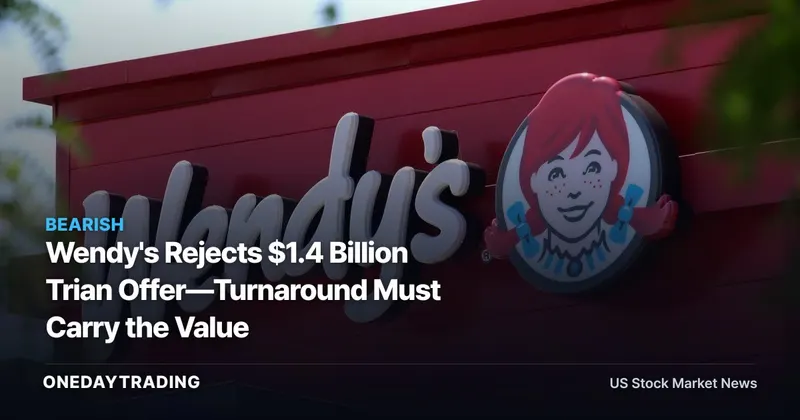
For Wendy's investors, the rejected $1.4 billion takeover offer turns a deal-driven valuation debate into a test of operating execution. In reporting published 2026-11-05, CNBC said the restaurant company rejected the proposal from an investor group led by Nelson Peltz's Trian Fund Management. The immediate question is whether Wendy's turnaround can produce enough improvement to justify refusing the cash offer.
The group offered Wendy's $7.35 per share in cash on Oct. 28 to take the company private. That proposal gave investors a concrete reference point, while the rejection removed the certainty that cash consideration would have provided. Wendy's shares fell less than 1% in premarket trading, suggesting the decision did not produce a dramatic immediate repricing.
Why Wendy's Board Said No to the Trian-Led Group
CNBC reported that the investor group included Trian Fund Management, BlueFive Capital, Sixth Street Partners and Flynn Group, one of Wendy's largest franchisees. The board had formed a committee of independent directors in February to assess a potential bid from Trian. That committee concluded that the proposal “substantially undervalues” Wendy's and failed to reflect potential gains from the ongoing turnaround strategy.
The board is therefore asking investors to value an operating path rather than accept the offered cash price as the final measure of the business. Art Winkleblack tied that confidence to Bob Wright's record of industry leadership and restaurant turnarounds. The statement identifies management execution as the central support for the board's position, but it does not quantify the gains the turnaround could produce.
Trian Fund Management declined to comment on Wendy's decision, and the investor group's response after the rejection is not given. The terms of a standstill agreement proposed by Wendy's are also unavailable. Those omissions matter because they leave the group's next step and the distance between the parties undefined.
The Poison Pill Changes the Control Contest
Wendy's adopted a shareholder rights plan with a one-year duration as of Wednesday. A shareholder rights plan, commonly called a poison pill, is the measure Wendy's chose to help stave off a hostile takeover. The company said the Trian-led group had rejected its offer for a standstill agreement that would have paused additional share purchases.
The rights plan gives the board time to pursue the turnaround without immediately yielding control to the bidder. It also raises the standard for management: the board has not merely disputed the price, it has linked that dispute to potential value that still has to be demonstrated. Investors can now compare future operating evidence with the $7.35-per-share cash proposal rather than relying only on the board's assessment.
Nelson Peltz and Wendy's Have a Long Shared History
The relationship between Nelson Peltz and Wendy's extends for more than two decades. Triarc, which owned Arby's at the time, bought Wendy's in a $2.3 billion deal in 2008. Triarc later sold Arby's, leaving Wendy's as a standalone company.
Wendy's named Nelson Peltz chairman emeritus in 2024 after he had spent 17 years on its board. Trian executive Peter May and Bradley still sit on the Wendy's board. That history makes this more than an approach from an unfamiliar bidder: the proposal comes from investors with longstanding proximity to the company, while the independent committee still judged the price inadequate.
Restaurant Performance Is the Valuation Hinge
The operating picture contains a clear tension. Wendy's third-quarter earnings and revenue topped Wall Street's expectations, providing evidence that reported results can exceed market forecasts. Same-store sales nevertheless declined for the seventh straight quarter, showing that the underlying restaurant sales trend had not yet turned.
For a consumer business, same-store sales connect customer behavior to the income statement by tracking performance at established locations. A continuing decline makes it harder for an earnings beat alone to prove that the turnaround has gained durable traction. Detailed third-quarter earnings and revenue figures were not provided, so the relative strength of the beat cannot be assessed from the available evidence.
Wendy's stock has lost about 60% of its value over the last three years. That decline helps explain why a cash proposal could attract attention, while also supporting the board's view that the prevailing valuation may not capture the turnaround's potential. The same fact supports competing readings: the shares may reflect substantial skepticism, or the decline may be warning that operating weakness remains unresolved.
Wendy's Bull and Bear Cases After the Rejection
Bull case: The board's independent committee believes the offer substantially undervalues Wendy's, quarterly earnings and revenue exceeded expectations, and management is pursuing an ongoing turnaround. If later results show improving same-store sales alongside continued earnings and revenue strength, the decision to reject $7.35 per share in cash could look economically defensible.
Bear case: Same-store sales have declined for the seventh straight quarter, and the stock has lost about 60% over three years. If that sales pattern persists, investors may place less weight on unquantified turnaround gains and more weight on the certainty that the rejected cash proposal represented. The poison pill can provide time, but the supplied evidence does not establish that additional time will improve operating results.
The sector read-through is limited but relevant. Dine Brands, the owner of Applebee's, also adopted a poison pill to block a takeover bid from Arkhouse Management and Cobblers Cove Capital. The shared feature is board resistance to an acquisition attempt, not evidence that the companies face identical operating conditions or that either contest will produce a particular outcome.
Checkpoints for Wendy's Investors
- Same-store sales: Check whether the next reported reading ends the run of declines that reached a seventh straight quarter.
- Earnings and revenue: Determine whether Wendy's can keep exceeding Wall Street's expectations while improving the restaurant sales trend.
- Turnaround evidence: Look for measurable support for the potential gains cited by the independent committee, because the available facts do not quantify them.
- Control developments: Monitor any response from Trian Fund Management and the other group members, along with any change involving the one-year shareholder rights plan.
The next decisive signal will come from Wendy's operating record, not another description of the strategy. An improving same-store-sales trajectory would strengthen the board's valuation argument; another decline would sharpen the gap between the rejected cash offer and the still-unproven value of the turnaround.
📊 Analysis
Signal Bearish
Why Wendy's earnings beat offers support, but a seventh straight quarter of same-store sales declines and about 60% stock loss over three years keep pressure on the turnaround.
This article was independently written by OneDayTrading from public reporting. Read the original (CNBC)