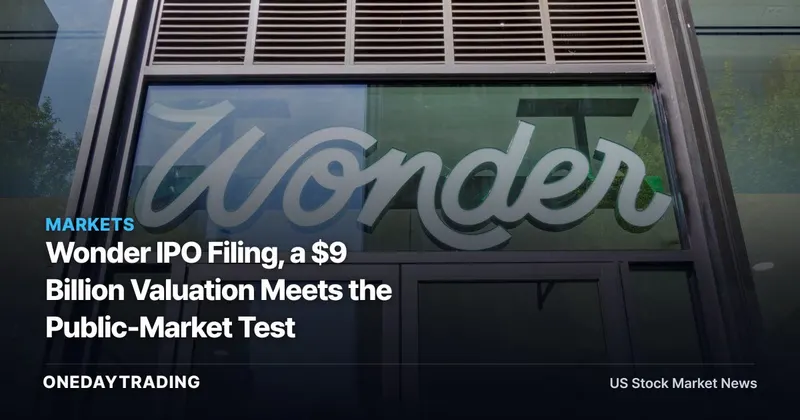
Wonder’s Confidential IPO Filing Raises the Valuation Question
Wonder said Thursday that it had confidentially filed for an initial public offering, putting Marc Lore’s food startup on a potential path to the public market. For investors, the event matters less as confirmation of an offering than as the first prospective test of whether Wonder’s operating footprint, acquired businesses and funding history can support its private valuation.
CNBC reported that Marc Lore created Wonder in 2018 and that the company now has roughly 170 brick-and-mortar locations across the U.S. A confidential IPO filing is Wonder’s stated step toward an initial public offering; the planned listing date, exchange, ticker symbol, share count, price range and targeted proceeds remain undisclosed.
That distinction sets the analytical boundary. The filing establishes intent, not completed financing, and the unavailable documents leave Wonder’s revenue, profitability and other financial results outside the evidence. Investors therefore cannot yet connect the company’s physical scale to its financial performance.
Wonder’s $9 Billion Benchmark Meets an Unseen Financial Record
Wonder’s Series D fundraising round earlier this year assigned the company a $9 billion pre-money valuation, according to CNBC. The company has also received more than $3 billion in venture funding, establishing two clear reference points for evaluating any eventual IPO terms.
Those figures create the central debate. An offering priced around the private benchmark would ask public investors to assess a business that has expanded through both locations and acquisitions. A different valuation would alter that comparison, though no price range has been provided and the confidential filing documents are unavailable.
The footprint is tangible: Wonder currently operates roughly 170 brick-and-mortar locations, and its sites offer menu items from more than two dozen restaurants. Its vertically integrated app supports delivery and takeout, linking the customer interface to the company’s physical locations. What the supplied facts cannot show is how effectively those elements translate into revenue or financial returns.
That missing bridge is more important than the headline valuation. Location count describes reach, while the private funding totals describe capital supplied to the business. Neither figure, on its own, establishes the financial performance that public investors would need to compare with an eventual offering price.
Acquisitions and Wonder Create Expand the IPO Thesis
Wonder has spent at least $1 billion on acquisitions, including Grubhub, Blue Apron and Relay. The transactions have brought a delivery service, a meal-kit brand, and a delivery and logistics provider under Wonder, giving an eventual prospectus several distinct acquired operations to explain.
Marc Lore told CNBC in September that IPO proceeds could enable more acquisitions. That is a possible use of capital rather than a completed outcome: no targeted proceeds have been disclosed, and specific future acquisition candidates have not been identified.
Wonder also plans to introduce additional dining options through Wonder Create starting Nov. 17. Under the announced model, influencers, entrepreneurs and brands can pay Wonder Create 10 USD per month to start a restaurant business from a Wonder location and receive a portion of order revenue.
The investor question is whether Wonder Create adds meaningful activity to the existing location network. The available evidence defines the subscription charge and launch timing, but supplies no expected participation, order volume or financial contribution. Nov. 17 is therefore an operating checkpoint, not proof that the initiative has achieved scale.
Lore’s record supplies relevant background without resolving that question. He previously founded Diapers.com and Jet.com, then sold those businesses to Amazon and Walmart, respectively. Those relationships explain why his name is central to the Wonder IPO story; they do not provide financial evidence for Wonder itself.
What Investors Need From Wonder Next
- Offering terms: The next decisive disclosure would identify the planned IPO date, exchange, ticker symbol, share count, price range and targeted proceeds. Until those terms emerge, the $9 billion pre-money valuation remains the available pricing benchmark rather than a public-market result.
- Financial results: Wonder’s confidential filing does not provide investors with its financial record. Any later disclosure of financial results would be necessary to judge the relationship among roughly 170 locations, more than $3 billion in venture funding and at least $1 billion spent on acquisitions.
- Acquired operations: Investors will need evidence that clarifies how Grubhub, Blue Apron and Relay fit within Wonder’s broader model. The confirmed acquisition relationships establish scope, but not their individual financial contributions.
- Wonder Create execution: Starting Nov. 17, the concrete checks are whether the planned offering launches as described and whether later company disclosures quantify participation or order revenue. The stated 10 USD monthly charge alone cannot establish the initiative’s importance.
The balanced view is straightforward. Wonder brings a sizable U.S. location base, multiple acquired businesses and substantial venture backing to the prospective offering process. The counterweight is equally material: without public filing documents, financial results or IPO terms, investors cannot determine whether the operating story supports the private valuation.
The next phase should be judged on disclosure rather than ambition. A public filing that connects Wonder’s locations, acquisitions and new dining initiative to financial results would turn the IPO narrative into an assessable proposition; until then, the confidential filing is significant, but not directional evidence for a listed stock.
📊 Analysis
Signal Neutral
Why The filing creates a potential path to public capital, while undisclosed financial results and offering terms prevent a directional assessment.
This article was independently written by OneDayTrading from public reporting. Read the original (CNBC)