Key Takeaways
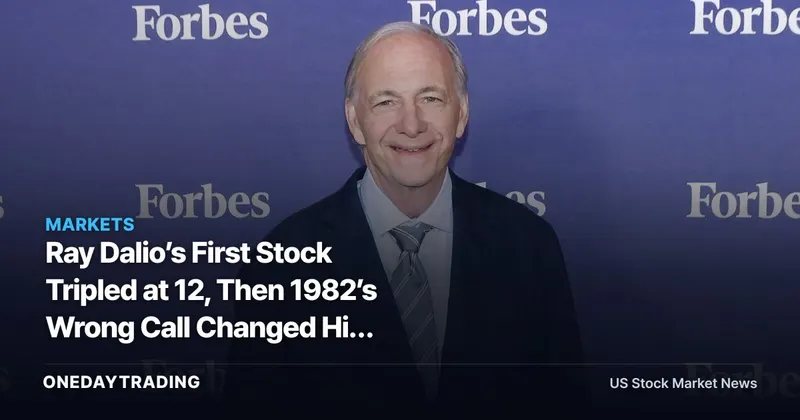
Ray Dalio’s investing story links an early win to a later failure, illustrating how confidence can outrun evidence. Yahoo Finance reports that Dalio used money earned caddying in the 1960s to buy Northeast Airlines stock at age 12; he said the investment tripled after another company bought the airline. In 1982, he predicted the United States was nearing another depression, but that depression did not occur, and he later said the losses forced him to dismiss everyone at Bridgewater Associates and borrow $4,000 from his father.
For investors, the reported lesson is process rather than a trade signal: Dalio says diversification, preparation for periods without incoming money and humility about unknowns changed how he made decisions.
What Happened to Ray Dalio’s First Stock and Later Forecast
Dalio founded Bridgewater Associates, but his market education began before the firm. According to Yahoo Finance, he worked as a golf caddy in New York during the 1960s and invested those earnings in Northeast Airlines. He described the airline as close to going broke, yet said an acquisition by another company caused his holding to triple. The fact sheet does not identify the acquiring company, the purchase date or the amount he initially invested.
Dalio later wrote that the first success made stock-market investing seem easy. Yahoo Finance reports that he soon lost money and learned what he called the costs of being wrong. The account does not provide the size of those early losses or a performance record for the clients involved later.
The most consequential episode came in 1982. Dalio predicted that the United States was on the verge of another depression. That depression failed to materialize. In a 2019 interview, he said the resulting losses affected both his own money and client money, led him to let everybody at Bridgewater go and left him so short of cash that he borrowed $4,000 from his father to help pay family bills.
Why the Northeast Airlines Win Could Mislead an Investor
A tripled investment can compress a complicated outcome into a simple story: buy a stock and wait for a payoff. Dalio’s own account, as reported by Yahoo Finance, shows the danger in treating one favorable outcome as proof of a repeatable method. The fact sheet confirms that the investment tripled after an acquisition, but it does not establish that Dalio forecast the transaction or that the result reflected a durable edge.
This distinction matters because a corporate takeover can determine a single stock’s return while saying little about an investor’s broader ability to value businesses. The source also cites an SEC discussion of investor mistakes, including familiarity bias, market manias and panics, and excessive trading. A 2002 study is cited for the finding that overconfidence can help explain high trading levels and poor individual-investor performance. Those references provide context for why an early windfall may encourage behavior that later increases risk; they do not prove that Dalio’s first purchase caused his later decisions.
What the 1982 Error Changed at Bridgewater
Dalio describes the 1982 experience as a decision-making reset. Yahoo Finance reports that he became more open-minded, diversified better and focused on dealing with what he did not know. His phrase “Pain plus reflection equals progress” summarizes that interpretation, while his reported comment that success depended more on handling unknowns than on what he knew defines the central theme of his account.
That framework shifts attention from being right on one forecast to surviving when a forecast is wrong. Diversification can reduce the damage from any one exposure, while financial reserves can give an investor time to avoid forced selling when income stops. Dalio told the Wall Street Journal that, when considering how to invest $10,000, he first asked how long he could live without money coming in. The source does not specify an asset allocation for that amount, a return target or a current portfolio.
Dalio also emphasized that investors should think in real returns and diversify well after protecting themselves against shocks such as job loss. These are principles attributed to his interviews, not guarantees of performance. The fact sheet supplies no evidence that any particular fund, stock or strategy achieved a specified return from following them.
Market and Stock Impact
- No direct listed-stock catalyst: The reported episode concerns Dalio’s personal history and investing philosophy. Yahoo Finance provides no current earnings, price move, guidance change or policy announcement tied to Bridgewater Associates or Northeast Airlines.
- Financial-services relevance: Dalio founded Bridgewater Associates, making the story relevant to discussions of investment management and risk controls. The source does not disclose Bridgewater’s current holdings, client identities or client performance, so no company-specific market reaction can be established.
- Behavioral-risk channel: The SEC and Investor.gov references support general caution around overconfidence, trading frequency and market manias. They do not identify a specific sector beneficiary or victim, and no ticker is directly tied to the event.
- Professional-development angle: Barry Ritholtz, founder of Ritholtz Wealth Management, asked Dalio for advice to young people entering finance in 2020. Dalio stressed humility, learning from setbacks and treating finance as a lifelong journey; the exchange does not create an investable signal for Ritholtz Wealth Management.
Investor Checkpoints
- Separate outcome from process: When reviewing a past winner, ask whether the return came from a repeatable analysis or an event such as an acquisition. The source confirms the tripling but leaves the purchase rationale and initial investment unknown.
- Test concentration risk: Dalio says becoming better diversified changed his approach. Investors can review whether one stock, sector or thesis dominates their exposure, while recognizing that the fact sheet gives no prescribed mix.
- Plan for no incoming money: His Wall Street Journal advice starts with the period an investor could live without income. The relevant checkpoint is personal cash resilience, not a market forecast; the source gives no universal reserve period.
- Audit confidence after forecasts: Dalio’s 1982 prediction was wrong, and he says reflection followed the losses. Investors can record assumptions before major decisions and revisit them after outcomes, without assuming that a single review guarantees better results.
Outlook
The constructive reading is that a severe professional setback can produce stronger risk discipline. Dalio says the 1982 losses pushed him toward open-mindedness, diversification and explicit attention to what he did not know. For long-term investors, those ideas may be useful as a framework for limiting dependence on any one forecast.
The counterpoint is that a philosophy is not the same as verified performance. The supplied reporting does not provide Bridgewater’s current results, the identities or outcomes of affected clients, the size of Dalio’s 1982 positions or the terms of his later investments. Readers should therefore treat the episode as a documented account of decision-making under uncertainty, not as evidence that copying Dalio would produce a particular return.
The next useful checkpoint is the investor’s own process: whether a portfolio can withstand an income interruption, whether exposures are diversified and whether a thesis states what would prove it wrong. Those checks follow directly from Dalio’s reported reflections while leaving room for the uncertainty his story highlights.
FAQ
What was Ray Dalio’s first stock investment?
Yahoo Finance reports that Dalio bought Northeast Airlines stock with money he earned caddying in the 1960s, when he was 12 years old. He said the investment tripled after another company bought the airline.
What happened to Ray Dalio after his 1982 depression prediction?
Dalio predicted that the United States was close to another depression, but the depression did not occur. He later said the losses led him to let everyone at Bridgewater go and borrow $4,000 from his father for family bills.
What investing lessons did Ray Dalio emphasize?
He emphasized dealing with what he did not know, diversifying and preparing for periods without incoming money. In a 2020 conversation with Barry Ritholtz, he also stressed humility, learning from setbacks and treating finance as a lifelong journey.
📊 Analysis
Signal Neutral
Why The account offers no current company earnings or price catalyst; its market relevance is an evidence-based lesson on diversification, uncertainty and decision risk.
This article was independently written by OneDayTrading from public reporting. Read the original (Yahoo Finance)