Summary
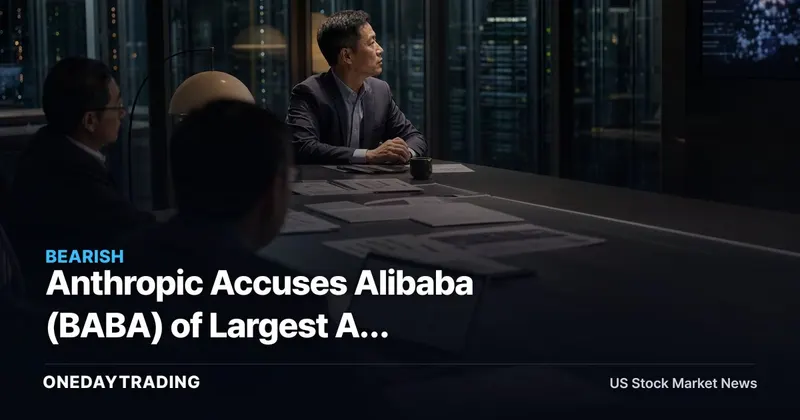
Anthropic has sent Alibaba a letter, obtained by CNBC, alleging the Chinese tech giant orchestrated what it calls the largest known distillation attack on its AI models to date. The accusation reframes the China-versus-US AI race as a question of intellectual-property security, putting fresh scrutiny on Alibaba (BABA) and the cost basis behind cheap, fast-improving Chinese frontier models.
The Full Story
Distillation is the practice of using a stronger model to train a cheaper one — feeding prompts to a leading system and using its outputs to teach a smaller model to imitate its reasoning. Anthropic frames Alibaba's alleged effort as brazen and illicit, meaning the outputs were harvested in violation of usage terms designed to stop exactly this. If a rival can shortcut years of training spend by siphoning a competitor's outputs, the economics of building a frontier lab change materially.
For investors, the immediate signal is not a courtroom outcome but a narrative shift. US labs have argued their multibillion-dollar training runs create a durable moat. An accusation that a Chinese hyperscaler captured those capabilities at a fraction of the cost cuts both ways: it validates how good closed US models are, while suggesting the lead is easier to compress than the spending implies.
Structural Background
The dispute lands amid an escalating US-China AI rivalry, where Chinese models have repeatedly matched Western performance at lower reported training cost. Anthropic, backed by Amazon and Google, competes directly with Alibaba's Qwen family. Allegations of data extraction feed into Washington's broader case for export controls on advanced chips and tighter rules on model access — a policy channel that touches the entire China tech complex.
Stock & Sector Ripple
- Alibaba (BABA): Direct subject. Reputational and potential legal overhang on its Qwen AI ambitions and cloud unit, the segment management has positioned as a primary growth engine; ADR sentiment is sensitive to US regulatory headlines.
- Amazon (AMZN) and Alphabet (GOOGL): Key Anthropic backers; a stronger IP-protection narrative supports the value of their model investments and cloud differentiation.
- Nvidia (NVDA): If the episode hardens US export-control logic, China chip access tightens — a demand-mix risk, even as broader AI training intensity stays a tailwind.
- Microsoft (MSFT): As an OpenAI partner, benefits from any market re-rating that rewards proprietary model security over fast-following.
Bull vs Bear Scenarios
Bear case for BABA: the allegation amplifies governance and regulatory risk exactly as the company leans on AI and cloud to justify a higher multiple, and any formal action could restrict access to US tools and data. Bull case: it remains a letter, not a ruling — distillation is hard to prove and widely practiced industry-wide, so a denial plus no enforcement could let the story fade, leaving Alibaba's core commerce earnings and cheap valuation to drive the stock.
Investor Action Points
- Watch for Alibaba's formal response and any move from US regulators or Anthropic toward litigation — escalation versus silence sets the tone.
- Track BABA's next quarterly cloud-and-AI revenue growth to gauge whether the headline dents enterprise demand.
- Monitor any new export-control or model-access policy dates that could turn a corporate spat into a sector-wide constraint for NVDA and China tech.
- Gauge sentiment spillover into AMZN and GOOGL as proof points for the proprietary-moat thesis.
Market data check: BABA
BABA last traded near $100.17 (-2.37%). Our composite signal — blending price momentum and news flow — reads 🟡 neutral. Price momentum scores 31/100 (soft).
Data as of publication. Price via market feeds; for reference only, not investment advice.
📊 Analysis
Signal Bearish
Why A public accusation of illicit, large-scale IP extraction adds regulatory and reputational risk to Alibaba's AI and cloud growth story.
Tickers$BABA$AMZN$GOOGL$NVDA$MSFT
This article was independently written by OneDayTrading from public reporting. Read the original (CNBC)