What Changes
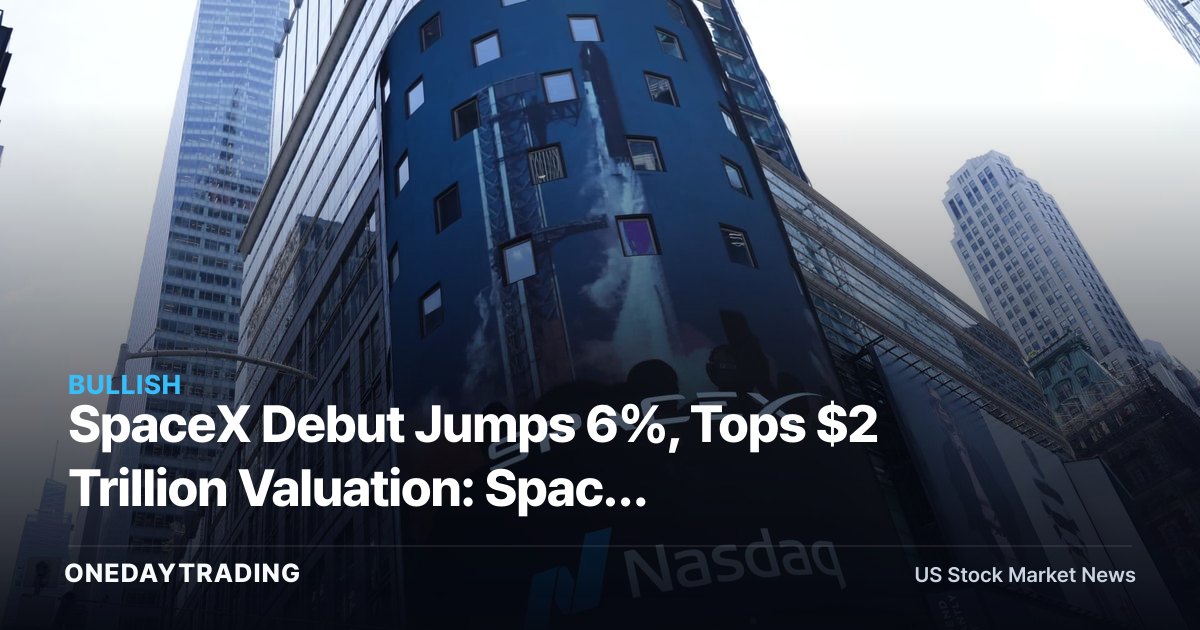
For years the most valuable space company on Earth was inaccessible to public investors. With a trading debut and a valuation north of 2 trillion dollars, that changes overnight. A first-day pop of roughly 6% signals strong appetite from institutions and retail buyers who have waited a long time for direct exposure to launch, satellite broadband and the broader orbital economy.
A valuation at this scale also creates a new benchmark. Smaller pure-play space names have traded on narratives and contract wins; now the market has a mega-cap anchor against which every launch provider and satellite operator will be measured. That can lift sentiment across the group, but it also raises the bar, since peers must justify their multiples relative to the clear category leader.
The debut may also accelerate capital flows into adjacent themes such as reusable rockets, satellite internet and defense-linked space infrastructure, while inviting sharper scrutiny of profitability and cash burn across the field.
By the Numbers
A 6% premarket move on debut is a meaningful first-session signal, reflecting demand that outstripped initial pricing. Crossing the 2 trillion dollar threshold puts the company in rarefied air, a tier historically reserved for the largest technology platforms rather than aerospace firms.
At that size, even modest percentage swings translate into enormous shifts in market value, which means volatility in early sessions can be severe as price discovery plays out.
Winners & Losers
- Space and launch sector — A landmark debut validates the investment thesis and can pull capital toward the whole group.
- RKLB (Rocket Lab) — A high-profile peer that may benefit from renewed sector attention, though it now competes for capital against a giant.
- ASTS (AST SpaceMobile) — Satellite connectivity gains visibility, but faces tougher comparison on scale and execution.
- LUNR (Intuitive Machines) — Lunar and services names ride the theme, with elevated valuation risk.
- TSLA — Sentiment around the founder ecosystem can move alongside the headline, even without direct linkage.
Risk Check
- Debut pops often fade as lockups, supply and sober fundamentals reassert themselves.
- A 2 trillion dollar valuation prices in years of flawless execution and leaves little margin for error.
- Launch is capital-intensive and cyclical, exposed to mission failures and program delays.
- Regulatory, geopolitical and concentration risks around founder-led control remain.
Bottom Line
SpaceX going public at a 2 trillion dollar valuation with a 6% debut pop is a genuine milestone that opens the space economy to public investors and lifts the whole sector, but the lofty price tag and early volatility mean enthusiasm should be balanced with caution.
📊 Analysis
Signal Bullish
Why A record-setting public debut with a 6% pop and a 2 trillion dollar valuation is a strong positive catalyst for the commercial space sector.
Tickers$RKLB$ASTS$LUNR$TSLA
This article was independently written by OneDayTrading from public reporting. Read the original (CNBC)