Summary
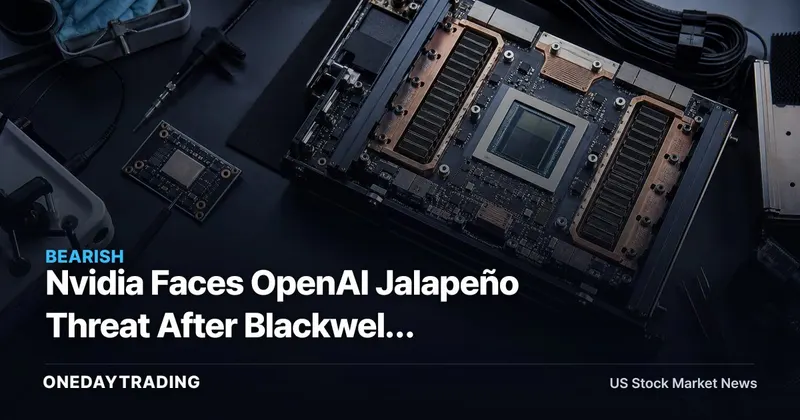
Nvidia (NVDA) investors face a margin question after CNBC reported that OpenAI’s Jalapeño AI chip beat Nvidia Blackwell systems on key inference-efficiency tests, because custom AI silicon attacks the most profitable layer of the AI infrastructure stack: repeatable inference workloads at scale.
The tape already understands that hyperscale AI demand is strong; the harder question is whether Nvidia Blackwell pricing power holds if large AI customers can shift selected workloads onto internally designed accelerators.
The Full Story
OpenAI’s Jalapeño chip is a custom AI semiconductor referenced in CNBC’s report, and inference means the production phase where a trained AI model generates responses for users rather than learning from data.
CNBC reported that OpenAI’s Jalapeño chip beat Nvidia Blackwell systems on key inference-efficiency tests, which matters because inference efficiency flows directly into cost per answer, server utilization, and the willingness of AI platforms to pay Nvidia’s full-stack premium.
Nvidia Blackwell systems remain central to the AI accelerator market, but the Jalapeño result points to a narrower battlefield: not whether custom silicon replaces Nvidia everywhere, but whether purpose-built chips can take the highest-volume inference jobs where software stacks are stable and workloads repeat.
That distinction is critical for Nvidia (NVDA) gross margin risk. Nvidia can still win where flexibility, developer tools, and broad model support matter, while OpenAI-style custom silicon can pressure the price umbrella where one customer controls the model, the deployment environment, and the optimization target.
Structural Background
Custom AI silicon gains ground when a major tech company has enough workload scale to justify chip design, enough engineering control to tune models to hardware, and enough purchasing leverage to reduce dependence on merchant GPUs.
The source report does not provide a Jalapeño shipment count, a Blackwell performance percentage, or a dollar margin figure, so investors should treat the CNBC item as a strategic signal rather than a quantified earnings reset.
Stock & Sector Ripple
- Nvidia (NVDA): Nvidia faces the clearest negative read-through because OpenAI’s Jalapeño chip directly challenges Blackwell inference efficiency, the metric tied most closely to AI operating cost.
- AI semiconductors: The AI chip sector gets a competitive reset as custom accelerators gain credibility against merchant GPU systems in targeted inference tasks.
- Data center infrastructure: Data center buyers gain bargaining power if custom silicon proves efficient enough to sit beside Nvidia Blackwell systems rather than below them.
- AI platforms: OpenAI-style model operators benefit when inference efficiency reduces compute cost per response, but only if custom silicon can scale beyond benchmark wins.
Bull vs Bear Scenarios
The bull case for Nvidia (NVDA) is that Blackwell systems keep their premium because AI customers still need broad compatibility, fast deployment, and a mature GPU software ecosystem across changing model architectures.
The bear case for Nvidia (NVDA) is that OpenAI’s Jalapeño efficiency lead becomes a template for major tech companies to reserve Nvidia GPUs for training and flexible workloads while moving predictable inference onto internal chips.
Investor Action Points
- Track Nvidia’s next earnings call for any language on Blackwell inference demand, pricing, and customer concentration.
- Watch whether CNBC’s reported Jalapeño test advantage turns into deployed capacity, not only benchmark performance.
- Monitor Nvidia gross margin commentary, because custom silicon pressure shows up first in pricing discipline before it shows up in unit demand.
- Listen for whether major tech companies describe custom AI chips as supplemental capacity or direct Blackwell substitutes.
FAQ
Why is OpenAI’s Jalapeño chip a threat to Nvidia stock?
OpenAI’s Jalapeño chip is a threat to Nvidia (NVDA) because CNBC reported that Jalapeño beat Nvidia Blackwell systems on key inference-efficiency tests. Inference efficiency affects AI operating cost, and lower cost can weaken Nvidia’s pricing power in selected workloads.
What is AI inference efficiency in Nvidia Blackwell systems?
AI inference efficiency measures how effectively a system runs trained models to produce answers for users. Nvidia Blackwell systems compete on that metric because better inference efficiency can reduce compute cost for AI services.
Does OpenAI’s custom AI chip mean Nvidia demand is over?
OpenAI’s Jalapeño chip does not prove Nvidia demand is over because CNBC’s report cited key inference-efficiency tests, not broad replacement across all AI workloads. Nvidia Blackwell demand depends on whether customers value flexibility and software depth more than custom efficiency in specific deployments.
Market data check: NVDA
NVDA last traded near $212.08 (-0.46%). Our composite signal — blending price momentum and news flow — reads 🟡 neutral. Price momentum scores 46/100.
Data as of publication. Price via market feeds; for reference only, not investment advice.
📊 Analysis
Signal Bearish
Why CNBC’s report that OpenAI’s Jalapeño chip beat Nvidia Blackwell systems on key inference-efficiency tests creates a plausible margin and pricing-power risk for Nvidia.
This article was independently written by OneDayTrading from public reporting. Read the original (CNBC)