What Changes
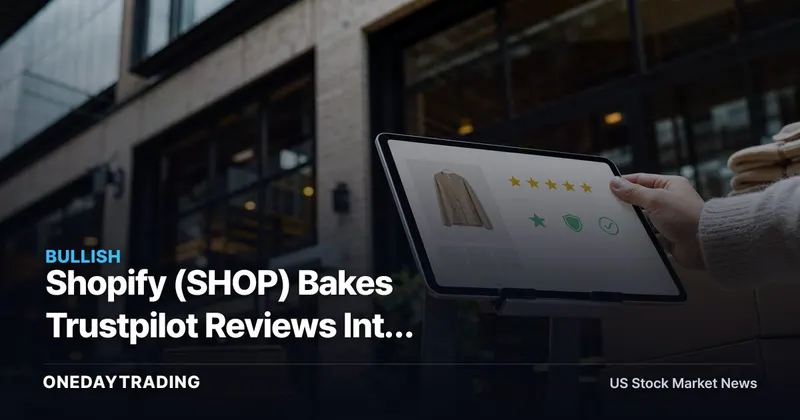
Reviews have always lived adjacent to commerce; this moves them inside it. Embedding Trustpilot ratings on product and checkout pages compresses the trust-building step into the buying flow, where abandoned-cart friction is highest. For Shopify, that is a merchant-retention feature dressed as a partnership — the more native tooling that lives inside the platform, the higher the switching cost for a store owner weighing WooCommerce or BigCommerce.
The strategic logic favors Shopify more than Trustpilot. Shopify monetizes through subscriptions and a take rate on merchant volume; anything that nudges conversion higher feeds Merchant Solutions revenue, its faster-growing and higher-dollar segment. Trustpilot, by contrast, sells review-management software on subscription — a single channel integration widens its funnel but does not by itself re-rate a SaaS business priced on net new ARR and retention.
Watch where this sits in Shopify's app and partner architecture. A deep first-party integration carries different economics than another listing in a crowded App Store, where review apps already compete on price.
By the Numbers
The release carries no disclosed financial terms, attach targets, or conversion data — which is the point. Without a revenue-share figure or a pilot conversion-lift number, this is a product announcement, not a guidance event. The figures to demand arrive later: any merchant-adoption count, contribution to Trustpilot subscription growth, and whether Shopify references it in Merchant Solutions commentary.
Winners & Losers
- Shopify (SHOP) — Primary beneficiary; stickier merchant tooling and a potential conversion tailwind into its take-rate-driven Merchant Solutions line.
- Trustpilot (TRST, London) — Distribution win and funnel expansion, but no near-term ARR proof; not U.S.-listed.
- Etsy (ETSY) / e-commerce SaaS peers — Marginal pressure as Shopify deepens its native trust layer and competitive moat.
- Review-app and UGC vendors (e.g., Yotpo, Okendo — private) — Crowded-out risk if Shopify privileges a marquee partner.
- Amazon (AMZN) — Indirect; Shopify's pitch to independent brands leans on owning the customer relationship that marketplaces don't offer.
Risk Check
- No disclosed economics — revenue impact for either company is unquantified.
- Integration depth unclear; an App Store listing is far less defensible than first-party rails.
- Conversion lift is the entire thesis and remains unproven without merchant data.
- Trustpilot's London listing means U.S. investors get only an indirect, second-order read via SHOP.
Bottom Line
Treat this as an incremental moat-deepening for Shopify rather than a catalyst — a sensible feature that raises switching costs and could nudge conversion, but one that earns a re-rating only if attach rate and checkout lift show up in the next few quarters of Merchant Solutions and Trustpilot subscription numbers.
Market data check: SHOP
SHOP last traded near $116.86 (+4.69%). Our composite signal — blending price momentum and news flow — reads 🟡 neutral. Price momentum scores 88/100 (firm).
Data as of publication. Price via market feeds; for reference only, not investment advice.
📊 Analysis
Signal Bullish
Why A native trust-and-conversion feature deepens Shopify's merchant lock-in and could lift its take-rate-driven Merchant Solutions revenue, a modest positive catalyst.
This article was independently written by OneDayTrading from public reporting. Read the original (Investing.com)