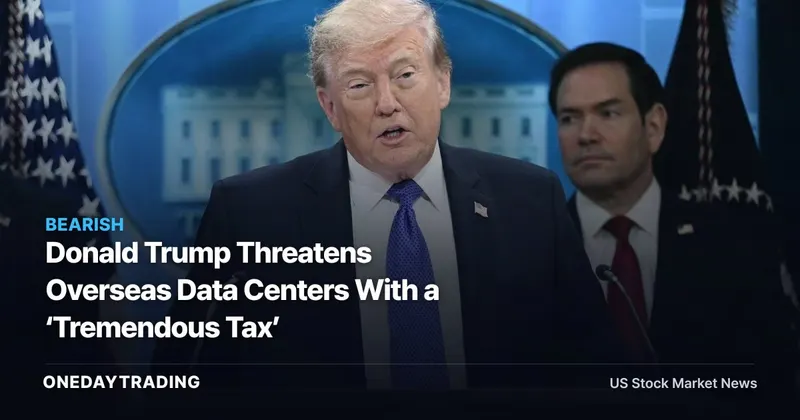
Donald Trump’s Data Center Threat Raises a New Cloud-Infrastructure Risk
Donald Trump put Alphabet, Amazon, Microsoft, Meta and Oracle investors on notice Friday by proposing that U.S. companies be barred from building data centers abroad or face a tax penalty. CNBC reported the remarks from a White House press conference, making the immediate investment issue clear: overseas data-center expansion now carries a potential policy risk, even though no enforceable rule has been established.
The proposal concerns where U.S. companies may build data centers, the physical facilities that house the computing infrastructure used to process and store digital workloads. For the affected technology groups, the relevant question is not whether the statement changes current operations immediately. It is whether a future restriction could alter the cost, location or feasibility of additional foreign construction.
What Donald Trump Announced on Friday
Trump said U.S. companies would either be prohibited from constructing data centers in other countries or penalized through taxation. “We're going to fight very hard for the data centers,” Donald Trump said, framing domestic control of this infrastructure as the policy objective.
He also left open a path for companies to continue overseas construction at a cost. “They can, but we're going to put a tremendous tax on them,” Donald Trump said. That distinction matters: a ban would constrain location choices directly, while a tax would operate through project economics. The available facts do not establish which route would apply, whether companies could choose between them or how either approach would work.
The remarks followed Trump’s meeting with Xi Jinping and Vladimir Putin in China for a trilateral summit the day before. Trump said Xi had “congratulated me on how well we're doing” in artificial intelligence. The meeting provides timing for the announcement, though the confirmed facts do not establish a causal connection between the summit and the proposed data-center policy.
The Domestic Constraint Behind Trump’s Data Center Push
Moving more construction toward the U.S. would encounter visible public resistance. CNBC’s All-America Economic Survey found that 64% of registered voters opposed an AI data center within 10 miles of their home. The same CNBC survey found that 13% of respondents supported an AI data center within 10 miles of their home.
Those results expose the central tension in the proposal. Restricting foreign construction could increase the strategic importance of domestic sites, while the survey indicates that nearby projects face opposition among registered voters. A policy that limits one geographic option does not automatically make another option easier to execute.
For investors, this tension shifts attention from the political slogan to implementation. If overseas projects become less attractive, companies would need acceptable alternatives for future construction. The fact sheet establishes neither the availability of such locations nor the terms on which projects might proceed, so the survey should be read as a constraint signal rather than proof of any specific operating outcome.
Alphabet, Amazon, Microsoft, Meta and Oracle Face Uneven Questions
Alphabet, Amazon, Microsoft, Meta and Oracle have already built data centers in foreign countries. That confirmed overseas presence makes each company directly relevant to the proposal, though it does not reveal which existing facilities, future projects or countries might fall within its scope.
- Alphabet: Its established foreign data-center footprint creates direct exposure to any rule covering additional overseas construction. Investors need the policy text before distinguishing risk to existing assets from risk to future sites.
- Amazon: A ban could narrow its location choices, while a tax could change the relative cost of covered projects. Neither effect can be quantified because the tax rate and covered countries are unknown.
- Microsoft: The same decision framework applies: project location could become a policy-controlled variable rather than a purely operating choice. The statement does not show whether current foreign facilities would be treated differently from new construction.
- Meta: Its inclusion follows from the confirmed fact that it has built data centers abroad. The investor issue is prospective construction risk, not a demonstrated change to present operations.
- Oracle: Any directional assessment depends on whether the eventual policy covers the company, the relevant countries and additional projects. The announcement alone cannot establish the financial size of that exposure.
The common transmission channel is straightforward. A prohibition would remove covered foreign sites from the available set of choices; a tax would add a policy-linked burden to covered construction. Company-specific consequences remain indeterminate because the fact sheet provides no project pipeline, revenue exposure, construction spending or tax amount.
Bull and Bear Cases for U.S. Cloud and AI Infrastructure
Bear case: The proposal becomes an implemented restriction broad enough to cover the named U.S. technology companies. A ban could reduce flexibility over where new data centers are built, and a tax could make covered foreign projects less attractive. Domestic resistance, reflected in the CNBC survey, could then complicate the alternative of concentrating more construction in the U.S.
Bull case: The statement does not develop into an enforceable policy, or its eventual coverage is narrower than the initial language suggests. Companies could also retain an overseas option if the policy takes the form of a tax rather than a prohibition. That scenario still requires the rate to be known before investors can judge whether the charge would materially change a construction decision.
The balanced reading is bearish for policy uncertainty, not a forecast of a confirmed financial loss. There is no legal mechanism, effective date, tax rate, covered-company list or covered-country list. Whether the proposal will be implemented is also unknown, preventing a defensible estimate of company-level impact.
Investor Checkpoints After Trump’s Announcement
- Legal form: Determine whether the proposal emerges as a ban, a tax or another mechanism. The distinction decides whether companies face a hard location constraint or an added cost.
- Scope: Check which U.S. companies, foreign countries and types of construction are covered. The named technology groups have foreign data centers, but that fact alone does not establish legal exposure.
- Treatment of existing facilities: Look for language separating data centers already built abroad from future projects. The announcement referred to building activity without defining how current assets would be handled.
- Implementation details: Wait for an effective date and, if taxation is used, the amount or rate. Until those terms exist, the proposal cannot be translated into a supported cost estimate.
The next investable signal is not another broad statement about keeping data centers in the U.S. It is a concrete policy document that identifies authority, coverage and economic terms. Until that appears, Alphabet, Amazon, Microsoft, Meta and Oracle carry a shared headline risk, while the magnitude and distribution of any actual burden remain unresolved.
📊 Analysis
Signal Bearish
Why The proposal introduces potential tax and expansion constraints for U.S. technology companies with data centers in foreign countries, although its scope and implementation remain undefined.
Tickers$GOOGL$AMZN$MSFT$META$ORCL
This article was independently written by OneDayTrading from public reporting. Read the original (CNBC)