Key Takeaways
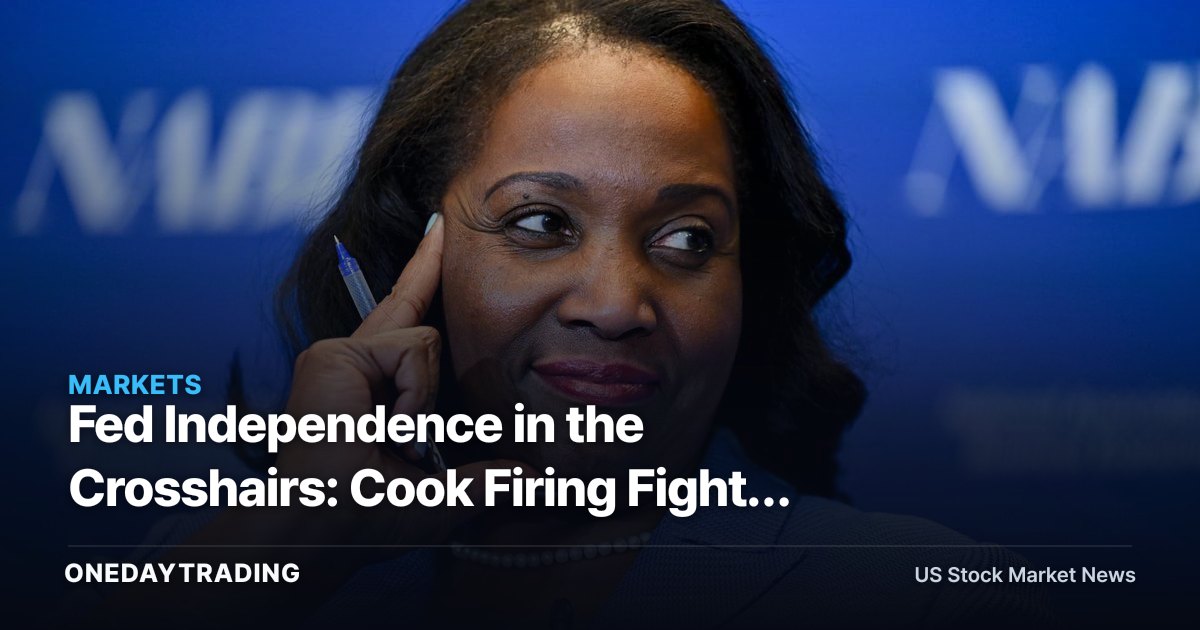
A financial disclosure showing that Federal Reserve Governor Lisa Cook spent more than 1 million dollars on legal and security costs to fight her attempted removal is a small headline with an outsized signal: the independence of the U.S. central bank is being tested in real time. For investors, the transmission runs not through one stock but through the price of policy credibility — long-term Treasury yields, the dollar, and gold.
What Happened
The disclosure from Governor Cook details large personal legal and security expenses tied to President Trump's effort to fire her, a sum exceeding 1 million dollars. The figure quantifies a governance clash that markets have so far treated as background noise.
The dollar amount matters because it underscores that this is not a symbolic dispute resolved by a memo. A sitting Fed governor is funding a sustained legal defense, which implies the question of whether a president can remove a governor at will is being contested seriously rather than dropped.
Background and Context
The Federal Reserve sets short-term interest rates and is structurally insulated from the executive branch precisely so that monetary policy is not bent to a political calendar. Investors price that insulation into the entire term structure of interest rates. Any credible challenge to a governor's job security chips at the premise that rate decisions follow inflation and employment data rather than White House preference.
Market and Stock Impact
- Gold (GLD, NEM): Erosion of central-bank independence is a classic catalyst for hard assets, because it raises the perceived risk that policy could tolerate higher inflation. Gold has no earnings to discount, so it benefits directly when confidence in fiat policy credibility weakens.
- Long-dated Treasuries and rate-sensitive equities: If markets doubt the Fed's autonomy, they tend to demand more term premium on longer maturities. Higher long yields pressure long-duration growth and dividend proxies even if the front end is unchanged.
- Banks (JPM, BAC): Lenders are leveraged to the yield curve and to policy predictability. A steeper curve driven by independence fears can lift net interest margins, but disorderly volatility in rates raises funding and credit uncertainty — a mixed channel rather than a clean positive.
- The dollar (UUP): Reserve-currency status rests partly on institutional trust. Sustained politicization risk is a slow-burn negative for the greenback against gold and major peers.
Investor Checkpoints
- Watch the 10-year Treasury yield and the 2s10s spread for any term-premium widening that coincides with court filings or rulings in the Cook matter.
- Track the next FOMC decision and dot plot for whether dissents or messaging shift in a way markets read as political.
- Monitor gold and the dollar index together — a simultaneous gold rally and dollar slip is the cleanest tell that independence risk is being repriced.
- Follow the litigation calendar; a definitive ruling on removal authority is the binary event that could move term premium.
Outlook
The bull case for stability is straightforward: courts and precedent have historically protected Fed governors, the dispute may resolve without altering rate-setting, and markets have largely shrugged so far. The risk case is structural rather than immediate — if removal authority is broadened, the market would likely demand a durable independence discount in long yields and a premium on gold, regardless of where inflation sits. The key variable is not the legal bill itself but whether the underlying authority question is settled in a way that preserves, or weakens, the wall between the central bank and the executive.
📊 Analysis
Signal Neutral
Why The filing quantifies a governance clash over Fed independence but is not itself a directional catalyst for any single stock; its market impact is a slow-burn tail risk to rates, the dollar, and gold.
Tickers$GLD$NEM$JPM$BAC$UUP
This article was independently written by OneDayTrading from public reporting. Read the original (CNBC)