Key Takeaways
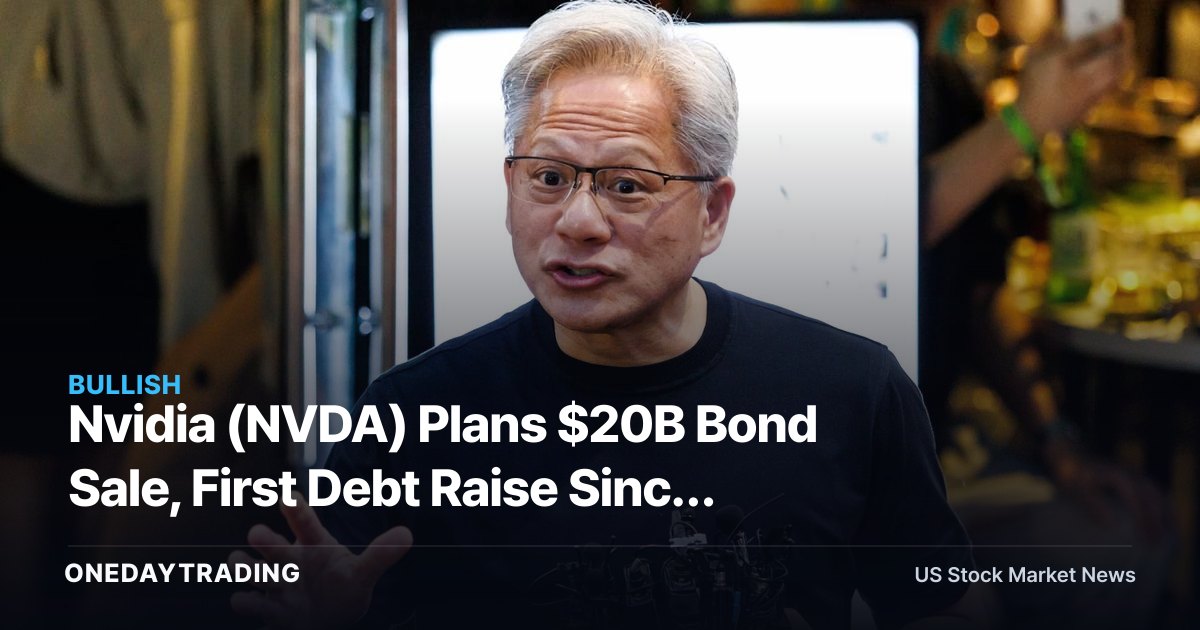
Nvidia is tapping the corporate bond market for at least $20 billion, its first debt sale since 2021, when the company was a fraction of its current size. For investors, the move is less about funding a cash-strapped balance sheet and more about how Nvidia chooses to finance the next leg of the AI buildout while keeping equity intact.
What Happened
Nvidia plans to raise a minimum of $20 billion through a debt offering, marking its return to the bond market for the first time since 2021. That timing matters: in 2021, Nvidia was a far smaller enterprise, before the generative-AI wave turned its data-center GPUs into the central hardware of the buildout and pushed the company into the ranks of the largest firms by market value.
A company that generates enormous free cash flow does not strictly need to borrow. Choosing debt over drawing down cash or issuing stock is a capital-structure decision: it locks in financing without diluting existing shareholders, and it signals management sees long-duration uses for capital large enough to justify leverage on the balance sheet.
Background & Context
The AI cycle has shifted from chips alone toward the full stack around them, with hyperscalers and Nvidia itself committing to data centers, networking, supply agreements and strategic investments. A $20 billion-plus raise gives Nvidia dry powder for that broader footprint, from partnerships and equity stakes to securing capacity, at a moment when AI infrastructure spending commitments are measured in the hundreds of billions.
Market & Stock Impact
- Nvidia (NVDA): A bond sale is shareholder-friendly versus equity issuance because it avoids dilution; the cost of capital and credit terms will show how the market prices Nvidia debt for the first time in the AI era.
- AI infrastructure and supply chain (AMD, AVGO, TSM): Nvidia deploying borrowed capital into capacity and partnerships reinforces durable end-demand for foundry and networking suppliers tied to GPU output.
- Hyperscalers (MSFT, AMZN, GOOGL): Nvidia funding its ecosystem aggressively supports the spending arms race, but also raises questions about how much AI capex is being financed rather than self-funded.
- Investment-grade credit markets: A jumbo issue from a mega-cap tech name adds supply that bond investors must absorb, a barometer of appetite for tech leverage.
Investor Checkpoints
- Final deal size and whether it exceeds the $20 billion floor, plus the coupon and credit rating assigned.
- Stated use of proceeds in the filing: buybacks, capacity, strategic investments or general purposes.
- Next earnings update for data-center revenue trajectory and free cash flow that services any new debt.
- Whether peers follow with their own AI-linked debt, signaling a broader financing shift.
Outlook
The bull read is straightforward: a cash-rich leader using cheap leverage to fund growth without diluting owners, while demand for its chips stays robust. The counterweight is that issuing debt to finance an ecosystem of stakes and capacity introduces leverage and circular-funding optics into a story that was previously all organic cash flow. The key variable is whether AI end-demand keeps compounding fast enough to make borrowing today look conservative rather than late-cycle.
Market data check: NVDA
NVDA last traded near $212.07 (+3.35%). Our composite signal — blending price momentum and news flow — reads 🟡 neutral. Price momentum scores 77/100 (firm).
Data as of publication. Price via market feeds; for reference only, not investment advice.
📊 Analysis
Signal Bullish
Why A non-dilutive debt raise to fund AI growth signals management confidence and shareholder-friendly capital allocation amid strong data-center demand.
Tickers$NVDA$AMD$AVGO$TSM$MSFT$AMZN
This article was independently written by OneDayTrading from public reporting. Read the original (CNBC)