Federal Reserve Pause Leaves the Larger Rate Risk Intact
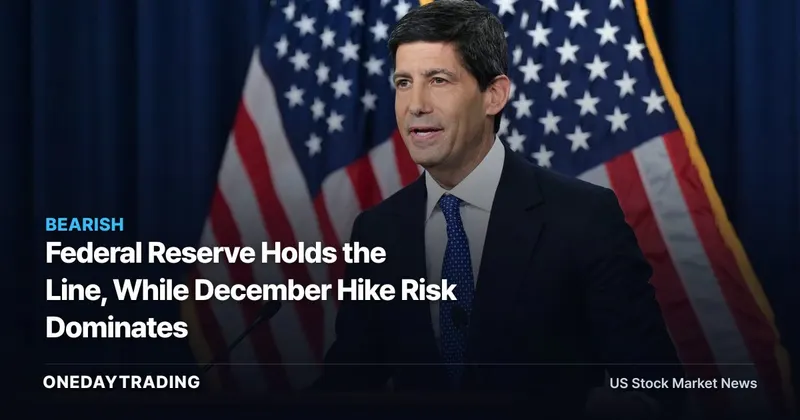
The Federal Reserve entered this week’s policy meeting with the Federal Open Market Committee expected to keep benchmark interest rates steady Wednesday after September’s increase. For investors, the immediate decision matters less than whether Kevin Warsh frames a pause as time to study the data or as an interval before further tightening, with housing, consumer credit and technology facing different degrees of policy exposure.
The Federal Open Market Committee is the Federal Reserve body responsible for setting benchmark interest-rate policy. A steady decision would therefore leave the existing stance in place rather than settle how far or how quickly rates may rise.
The sharp market distinction is between this meeting and the policy path beyond it. CNBC reported that fed funds futures implied about a 10% chance of a Federal Open Market Committee increase this week, while CME Group data indicated a better than 80% probability of an increase in December. The tape is pricing a pause now and substantial tightening risk later; it is not resolving the eventual destination of rates.
September Inflation Keeps Pressure on the Federal Reserve
CNBC reported that the consumer price index ran at a 3.7% annual rate in September. Core CPI was 2.6% in September after rising 0.3 percentage points from August, leaving it above the Federal Reserve’s stated 2% inflation mandate. Those readings explain why a pause cannot automatically be read as the end of the tightening debate.
The September increase was a quarter percentage point. Brett Ryan, senior U.S. economist at Deutsche Bank, argued that leaving rates unchanged in October would give officials more time to evaluate trends in the data. That interpretation makes the pause a window for assessment, not evidence that inflation risk has disappeared.
Warsh’s communication strategy raises the stakes. He has sought to move the Federal Reserve away from the forward-guidance practice used through much of the 21st century, preferring incoming data to carry more of the signal. Less explicit guidance places greater weight on the wording around inflation, the pace of future action and the conditions that could change that pace.
Kevin Warsh Must Separate Patience From Complacency
The central communication challenge is to acknowledge inflation without making a premature commitment. Krishna Guha, head of economics and central bank strategy at Evercore ISI, summarized that difficulty on Monday: “But there is material execution risk.” The risk lies in conveying restraint at the current meeting while preserving freedom to respond to later data.
Guha interpreted Warsh’s remarks to the World Bank and International Monetary Foundation as consistent with a deliberative baseline pace of once per quarter. That pace was not presented as a promise. It remained conditional on what policymakers learn, how far rates may ultimately need to move and whether a faster pace might become necessary.
Comments associated with Vice Chair Philip Jefferson and New York Fed President John Williams also pointed toward increases at every other meeting. The supplied evidence does not establish the final path, and it does not confirm the Federal Open Market Committee’s Wednesday decision. Investors can assess the stated pace and probabilities, while the outcome and endpoint remain open.
Housing and Credit Carry the Clearest Tightening Exposure
Mortgage rates were above 7%, and the housing market was already struggling under that pressure. Additional monetary tightening could intensify that strain, making housing the clearest area where the inflation response and economic cost collide.
Mohamed El-Erian, chief economic advisor at Allianz, said on Monday that further increases would be the wrong policy measure and argued for “fiscal containment, not monetary tightening.” His concern centered on housing, consumer car loans, consumer loans and economic disparities. He also said technology would not be affected as much as the rest of the economy.
The labor picture adds another constraint. Layoffs were around their lowest levels since the late 1960s, while people without work were struggling to find jobs. That combination complicates a simple inflation-only reading because further restraint may reach a labor market in which hiring is already subdued even though layoffs remain low.
Financial conditions have also moved. The Chicago Fed’s financial-conditions index tightened slightly after the September rate increase, with stock-market volatility among the factors cited. This matters because policymakers consider financial conditions alongside inflation and employment when calibrating policy.
Market and Sector Read-Through
- Housing and real estate: Mortgage rates above 7% were already associated with a struggling housing market. A stronger signal of additional tightening would add pressure to the area most visibly exposed to borrowing costs.
- Consumer credit: El-Erian identified consumer car loans and consumer loans among the channels likely to be hit by more monetary tightening. The eventual effect is unknown, so the relevant signal is whether the Federal Reserve validates the market’s expectation of another increase.
- Technology: El-Erian argued that technology would be less affected than the rest of the economy. That is a relative assessment, not evidence that the sector is insulated from tighter financial conditions or stock-market volatility.
- Broad equities: The Chicago Fed’s index had tightened slightly since September, partly alongside stock-market volatility. An unexpectedly forceful policy message could therefore matter even if the benchmark rate itself remains unchanged Wednesday.
What the Rate Market Prices—and What It Cannot
CME Group’s probabilities draw a clear boundary around current expectations. The roughly 10% chance of an increase this week indicates that a hold was the dominant view, while the better than 80% probability for December shows that investors were not pricing an extended pause.
Beyond December, confidence fades. The market-implied path placed another increase in March 2027 and assigned a 50-50 chance to a final move before the end of next year. Those probabilities describe trading expectations, not confirmed Federal Reserve decisions.
Citigroup economists offered a counter-scenario: easing inflation in the months ahead could support staying on hold and potentially cutting next year, even though the firm forecast an increase in December. The disagreement makes subsequent inflation evidence more important than any fixed narrative about an uninterrupted series of increases.
Investor Checkpoints After Wednesday’s Decision
- Policy language: Check whether Kevin Warsh presents the expected hold as an assessment period or emphasizes that more tightening will likely be required.
- Inflation trend: Compare the next evidence with September’s 3.7% annual consumer price index rate, September’s 2.6% core CPI and the 0.3-percentage-point core increase from August.
- December pricing: Watch whether CME Group’s better than 80% probability of a December increase holds after the Federal Open Market Committee communicates its decision.
- Transmission stress: Follow mortgage rates, housing conditions, labor-market hiring and the Chicago Fed’s financial-conditions index for signs that prior tightening is exerting greater pressure.
The Next Signal Is the Policy Path, Not the Pause
A steady decision could give the Federal Reserve more time to evaluate the September increase and the slight tightening in financial conditions. It could also reduce the risk of committing too early to a pace that later data may not justify.
The opposing risk is that inflation remains above the stated mandate and forces additional action. In that case, the burden would fall most clearly on housing and credit-sensitive parts of the economy, while technology may prove relatively less exposed under El-Erian’s assessment.
Wednesday’s decision is the first checkpoint, not the resolution. The decisive question is whether Warsh’s message sustains the market’s better than 80% December probability or gives investors reason to reconsider it as the next inflation and financial-conditions evidence arrives.
📊 Analysis
Signal Bearish
Why Persistent inflation and a market-implied December increase create tighter-policy risk for housing, consumer credit and most of the economy outside technology.
This article was independently written by OneDayTrading from public reporting. Read the original (CNBC)