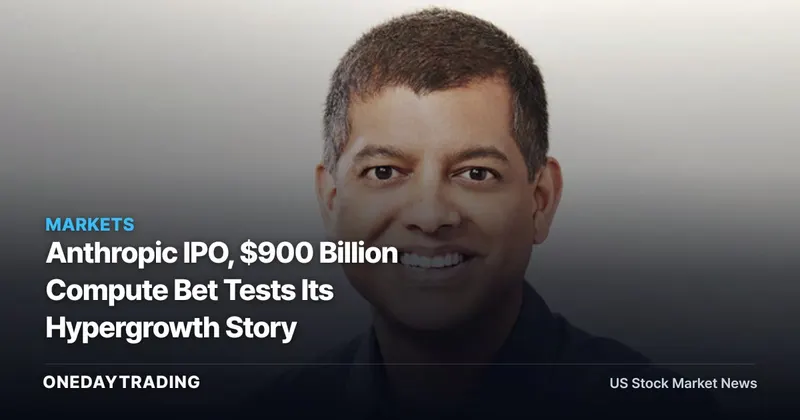
Krishna Rao Must Translate Hypergrowth Into an Investable Case
Anthropic’s expected Nasdaq IPO puts a stark equation in front of investors: extraordinary reported revenue growth on one side and an immense compute commitment on the other. CNBC’s profile, published 2026/11/16, identifies CFO Krishna Rao as the executive tasked with explaining that equation as the AI company approaches the public market.
The IPO is an initial public offering, the process through which a private company offers shares to public-market investors. The listing could value Anthropic at roughly $1.4 trillion, according to CNBC, although the final valuation, proceeds and Nasdaq listing date remain unknown.
That distinction matters. A potential valuation describes the price investors may assign to the business; it does not establish the durability of future financial performance. Rao’s burden is to connect revenue, infrastructure obligations and prospective capital deployment without treating an expected outcome as a completed one.
Rao joined Anthropic in 2024 and serves as its first CFO. He led the company’s early testing-the-waters meetings in August, placing him at the center of the dialogue through which prospective investors could evaluate the proposed offering before a confirmed debut.
Anthropic’s Revenue Numbers Set a Demanding Baseline
Anthropic reported $33.24 billion in revenue for the nine months ending Sept. 30, a roughly 1,200% increase from the same period last year. The scale and comparison period are essential: this is nine-month revenue and year-over-year growth, not a forecast for a later reporting period.
The company generated $386 million in revenue in 2024, the year Rao joined. Read together, the figures make growth the strongest component of the IPO narrative, while also creating a difficult baseline against which investors will judge future disclosures.
For software and AI investors, the useful metric is not growth in isolation. The sharper question is whether subsequent revenue disclosure remains commensurate with the infrastructure commitments required to train models and serve customers. The fact sheet provides no future financial performance, so any claim about the persistence of the reported pace would outrun the evidence.
OpenAI is described as Anthropic’s chief rival, establishing a competitive frame without supplying comparable financial metrics. That means the available evidence can support a discussion of Anthropic’s own trajectory, not a numerical ranking between the companies.
The $900 Billion Compute Commitment Is the Core IPO Test
Anthropic said in an amended prospectus that aggregate spend commitments totaled roughly $900 billion last week, substantially all related to compute and infrastructure. Compute is the processing capacity used to train AI models and serve customers, making the commitment central to the operating model rather than a peripheral expense.
Rao captured that dependency directly: “The compute that we procure, it's the lifeblood of our business.” He also called it “the canvas on which everything else gets built.” Those descriptions establish strategic importance, while the prospectus figure establishes financial magnitude.
The investor mechanism is straightforward. Compute enables the service capacity underlying revenue, and contractual spending commitments create obligations that must be assessed alongside that revenue. The supplied evidence does not specify the timing, structure or future return attached to those commitments, so it cannot establish whether the spending will produce attractive economics.
Anthropic closed a $65 billion funding round in May. CNBC also reported that the company could receive more than $60 billion in IPO proceeds this week, but the final proceeds and their deployment are unknown. Funding capacity may support infrastructure needs; it does not by itself answer how efficiently capital will translate into future revenue.
Why Rao’s Operating History Matters Now
Rao’s relevance is not celebrity but financial translation. Byron Deeter of Bessemer Venture Partners, described as a repeat Anthropic investor, said Rao does not allow important issues to go unspoken and gives investors advance visibility into what is coming. That reputation will be tested by the specificity of Anthropic’s public disclosures.
His background spans Bain & Company, Blackstone, Airbnb, Fanatics Commerce and Cedar. Rao graduated from Harvard University in 2005, later completed his legal education at Yale Law School and worked in private equity at Blackstone, where a 2014 poker game was credited with inspiring the unit’s annual tournament.
Rao later followed Laurence Tosi to Airbnb and supported that company’s late 2020 IPO. Airbnb experienced a 70% revenue decline during a seven-week period, according to Rao’s account cited by CNBC. The episode supplies evidence of experience under financial pressure, though it does not guarantee an outcome for Anthropic.
Jonathan Mildenhall, described as a Fanatics board member and Airbnb’s former marketing chief, characterized Rao as committed, principled and effective across complex companies. Mildenhall is now associated with Rocket Companies. These endorsements illuminate management style; investors still need financial disclosure to evaluate the offering.
Potential Winners, Exposures and Missing Evidence
- Anthropic: The company could gain access to more than $60 billion in IPO proceeds this week if the reported outcome occurs. The amount is not final, and no supported evidence explains how the capital would be deployed.
- AI infrastructure: Anthropic’s roughly $900 billion of aggregate spend commitments makes compute and infrastructure the clearest operating exposure in the story. The fact sheet does not identify specific suppliers, listed beneficiaries or allocation schedules.
- Prospective public investors: Reported nine-month revenue growth provides a powerful top-line case, while the possible roughly $1.4 trillion valuation and large spending commitments raise the standard for future execution and disclosure.
- OpenAI: Its role here is limited to being identified as Anthropic’s chief rival. No supported valuation, revenue or spending comparison is available.
What Could Break the Anthropic IPO Thesis
- Valuation risk: Roughly $1.4 trillion is an expected IPO valuation, not a final figure. The investment case can change with the actual offering terms.
- Commitment risk: Roughly $900 billion of aggregate spend commitments is substantial relative to the information available, while their timing and future economic return are unspecified.
- Durability risk: Roughly 1,200% year-over-year revenue growth for the nine months ending Sept. 30 is historical. The supplied facts do not establish future growth or financial performance.
- Execution risk: Rao has supported an IPO before, but he has not previously taken a company public as CFO. Anthropic’s transition to public reporting will place its first finance chief under a new form of scrutiny.
Anthropic’s Next Checkpoints
The first checkpoint is the expected Thursday Nasdaq debut: investors need confirmation that the listing occurs, along with the final valuation and proceeds. Until those terms are known, the possible roughly $1.4 trillion valuation and more than $60 billion in proceeds remain scenarios rather than completed results.
The next financial checkpoint is the first public disclosure that updates revenue against the nine months ending Sept. 30 and clarifies the roughly $900 billion of aggregate commitments. Investors should focus on the timing and structure of those obligations and any supported explanation of capital deployment.
The upside case rests on Anthropic converting reported hypergrowth and new capital into a durable public-company model. The countercase is that infrastructure obligations outrun the evidence available on future performance. Rao’s communication may make the trade-offs legible, but the offering terms and subsequent financial metrics must carry the thesis.
📊 Analysis
Signal Neutral
Why Anthropic’s exceptional reported growth supports the IPO case, while its roughly $900 billion of spend commitments and unresolved valuation and proceeds keep the risk-reward unsettled.
This article was independently written by OneDayTrading from public reporting. Read the original (CNBC)