At a Glance
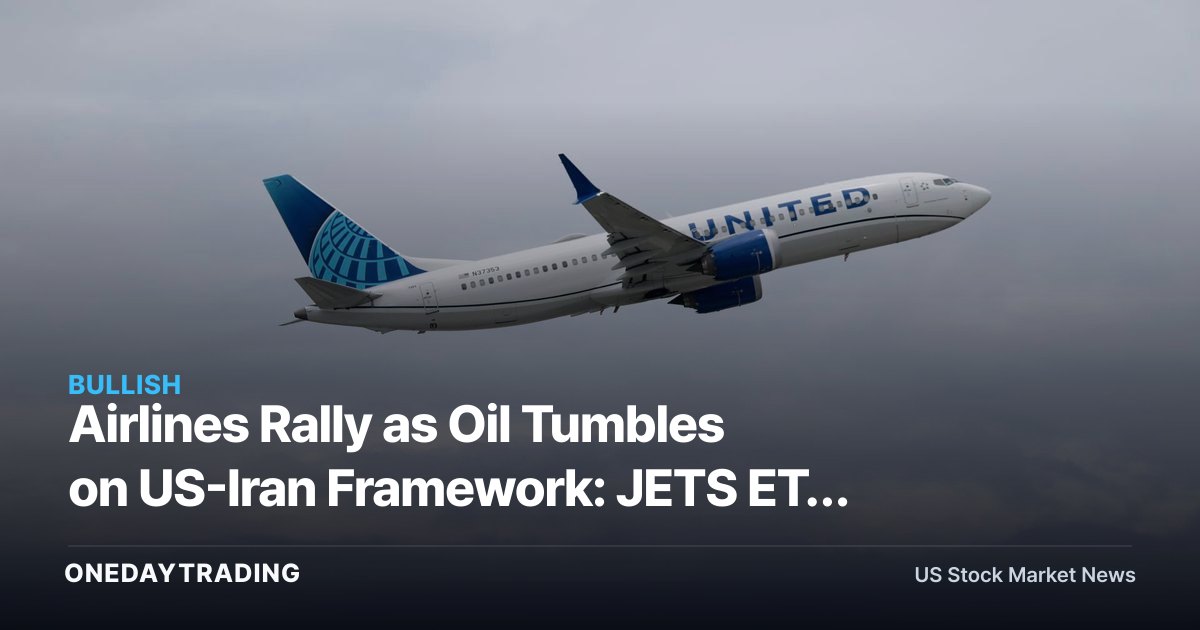
A reported framework for a US-Iran deal is pushing crude oil sharply lower, and the immediate equity beneficiary is the airline group. The U.S. Global Jets ETF (JETS) is approaching a fresh high for the year, signaling that traders are treating cheaper fuel as a direct margin tailwind rather than a passing headline.
Why It Matters Now
Fuel is typically the single largest variable cost for carriers, often running between 20 and 30 percent of operating expenses. When crude falls, jet fuel follows with a lag, and because airlines hedge only a portion of their consumption, a sustained move flows straight to the bottom line. That is the mechanical reason airlines outperform on down-oil days while the broad market shrugs.
The policy channel is what gives this move its weight. A US-Iran framework raises the prospect of more barrels reaching the market, easing the supply premium that has been embedded in prices on geopolitical risk. For carriers, the read-through is lower unit costs (CASM ex-fuel stays fixed while fuel CASM drops), which can lift quarterly earnings without any change in demand or fares. The mirror image is energy producers, whose revenue is priced directly off the barrel.
The catch is that the catalyst is a framework, not a signed deal. Headlines around Iran negotiations have a history of reversing, and a single comment can send crude back up and unwind the airline trade in hours. Lower oil is also a double-edged signal: if it reflects weakening global demand rather than added supply, the same softness eventually reaches travel bookings.
FAQ
- Why do airlines rise when oil falls? Jet fuel tracks crude, and fuel is one of the largest cost lines, so cheaper oil expands margins directly.
- What is JETS? The U.S. Global Jets ETF, a basket of airline and air-travel-related stocks now nearing its high for the year.
- Who loses when oil drops? Oil producers and oilfield-services names, whose revenue is tied to the price of crude.
- Is the move durable? Only if the supply story holds; a stalled deal or demand-driven decline would change the thesis.
Related Stocks & Sectors
- JETS (airline ETF): the cleanest proxy for the fuel-cost tailwind across the group.
- Delta, United, American (DAL, UAL, AAL): network carriers with heavy fuel bills gain most on falling crude.
- Southwest (LUV): high-volume domestic flier leveraged to lower per-gallon costs.
- ExxonMobil, Chevron (XOM, CVX): integrated producers pressured as crude prices fall.
What to Watch
- Whether the US-Iran framework converts into a concrete agreement or stalls.
- The crack spread and spot jet-fuel prices, which decide how much of the crude drop airlines actually capture.
- Upcoming airline guidance for unit-cost and capacity commentary tied to fuel.
- JETS holding above its prior yearly high versus fading on an oil rebound.
Overall Outlook
The bull case is straightforward: added supply lowers fuel costs at a time when summer travel demand is intact, handing carriers a margin lift they did not have to earn through fares. The risk is that the framework is fragile, that crude reverses on any negotiating setback, and that part of the oil decline reflects softer global activity that would eventually weigh on bookings. The trade is real but tethered to a headline that can move both ways.
📊 Analysis
Signal Bullish
Why Falling crude on a US-Iran framework cuts airlines' largest variable cost, expanding margins and lifting the JETS ETF toward a yearly high.
Tickers$JETS$DAL$UAL$LUV$XOM$CVX
This article was independently written by OneDayTrading from public reporting. Read the original (CNBC)