Summary
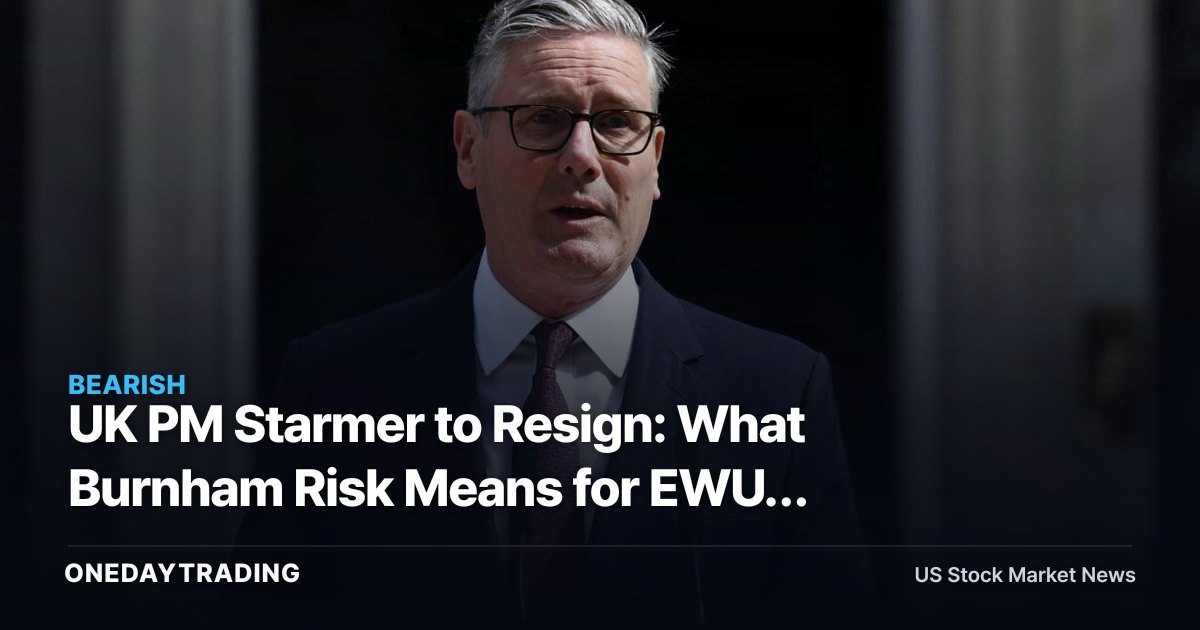
UK Prime Minister Keir Starmer says he is stepping down, and the leadership question now centers on whether Andy Burnham takes over the Labour Party. The market-relevant signal is narrow but specific: analysts expect UK borrowing costs to rise over the longer term under that scenario, which channels directly into gilt yields, sterling and the cost of capital for UK-exposed equities that US investors can access through ADRs and country ETFs.
The Full Story
A change at the top of government is not, by itself, a market event. What moves prices is the perceived policy direction of the successor. The read here is that a Burnham-led Labour Party would be associated with a higher long-term path for UK borrowing costs. For bond investors, that means a steeper or higher gilt curve as markets price in more issuance, looser fiscal posture, or a higher risk premium on sterling debt.
The transmission is mechanical. Higher gilt yields raise the discount rate on every UK cash flow, pressure rate-sensitive equities, and can weigh on the pound if the rise is read as fiscal risk rather than growth. A weaker pound cuts both ways for US holders: it erodes dollar returns on UK assets, but flatters the overseas earnings of London-listed multinationals that report in sterling.
Structural Background
UK assets carry a memory premium. Markets remain sensitive to any hint of unfunded fiscal loosening, and the gilt market has shown it will reprice quickly when fiscal credibility is questioned. That is why a leadership signal alone can nudge borrowing-cost expectations before any actual budget is written. For domestic banks, higher rates can lift net interest margins, but only if they arrive through orderly tightening rather than a disorderly risk-premium spike that also slows lending and raises loan losses.
Stock & Sector Ripple
- EWU (iShares MSCI United Kingdom ETF): the cleanest US-listed proxy for the whole story; combines UK equity beta with sterling exposure, so it absorbs both the rate move and any currency drag.
- FXB (sterling proxy): directly exposed if higher borrowing costs are interpreted as fiscal risk that pressures the pound rather than supporting it.
- BCS, LYG, NWG (Barclays, Lloyds, NatWest ADRs): domestically geared banks where higher yields can widen margins, but a fiscal-stress scenario raises credit and funding risk that can offset the margin benefit.
- HSBC: London-listed but globally diversified, so a weaker pound can lift the dollar value of non-UK earnings, partially insulating it from purely domestic stress.
Bull vs Bear Scenarios
Bear case: a leadership shift toward looser fiscal expectations lifts gilt yields, pressures the pound, and compresses UK equity multiples, with banks unable to fully bank the margin upside if growth slows. Bull case: the resignation removes uncertainty, any successor governs more cautiously than feared, and higher rates settle in an orderly way that actually supports bank profitability. The key variable is credibility, not the headline itself.
Investor Action Points
- Track the 10-year gilt yield as the real-time scoreboard for how markets price the leadership outcome.
- Watch GBP/USD for confirmation of whether higher yields reflect fiscal stress (pound down) or healthy tightening (pound steady to up).
- For UK bank ADRs, separate the margin tailwind from credit risk; favor names with diversified, non-UK revenue if domestic stress builds.
- Wait for an actual fiscal statement or budget date before treating leadership rhetoric as policy.
📊 Analysis
Signal Bearish
Why A leadership shift linked to higher long-term UK borrowing costs pressures gilts, sterling and UK-exposed equities, outweighing the conditional margin benefit to banks.
Tickers$EWU$FXB$BCS$LYG$NWG$HSBC
This article was independently written by OneDayTrading from public reporting. Read the original (MarketWatch)