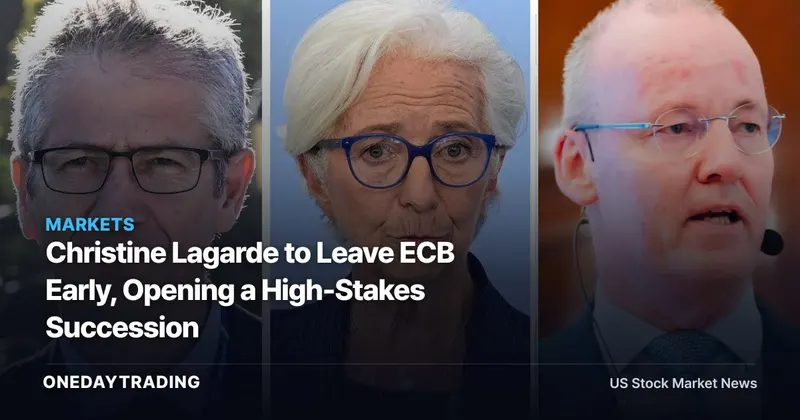
Christine Lagarde’s Early ECB Exit
Christine Lagarde will step down as president of the European Central Bank on Feb. 7 next year, nearly nine months before her term expires in October 2027. For investors, the immediate issue is not a confirmed policy shift but the transfer of authority at an institution whose decisions can shape the European macro backdrop.
CNBC Markets reported that the process to appoint her successor will begin immediately. The European Central Bank succession is the formal process through which the European Council chooses the institution’s next president after consultations with the European Parliament and euro area member states.
The announcement answers who is leaving and when, while leaving the market-critical question unresolved: who will succeed her. Pablo Hernández de Cos and Klaas Knot are widely regarded as the top contenders, although neither has been confirmed.
Why the Timing Changes the Investor Question
Lagarde has led the European Central Bank since July 2019. Moving her exit to February 2027 from the scheduled October 2027 expiration compresses the period available for governments and European institutions to settle the succession.
Christine Lagarde’s departure comes nearly nine months before October 2027, according to CNBC Markets. That interval matters because investors must now assess leadership selection alongside monetary-policy expectations instead of treating the presidency as a question for the end of her scheduled term.
Lagarde said she advanced her departure because she wanted greater freedom to express political opinions and engage on subjects outside monetary policy. “I want to have the freedom of speech, the freedom of expression and the freedom to engage on matters that are not monetary policy matters,” she said, according to CNBC Markets.
Her explanation establishes her stated reason for leaving early. It does not establish that she will enter the French presidential election, whose first-round vote is in April, or that she will take another public role. Whether she will run and whether she will become chair of the World Economic Forum remain unknown.
How the European Central Bank Chooses a President
The European Central Bank is institutionally independent, which separates its mandate from the political bodies involved in selecting its senior leadership. Appointments to its top positions are made by the European Council after consultations with the European Parliament and euro area member states.
The European Central Bank Governing Council combines the governors of 21 national central banks with the six members of the European Central Bank Executive Board. Those figures show why succession is broader than a contest between individual résumés: the chosen president must lead a structure that brings national institutions and an executive body into one decision-making framework.
Leadership turnover is not limited to the presidency. Philip Lane and Isabel Schnabel are among the senior European Central Bank figures relevant to the institution’s top-level transition. Investors therefore need to distinguish the confirmed presidential departure from the wider composition of the leadership team.
The process is political in the institutional sense because multiple European bodies participate, even though the central bank itself is independent. That distinction is essential: negotiation over an appointment does not, by itself, prove how the successful candidate would handle future policy decisions.
Pablo Hernández de Cos and Klaas Knot Enter Focus
Pablo Hernández de Cos led his national central bank from 2018 to 2024 and is now general manager of the Bank for International Settlements. His record places central-bank leadership and an international institutional role at the center of the case investors can evaluate.
Klaas Knot served as his country’s central-bank chief from 2011 until 2025 and is a distinguished visiting fellow at the Peterson Institute for International Economics. His candidacy likewise brings an extended monetary-policy background, but the fact sheet does not establish which contender has greater institutional support.
The names give markets a defined shortlist, not a settled outcome. Comparing their tenures can clarify experience; it cannot substitute for the European Council’s decision or the consultations required with the European Parliament and euro area member states.
That boundary should discipline any market narrative. Until the selection process produces a nominee or clearer institutional signals, claims of a predetermined policy direction would run ahead of the confirmed evidence.
The Rates and Market Read-Through
The investable transmission channel is conditional. A successor can matter to expectations about European monetary policy, and those expectations can influence how investors assess rates-sensitive assets and the broader macro environment. The announcement itself provides no policy decision, rate level, yield move, currency move or asset-price response.
The European Union’s inflation rate exceeded 11% in 2022, according to CNBC Markets. That figure supplies important context for the institution’s recent operating environment, but it does not reveal the next president’s preferred policy path or the European Central Bank’s future decisions.
For U.S. equity investors, this is therefore a macro-governance event rather than a company-specific earnings catalyst. The fact sheet identifies no U.S.-listed company with direct exposure, no change in corporate revenue or costs, and no measurable sector outcome, so attaching a stock ticker would create false precision.
A confirmed successor could sharpen the analysis because investors would then have a specific leadership choice to evaluate. Until that point, the clean separation is between what is already known—Lagarde’s exit date and the appointment framework—and what remains unpriced in any evidence-based sense: the identity and approach of the next president.
Constructive and Adverse Scenarios
Constructive scenario: The European Council completes the process with a candidate whose experience supports confidence in institutional continuity. Either Pablo Hernández de Cos or Klaas Knot would bring a documented central-bank tenure, although experience alone cannot guarantee a particular policy outcome.
Adverse scenario: The consultations expose disagreement over the appointment or leave the future policy approach unclear for longer. That would extend uncertainty around leadership without proving that the European Central Bank’s decisions will change.
A separate risk is analytical overreach. Marine Le Pen is an entity in the surrounding political discussion, but the outcome of the French presidential election is unknown. Felix Feather of Aberdeen Investments, Holger Schmieding of Berenberg, Pierre Roke of Validus Risk Management and Carsten Brzeski of ING are identifiable commentators; their affiliations do not resolve the succession.
What Investors Should Monitor Next
- The formal succession process: Track the European Council’s choice and the consultations with the European Parliament and euro area member states.
- The candidate field: Watch whether Pablo Hernández de Cos and Klaas Knot remain the principal contenders or whether the process produces a different nominee.
- Leadership composition: Separate the presidential appointment from changes involving Philip Lane, Isabel Schnabel and the six-member Executive Board.
- Confirmed policy evidence: Require an actual European Central Bank decision or explicit guidance before translating the leadership contest into a directional rates or equity thesis.
Lagarde received a standing ovation from the European Central Bank Governing Council on Thursday and said serving the institution had been a source of pride. Antonio Costa credited her with “steady and determined stewardship, helping to safeguard stability and the resilience of the euro area,” according to CNBC Markets.
The next decisive trigger is not speculation about Lagarde’s destination. It is the point at which Europe’s appointment process converts an open contest into a named successor whose stated approach can be assessed against the European Central Bank’s mandate.
📊 Analysis
Signal Neutral
Why The early departure increases leadership uncertainty, but the succession process has not yet established a change in European Central Bank policy.
This article was independently written by OneDayTrading from public reporting. Read the original (CNBC Markets)