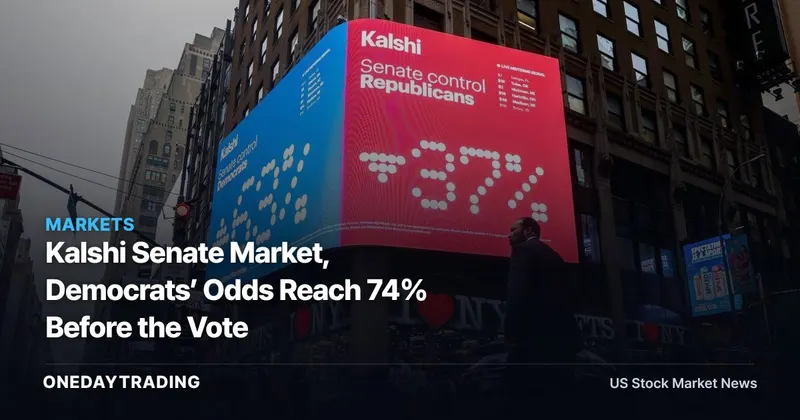
Kalshi’s 74% probability for Democrats to win control of the U.S. Senate is a sharp repricing before the midterm vote, but it is not yet an investable equity signal. CNBC reported the Monday reading just before Tuesday’s vote, making the change relevant to investors tracking U.S. political risk while providing no evidence of a directional effect on any listed company, stock index or industry.
Kalshi’s Senate Market Reversed a Republican Lead
CNBC reported that Kalshi traders assigned Democrats a 74% chance of winning Senate control on Monday, the party’s highest probability on the platform since the contract opened. A prediction market is a venue where participants trade contracts tied to an event’s outcome; its price reflects traders’ collective positioning rather than the methodology of a traditional political poll.
The contract asks, “Who will control the Senate?” and is scheduled to be verified by the Library of Congress after Tuesday’s vote. That settlement process matters because the traded proposition is control of the chamber, not a forecast for a particular company, sector or financial asset.
The move also represents a substantial change in the contract’s internal history. Republicans had dominated Kalshi’s market for Senate control since it opened in 2024. Their probability reached 60% in July after the gap had narrowed following the Feb. 28 launch of strikes on Iran by the U.S. and Israel.
Those observations establish the sequence recorded in the market, not why each trader changed position. The supplied evidence does not disclose individual trading methods, so the repricing cannot be assigned to a single cause or treated as proof that one political outcome will occur.
Democrats’ State-Race Odds Moved Across Kalshi and Polymarket
The national contract was not the only market moving toward Democrats. On Kalshi, traders put the party’s chance of winning the Texas Senate race at 74%, up from 68.4% over the past 24 hours. The common direction between that state contract and the chamber-control contract shows that the shift extended beyond one headline probability, while the evidence does not quantify how much Texas contributed to the national reading.
Polymarket’s probability favoring Democrats in Iowa rose to 50% from 42%. Because that comparison comes from a different platform, it offers a separate indication of changing trader expectations, though it should not be treated as methodologically identical to Kalshi’s contracts.
In Kansas, the probability of Adam Hamilton defeating Roger Marshall increased to 63% from 52%. The move stands out because Kansas has not elected a Democratic U.S. senator since 1932, but a prediction-market price cannot establish that the historical pattern has already broken.
Together, Texas, Iowa and Kansas show state-level movement in the same political direction. They do not provide the full composition of the Senate outcome, and the actual result remains unknown until the vote determines control.
The New York Times and Siena University Add Polling Context
The New York Times reported Sunday that its poll with Siena University found Democrats leading in several battleground states. That finding supplies context for the movement in prediction markets, but the available facts do not include the poll’s full results or methodology. It therefore cannot support a direct numerical comparison with the traded probabilities.
The distinction is essential. Political polls seek to measure voter preferences through a defined sampling process, while prediction markets record prices created by participants trading outcome contracts. The two can move in the same direction without becoming substitutes for one another.
For investors, the market price is best read as a measure of how participating traders were positioned at that moment. It does not demonstrate an election outcome, explain the assumptions behind each trade or translate automatically into earnings, valuation multiples, revenue exposure or sector leadership.
Attribution also deserves scrutiny. CNBC disclosed that it has a commercial relationship with Kalshi involving customer acquisition and a minority investment. That relationship does not alter the reported contract levels, but it is relevant context when evaluating the presentation and sourcing of the story.
What Investors Can Verify After Tuesday’s Vote
The immediate checkpoint is the election result and the Library of Congress verification of the Senate-control contract. Comparing that verified outcome with the pre-vote 74% reading will show whether the favored contract settled as traders expected; it will not, by itself, validate prediction markets as political polls.
The state contests provide additional checks. Investors can compare the outcomes in Texas and Iowa with the final market probabilities and determine whether Adam Hamilton or Roger Marshall wins in Kansas. Each result tests a specific contract expectation without proving that the same forecasting quality applies elsewhere.
The bullish interpretation is limited to Democratic prospects inside these markets: the chamber-control probability reached its highest level for the party since the contract opened, while the cited state contracts also shifted toward Democrats. The countercase is equally concrete: probabilities are not certified results, trader methodology is unknown, and the available polling detail is incomplete.
The disciplined market conclusion is neutral for equities. No U.S.-listed company, affected revenue stream, policy transmission channel or sector exposure appears in the supplied evidence, so attaching stock winners or losers would manufacture precision. The next observable fact is Senate control after Tuesday’s vote; only evidence establishing a resulting policy or company-level mechanism could support a directional equity conclusion.
📊 Analysis
Signal Neutral
Why The prediction-market shift is politically significant, but the supplied evidence establishes no directional impact on U.S.-listed stocks or sectors.
This article was independently written by OneDayTrading from public reporting. Read the original (CNBC)