At a Glance
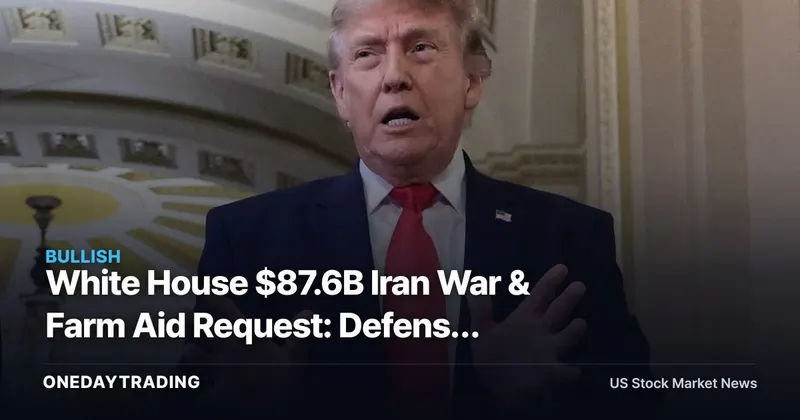
The White House has asked Congress for $87.6 billion in supplemental spending split between funding the Iran war effort and aid for U.S. farmers. Emergency war funding tends to flow first to munitions, missile defense and logistics, while farm aid cushions an agricultural sector squeezed by weak crop prices and trade friction.
Why It Matters Now
Supplemental requests outside the normal budget cycle are the clearest near-term signal of where federal dollars are heading. For defense primes, an Iran-focused package skews toward consumables — interceptors, precision munitions and air-defense systems that are fired and must be replenished — rather than slow-moving platform programs. That favors companies with large missile and guided-weapons franchises, because reorders convert directly into backlog and revenue within a few quarters rather than a decade.
The farm-aid portion matters because it acts as a direct income transfer into a stressed sector. Lower grain prices and softer export demand have pressured farmer cash flows, which in turn weighs on equipment purchases and input demand. Federal payments stabilize farm balance sheets, indirectly supporting machinery, seed, fertilizer and grain-processing players whose end-demand depends on farmer solvency. The Iran dimension also keeps a geopolitical risk premium under crude oil, a tailwind for U.S. producers and a cost headwind for fuel-intensive industries.
FAQ
- How big is the request? $87.6 billion in supplemental funds covering both the Iran war and farm aid.
- Is the money guaranteed? No — it is a request that Congress must approve, so the final amount, timing and allocation can change.
- Which area benefits most directly? War funding typically prioritizes munitions and air defense, while farm aid supports agricultural incomes.
- What is the oil angle? An active Iran conflict tends to keep a geopolitical premium in crude, supporting energy producers.
Related Stocks & Sectors
- Lockheed Martin (LMT) — missile-defense and precision-weapons exposure positions it for munitions replenishment orders.
- RTX (RTX) — interceptors and air-defense systems are core consumables in a Middle East conflict.
- Northrop Grumman (NOC) / General Dynamics (GD) — munitions, systems and logistics demand rise with sustained operations.
- Deere (DE) and Archer-Daniels-Midland (ADM) — farm-aid dollars stabilize farmer cash flow, the end-demand for equipment and grain processing.
- Energy producers (XOM, CVX) — a persistent Iran risk premium supports crude prices.
What to Watch
- Congressional action on the $87.6 billion request — the approved figure and how it splits between war and farm aid.
- Defense primes next earnings: book-to-bill and munitions backlog commentary.
- Crude oil and the geopolitical risk premium as a read on the energy and cost channel.
- Farm-income and equipment-order trends as a check on agriculture-linked demand.
Overall Outlook
The setup is constructive for defense munitions and supportive for agriculture and energy names tied to the package. The key counterweight is execution risk: this is a request, not law, so the dollar amount and timing are uncertain, and defense valuations already embed elevated geopolitical spending. A faster-than-expected de-escalation or a scaled-back appropriation would remove much of the catalyst.
Market data check: LMT
LMT last traded near $493.61 (-2.00%). Our composite signal — blending price momentum and news flow — reads 🟡 neutral. Price momentum scores 34/100 (soft).
Data as of publication. Price via market feeds; for reference only, not investment advice.
📊 Analysis
Signal Bullish
Why An $87.6B supplemental directs fresh federal spending toward defense munitions, farm aid and energy-exposed names, a positive demand catalyst for those sectors.
Tickers$LMT$RTX$NOC$GD$DE$XOM
This article was independently written by OneDayTrading from public reporting. Read the original (CNBC)