At a Glance
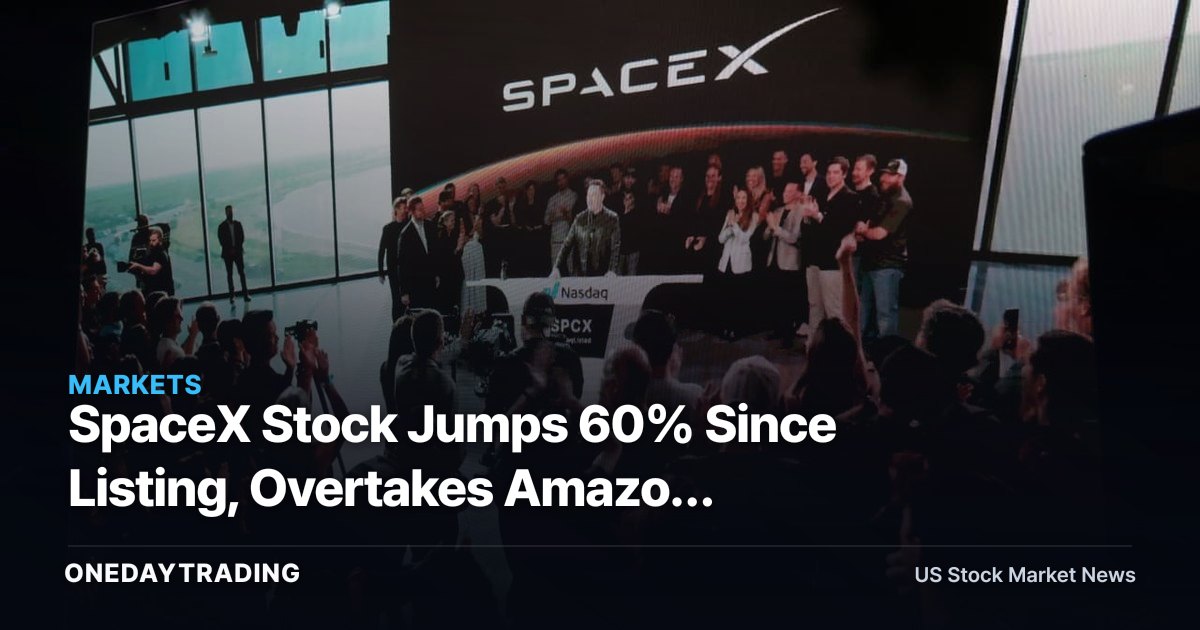
SpaceX shares have surged 60% since listing, an overnight spike large enough to vault the company past Amazon and into the position of America's fifth-largest company by market value. The catalyst was not a shift in earnings power but market plumbing: a very small free float, heavy retail speculation, supportive global newsflow, and mechanical buying from passive index funds.
Why It Matters Now
The mechanics here matter more than the milestone. When only a thin slice of shares trades freely, even modest order flow moves the price violently, because there is little supply to absorb demand. Layer on forced passive buying — index and benchmark-tracking funds that must purchase a newly eligible large-cap regardless of valuation — and you get demand that is price-insensitive by design. Retail momentum then compounds the move. None of these forces reflect a re-rating of SpaceX's underlying cash flows.
For Amazon, being nudged from fifth place is a headline event, not a business one. AMZN's e-commerce, advertising, and AWS cloud franchises are unchanged by a peer's float-driven spike, and the ranking can reverse as quickly as it appeared. The more durable read for investors is what this episode says about concentration and passive flows: when index rules and limited float interact, valuations can detach from fundamentals at the very top of the market, which is where most retirement portfolios are most exposed.
FAQ
- Why did SpaceX rise 60% so fast? A tiny free float plus forced passive buying and retail speculation, not an earnings surprise — small demand against small supply produces outsized price moves.
- Does this hurt Amazon's business? No. The displacement is a market-cap ranking change; AMZN's cloud, ads, and retail operations are unaffected.
- Is the move sustainable? Float-and-flow-driven spikes are fragile; as lockups expire and more shares trade, price-insensitive demand fades and valuation faces fundamental gravity.
- What should investors actually track? Free-float size, lockup-expiry dates, and index-weighting decisions, which govern how much real supply meets passive demand.
Related Stocks & Sectors
- Amazon (AMZN) — directly displaced from the top five; fundamentals intact, so the ranking is symbolic rather than operational.
- Apple (AAPL), Microsoft (MSFT), Nvidia (NVDA), Alphabet (GOOGL) — the other megacaps whose relative index weights shift as a new large-cap enters the top tier.
- Passive index funds and ETFs — mechanical buyers forced to add the name on inclusion, illustrating how rules-based flows can amplify thin-float moves.
- Aerospace and space sector — a high-profile listing raises the comparable valuation bar for satellite, launch, and defense-adjacent peers.
What to Watch
- Lockup-expiry dates and any secondary offerings that would expand the free float and add real supply.
- Index-provider weighting and eligibility decisions that determine how much passive money must buy.
- Whether the 60% gain holds once daily trading volume normalizes versus the listing-week spike.
- Amazon's next quarterly results — the test of whether the ranking gap reflects anything fundamental.
Overall Outlook
The bull case is straightforward: scarcity value, strong sentiment, and structural passive demand can keep a thin-float stock elevated longer than skeptics expect, and SpaceX commands genuine strategic mindshare. The risk is equally clear — a 60% move built on limited float and forced buying is mechanically unstable, and as supply broadens the price must answer to fundamentals rather than flows. For diversified investors, the practical lesson is less about one ticker and more about how index concentration and float dynamics can distort the largest names in their portfolios.
Market data check: AMZN
AMZN last traded near $248.2 (+0.89%). Our composite signal — blending price momentum and news flow — reads 🟡 neutral. Price momentum scores 57/100.
Data as of publication. Price via market feeds; for reference only, not investment advice.
📊 Analysis
Signal Neutral
Why The spike is driven by technical factors — thin free float and forced passive buying — rather than fundamentals, so there is no clear directional impact on Amazon's underlying business.
Tickers$AMZN$AAPL$MSFT$NVDA$GOOGL
This article was independently written by OneDayTrading from public reporting. Read the original (MarketWatch)