Kevin Hassett’s Data Center Thesis Meets a Political Constraint
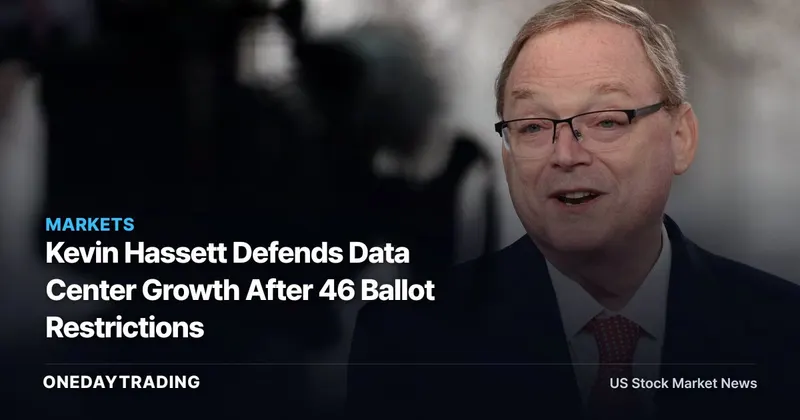
Kevin Hassett expects data center growth to continue as projected despite 2026 ballot results favoring restrictions on development. For investors exposed to AI infrastructure, the central tension is clear: political support for continued expansion remains intact, while local voter resistance has become too broad to dismiss as an isolated siting dispute.
The investable question is not whether the policy debate favors artificial intelligence in the abstract. It is whether planned facilities can proceed under local rules and whether future development can find locations willing to accept it. The available evidence confirms strong opposition and continued federal support, but it does not establish the amount, rate or geographic distribution of future growth.
Ballotpedia’s 46-Initiative Result Changes the Risk Map
According to CNBC, Ballotpedia’s tally showed that majorities voted to restrict facility development in at least 46 of the roughly 50 data-center initiatives placed on ballots in 2026. That result makes development restrictions a recurring policy consideration for the sector rather than a narrow objection tied to a single proposal.
A data center is infrastructure used to house the computing systems that support digital and artificial-intelligence workloads. Its investment relevance therefore depends not only on demand for computing, but also on whether development can advance in the jurisdictions where facilities are proposed.
Hassett’s position separates projected national growth from the ballot outcomes. He said he still expected expansion to continue as projected, even after voters favored restrictions. His statement supports continuity in the broad build-out thesis; it does not identify which projects, jurisdictions or development rules would permit that continuity.
That distinction matters. A national projection can remain directionally intact even if the feasible locations for development change. Such a shift could alter execution conditions across the sector without proving that aggregate growth will accelerate, slow or remain unchanged.
CNBC Voter Poll Shows Data Centers Became a Midterm Issue
The CNBC Voter Poll found that 56% of midterm voters classified data centers as a crucial or major issue. Among voters who considered the issue crucial, 62% favored the generic Democratic candidate, according to CNBC.
Those findings give the ballot results broader political context. Voters were not merely responding to technical language in individual initiatives; a majority of respondents placed data centers high in their assessment of the midterm. The poll does not show which aspect of development drove those views, so any explanation of voter motivation would go beyond the evidence.
For the AI infrastructure sector, the polling raises the importance of political durability. Projected demand alone cannot settle a development decision when voters treat the underlying facilities as a major electoral issue. The key transmission mechanism is permission to build: restrictions can affect the set of locations available for projects, while supportive jurisdictions may preserve another route for expansion.
This creates a more fragmented outlook than a single national policy signal implies. Investors should distinguish between support for AI development and the local rules governing physical facilities. The facts establish that both forces are present; they do not establish which will dominate future construction.
Donald Trump Keeps Federal Support Explicit
Donald Trump wrote on Truth Social, “As President, I am 100% in favor of Super Intelligence (SI).” That declaration confirms his continued backing for the technology after the midterm results and places the federal political message on the side of further AI development.
Kevin Hassett also acknowledged local decision-making, saying, “We respect the localities that decide that's what they want to do,” according to CNBC. Read together, the statements frame the policy tension without resolving it: national support can remain emphatic while localities pursue restrictions.
For investors, rhetoric is relevant because it shows policy preference, not because it proves project execution. Trump’s 100% expression of support does not specify a development volume, a host state or a change to any local regulation. Hassett’s projection likewise supplies no rate against which future progress can be measured.
AI Infrastructure Impact Without Unsupported Stock Calls
- AI infrastructure: Continued support from Donald Trump and Hassett’s expectation of projected growth preserve the sector’s expansion narrative. The 2026 ballot record adds a material siting and regulatory counterweight.
- Data center development: At least 46 restrictive outcomes among roughly 50 initiatives suggest that location selection may become central to execution. The evidence does not identify the initiatives or the states involved, preventing a more specific geographic assessment.
- Public-market exposure: The fact sheet names no listed company and provides no share-price, revenue, order, capacity or valuation data. Assigning a directional effect to an individual stock would therefore exceed the available evidence.
The appropriate sector stance is neutral rather than mechanically bullish or bearish. Federal support and Hassett’s confidence favor continuity, while the breadth of voter opposition increases uncertainty around the path. Neither side of that equation supplies enough evidence for a quantified market outcome.
Investor Checkpoints After the 2026 Ballot Results
- Project geography: Check which states or localities are selected for projected data center growth. No host states are identified in the available facts.
- Initiative scope: Examine which specific measures were included in Ballotpedia’s tally and what each restriction covers. The aggregate count cannot reveal whether the measures impose comparable constraints.
- Growth measurement: Look for a disclosed amount or rate of projected expansion that can be compared with later development. Hassett’s statement confirms his expectation, not a numerical forecast.
- Regulatory follow-through: Track whether jurisdictions that approved restrictions retain or change them. The evidence does not show that any reversal will occur.
What Could Confirm or Break Hassett’s Outlook
The constructive case rests on a simple proposition: data center growth can continue if projects proceed in locations that permit development. Hassett’s confidence and Trump’s explicit support reinforce that possibility, leaving open a path for expansion despite restrictive ballot outcomes.
The risk case begins with the same evidence. Majorities favored restrictions in at least 46 of roughly 50 initiatives, and the CNBC Voter Poll showed the issue carried substantial midterm importance. If that political resistance shapes the locations available for development, the national growth thesis may face execution constraints even while federal enthusiasm remains unchanged.
The next decisive evidence will not be another broad endorsement. It will be a clearer map of permitted locations, the actual scope of the ballot restrictions and a measurable projection for data center growth. Until those details emerge, investors can treat continued expansion as Hassett’s stated expectation—not as a verified development outcome.
📊 Analysis
Signal Neutral
Why Federal support for AI infrastructure remains firm, but widespread ballot opposition creates unresolved uncertainty over where and how projected data center growth can proceed.
This article was independently written by OneDayTrading from public reporting. Read the original (CNBC)