Anthropic IPO Odds Meet a Weaker AI Tape
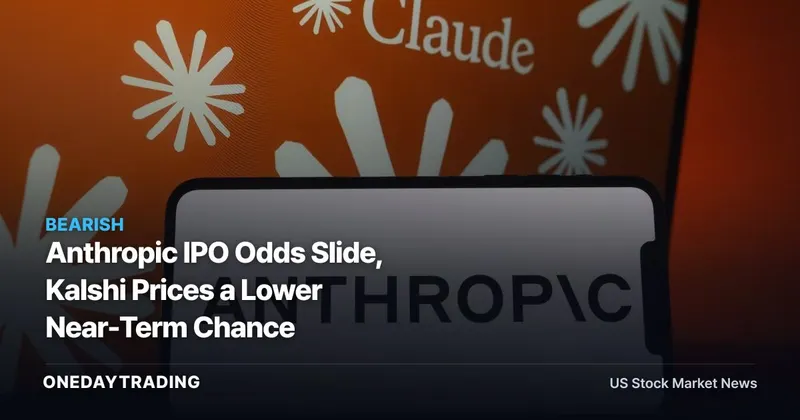
Anthropic’s near-term IPO announcement odds fell sharply on Kalshi as the Nasdaq Composite and AI-related shares recorded losses followed by a partial Friday rebound. For investors in Nvidia, Micron Technology and CoreWeave, the central signal is not that an Anthropic offering has been canceled; it is that traders assigned a lower probability to an official announcement within the contract’s near-term windows while public-market appetite for AI exposure weakened.
- CNBC reported that Kalshi’s odds of an Anthropic IPO announcement before December fell to 57% from over 85% in the last week.
- Kalshi’s probability of an Anthropic public-offering announcement before January declined to 68% from 90% over the same period.
- The Nasdaq Composite closed Thursday more than 10% below its most recent high, while Nvidia, Micron Technology and CoreWeave later participated in Friday’s attempted rebound.
The Kalshi contract is a prediction market on when Anthropic will officially announce an IPO, with the result verified by news outlets. That distinction matters: the contract prices the timing of an announcement, not the success, valuation or subsequent trading performance of an offering.
What Kalshi’s Anthropic Repricing Does—and Does Not—Say
The move from over 85% to 57% before December is a substantial change in expectations, while the January window retained a higher 68% probability after falling from 90%. The gap between those windows shows that the contract still assigned meaningful probability to an announcement, only with less confidence in the earlier timing.
Anthropic confidentially filed its IPO prospectus with the Securities and Exchange Commission in June, according to CNBC. A confidential filing and an official announcement are separate events, so the filing establishes that a regulatory step occurred without resolving whether or when the company will publicly announce an IPO.
The public-market backdrop adds context rather than proof of causation. On Thursday, the S&P 500 lost 4.4%, and the Dow Jones Industrial Average dropped more than 1,800 points, or 3.4%. The Nasdaq Composite also finished more than 10% below its most recent high, a threshold Wall Street views as a correction.
Texas policy formed another part of the uncertainty surrounding data-center expansion. Gina Hinojosa, the Democratic governor-elect who ousted three-term Republican Greg Abbott, told CNN on Thursday: “We will have laws to protect Texans and we need to stop what we are doing with data centers until we have those protections.” The statement identifies a possible policy constraint, though the available evidence does not specify enacted rules, their scope or their effect on Anthropic.
Nvidia, Micron Technology and CoreWeave Test the Rebound
Friday’s trading showed that the AI sell-off was not moving in only one direction. The Nasdaq gained 1.3% and the S&P 500 rose 0.7%, while the Dow shed 0.2%. Those mixed index moves frame the session as an attempted rebound rather than confirmation that the prior losses had been reversed.
Micron Technology and Nvidia each gained about 4% on Friday after falling 17% and 9%, respectively, the day before. The rebound therefore recovered only part of each preceding decline. For investors, the useful comparison is not simply whether the shares rose Friday, but whether the recovery persisted after losses of very different magnitudes.
CoreWeave rose more than 2% Friday morning after tumbling about 10% on Wednesday. Its move provides another read on AI-related risk appetite, although the evidence does not establish that Anthropic’s prospective IPO timing drove CoreWeave’s trading.
- Nvidia: Friday’s about 4% gain was a positive counter-move after the prior day’s 9% fall, leaving the durability of the rebound as the key observable condition.
- Micron Technology: An about 4% Friday gain followed a 17% decline the day before, making the imbalance between the loss and rebound the most important feature of the tape.
- CoreWeave: A rise of more than 2% Friday morning followed an about 10% Wednesday drop, indicating a partial recovery rather than a documented reversal.
The Next Evidence for Anthropic and AI Investors
The first checkpoint is an official Anthropic IPO announcement verified by news outlets, because that is the event defined by the Kalshi contract. Until that occurs, the 57% pre-December probability and 68% pre-January probability remain market-implied chances, not company guidance or confirmed outcomes.
The second checkpoint is whether Friday’s gains in Nvidia, Micron Technology and CoreWeave were sustained. Continued strength would provide a firmer counterweight to the earlier losses; renewed weakness would reinforce the message that public-market demand for AI-related risk remains fragile. The supplied evidence does not establish either outcome.
Policy details from Texas are the third checkpoint. Gina Hinojosa’s statement signals an intention to seek protections around data centers, though investors need the actual laws and their terms before estimating any operational effect. Treating a campaign position as an enacted restriction would run ahead of the facts.
The cleanest reading is bearish but conditional. Anthropic’s announcement odds moved lower, the Nasdaq Composite entered correction territory by Wall Street’s convention, and several AI-related shares suffered steep losses before rebounding. A verified IPO announcement, sustained strength in those shares or clearer Texas policy could change that assessment; none is confirmed in the available evidence.
CNBC disclosed that it and Kalshi have a commercial relationship involving customer acquisition and a minority investment. That relationship does not alter the stated contract figures, but it is relevant context when evaluating the reporting source.
📊 Analysis
Signal Bearish
Why Lower Kalshi announcement odds and steep losses in AI-related shares indicate weaker near-term risk appetite, although Friday’s partial rebound offers a counter-signal.
This article was independently written by OneDayTrading from public reporting. Read the original (CNBC)