At a Glance
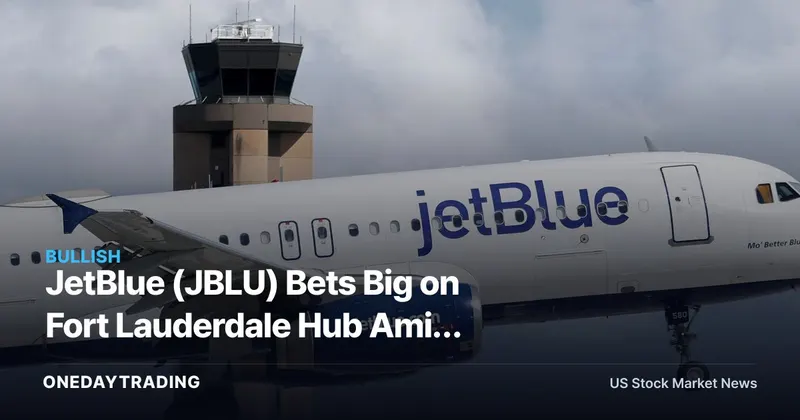
JetBlue is making Fort Lauderdale-Hollywood International Airport a centerpiece of its growth strategy, adding a new airport lounge and positioning the hub as an international gateway. The move puts the carrier in direct competition with nearby Miami International Airport, a longtime American Airlines stronghold.
Why It Matters Now
For JetBlue, Fort Lauderdale represents both a defensive and offensive play. The airline already operates a large presence at the South Florida airport, and deepening that footprint with premium amenities and international routes signals an attempt to capture higher-margin leisure and connecting traffic rather than competing purely on price.
The strategic tension here is geography. Fort Lauderdale and Miami sit roughly 25 miles apart, meaning JetBlue is effectively trying to pull demand away from American Airlines' dominant Miami operation. American has spent years building Miami into a premier gateway to Latin America and the Caribbean, so JetBlue's international ambitions out of Fort Lauderdale set up a head-to-head battle for the same lucrative south-of-the-border travel market.
The timing matters because JetBlue has been under pressure to demonstrate a credible standalone growth path, particularly after regulatory headwinds disrupted its broader expansion plans. Concentrating investment in a focus city it can dominate is a more disciplined approach than spreading capacity thin across contested markets.
FAQ
- What is JetBlue actually building in Fort Lauderdale? A new airport lounge plus an expanded international gateway, upgrading the hub beyond a domestic leisure base.
- Who is the main competitor? American Airlines, which dominates nearby Miami International Airport and its Latin America and Caribbean network.
- Why Fort Lauderdale over Miami? JetBlue can build a leadership position in a lower-cost airport rather than fighting American on its home turf.
- Is this a profitable strategy? Premium amenities and international routes target higher-yield travelers, but execution and capacity discipline are key risks.
Related Stocks & Sectors
- JBLU (JetBlue): Core stock; direct beneficiary if the Fort Lauderdale hub strategy lifts yields and load factors.
- AAL (American Airlines): Faces new competitive pressure on its Miami international franchise.
- DAL (Delta), UAL (United): Broader airline read-through on hub investment and premium-traffic strategy.
- SAVE (Spirit), ULCC (Frontier): Ultra-low-cost carriers active in South Florida that could feel competitive ripple effects.
- Airlines sector: Reflects the industry pivot toward premium revenue and disciplined network focus.
What to Watch
- Announced international destinations and route launch dates from Fort Lauderdale.
- JetBlue's quarterly unit revenue (RASM) and load factors in South Florida.
- American Airlines' competitive response in Miami pricing and capacity.
- Capital spending on lounge and terminal upgrades versus cost-cutting targets.
Overall Outlook
The bull case is that JetBlue carves out a defensible, higher-yield position in a fast-growing South Florida market while avoiding a costly direct war with American in Miami. The risks are real: international expansion is capital-intensive, fuel and labor costs remain volatile, and American is a deep-pocketed incumbent unlikely to cede its Latin America gateway. The strategy is sensible but its payoff hinges on disciplined execution and demand holding up.
📊 Analysis
Signal Bullish
Why A focused premium hub and international expansion is a credible growth catalyst for JBLU, even as competition and execution pose risks.
Tickers$JBLU$AAL$DAL$UAL$SAVE
This article was independently written by OneDayTrading from public reporting. Read the original (CNBC)