What Changes
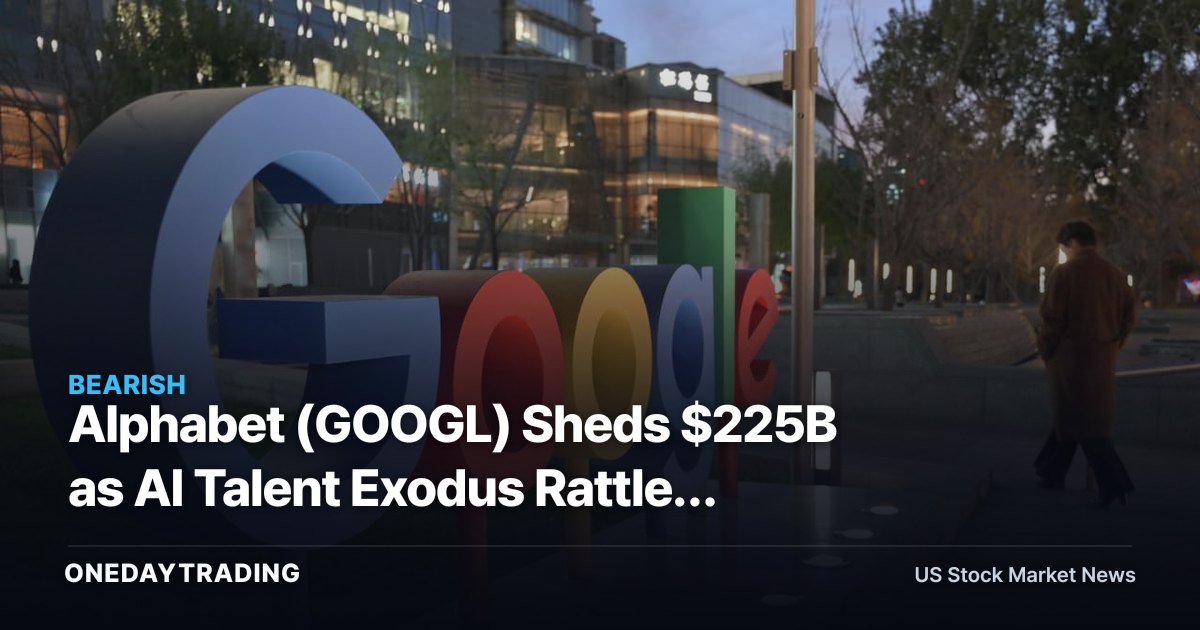
For investors, the message in this drawdown is that the market is now pricing AI leadership partly as a human-capital story, not just a compute or data story. Google DeepMind has long been treated as a structural edge embedded in Alphabet's valuation. When marquee names, including a Nobel-level researcher, are reported to be leaving for competing labs, the premium attached to that edge gets re-examined in real time.
The deeper concern is a compounding loss. Senior researchers do not leave alone; they tend to anchor teams, attract follow-on hires, and carry institutional knowledge that is expensive to rebuild. In a field where a handful of people can shape a model generation, the departure of even two leaders raises the cost and slows the cadence of frontier work that underpins Gemini and Google's broader AI roadmap.
This also reshuffles the competitive map. Talent flowing toward rival labs strengthens the very firms racing Google in search-adjacent assistants, cloud AI services, and enterprise model deployment, which is exactly where Alphabet's advertising and cloud revenue are most exposed.
By the Numbers
A 225 billion dollar single-stretch wipeout is the headline figure, and its size matters: it implies the market reassigned a meaningful slice of Alphabet's AI premium on a personnel signal rather than a guidance cut. The catalyst was narrow and specific, the reported exit of two AI leaders including a Nobel laureate, which makes the reaction a sentiment and confidence event rather than a fundamentals revision so far.
Winners and Losers
- Alphabet (GOOGL) — pressured: The talent narrative directly threatens the research moat baked into its multiple, with ad and cloud businesses most sensitive to any AI capability gap.
- Microsoft (MSFT) — relative beneficiary: Any perception that rival labs are gaining elite talent supports the OpenAI-aligned ecosystem Microsoft monetizes through Azure and Copilot.
- Meta (META) — relative beneficiary: Meta has aggressively recruited frontier researchers, so a loosening of Google's grip on top talent plays into its build-out narrative.
- Nvidia (NVDA) — neutral to positive: Intensified lab competition tends to expand frontier compute spending regardless of which firm wins the talent, supporting accelerator demand.
- Amazon (AMZN) — peripheral: As a cloud rival, any erosion of Google Cloud's AI differentiation marginally helps AWS positioning.
Risk Check
- Sentiment can reverse fast: a 225 billion dollar move on a personnel signal can partially retrace if Google announces retention packages or replacement hires.
- No fundamentals changed here yet; ad revenue, Cloud growth and Gemini adoption metrics have not been revised by this event.
- Two departures, however senior, are a small sample against thousands of researchers, so extrapolating to a structural decline is speculative.
- Rival labs gaining names does not guarantee they convert talent into shipped, monetizable products on Alphabet's timeline.
Bottom Line
The 225 billion dollar reaction shows how much of Alphabet's valuation rests on the assumption that it keeps the best minds in AI, and that assumption is now contested rather than broken. The upside case is a confidence dip that reverses on retention moves and continued Gemini progress; the risk case is the start of a slow talent drain that competitors compound. The metric that settles it is not this week's price but the next few quarters of Cloud growth, Gemini product cadence, and whether more senior names follow these two out the door.
Market data check: GOOGL
GOOGL last traded near $347.14 (-5.68%). Our composite signal — blending price momentum and news flow — reads 🟡 neutral. Price momentum scores 5/100 (soft).
Data as of publication. Price via market feeds; for reference only, not investment advice.
📊 Analysis
Signal Bearish
Why A 225 billion dollar market-cap loss driven by elite AI researchers, including a Nobel laureate, leaving Google signals erosion of the research moat priced into Alphabet's valuation.
Tickers$GOOGL$MSFT$META$NVDA$AMZN
This article was independently written by OneDayTrading from public reporting. Read the original (MarketWatch)