Federal Reserve October Pause at a Glance
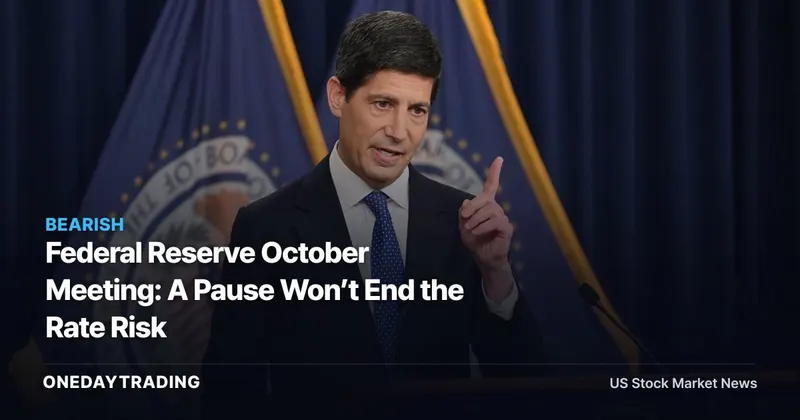
The Federal Reserve is expected to keep interest rates unchanged at its upcoming October meeting, leaving investors focused on rate-sensitive financial and consumer shares rather than on an immediate policy shock. In reporting dated 2026-10-26, CNBC said September annual inflation reached 3.7% in the U.S. economy, keeping the inflation constraint firmly in place.
The market has largely priced the near-term outcome, not the path beyond it. CME Group data put the probability of a quarter-point increase at the October meeting at less than 10%, while nearly 75% expected at least one Federal Reserve increase by year-end. That gap is the central investment tension: a pause is widely anticipated, but a durable end to tightening is not.
What the October Rate Setup Really Says
The federal funds rate is the benchmark rate governing overnight loans between banks, and it influences a broad range of consumer borrowing and savings rates. CNBC reported that the Federal Reserve raised rates by 25 basis points last month, taking its target range to 3.75% to 4%. An unchanged October decision would therefore preserve the higher financing baseline established by that move.
This distinction matters for market positioning. A widely expected hold carries less informational value than the Federal Reserve’s explanation of how inflation affects the next decision. Investors already have a low implied probability of an October increase; what remains exposed is the market’s much stronger expectation of another increase by year-end.
The consumer price index rose again in September, producing a 3.7% annual inflation rate. Kevin Warsh has expressed a commitment to returning inflation to the Federal Reserve’s 2% target. The distance between the reported inflation rate and that target helps explain why an October pause cannot automatically be interpreted as an end to rate risk.
Inflation Credibility Meets Election Timing
The meeting will occur days before the midterm elections, placing the decision close to a major political event. Heather Long of Navy Federal Credit Union said inflation remains the leading problem in the U.S. economy and argued that borrowing costs would stay very high for consumers. She also said the Federal Reserve would not raise rates in October.
That view supports the expected pause without resolving the policy trade-off. Holding rates steady avoids another immediate increase in short-term borrowing costs. Persistently elevated inflation can still leave investors questioning whether current policy is restrictive enough to reach the Federal Reserve’s stated target.
Aditya Bhave of Bank of America identified that risk directly in an Oct. 23 research note, warning that a hold could lead markets to question the Federal Reserve’s inflation-fighting credibility. The year of that note is not specified in the available evidence. The analytical implication is conditional: a pause can be consistent with continued inflation discipline, but the Federal Reserve must communicate why waiting does not represent retreat.
Mark Shore of CME Group is among the named economists connected with the meeting’s election context. The supplied evidence does not establish the October outcome, and proximity to the midterm elections does not by itself determine policy. The confirmed point is narrower: the calendar raises the scrutiny surrounding a decision that markets already expect to be unchanged.
The Consumer Rate Channels Already Under Pressure
Short-term borrowing rates remain closely linked to Federal Reserve policy. The prime rate is typically 3 percentage points above the federal funds rate, creating a direct transmission channel from the central bank’s target range to variable borrowing costs. Keeping policy unchanged would leave that channel operating from the existing rate level rather than reverse it.
Credit cards show the clearest current pressure. LendingTree places the average interest rate on a new credit card offer at 23.96% now. Since most credit cards carry variable rates that move closely with the Federal Reserve’s benchmark, an October hold would be consistent with rates remaining near current levels, not with immediate relief.
Long-term borrowing presents a separate problem because it depends more on inflation expectations and broader economic conditions. The 10-year U.S. Treasury yield has been near 5%, and Mortgage News Daily puts the average rate on a 30-year fixed mortgage close to 7.4%. A steady federal funds rate therefore does not guarantee lower mortgage costs.
Mark Zandi of Moody's said higher long-term rates are doing more damage to consumer wallets, highlighting pressure on refinancing, homebuying and vehicle sales. His distinction is important for investors: the Federal Reserve can hold its short-term rate steady while households continue to face elevated long-term financing costs.
Federal student loan rates operate on another timetable. Existing federal student loan rates are fixed for the life of the loan, while rates for new federal student-loan borrowers are higher in the current academic year based on the May 10-year Treasury note auction. That means an October hold would not alter the fixed rate on an existing federal loan.
The Debate the Market Has Not Settled
- Pause versus completion: Less than 10% odds of an October quarter-point increase indicate that CME Group futures largely reflect a hold. Nearly 75% expecting an increase by year-end shows that the market has not priced a definitive end to tightening.
- Inflation versus affordability: The September annual inflation rate is 3.7%, while borrowing costs are already high across credit cards and mortgages. Additional restraint could support the inflation objective while intensifying household financing pressure.
- Short rates versus long rates: Federal Reserve policy directly influences short-term benchmarks, but the 10-year U.S. Treasury and broader economic conditions matter more for mortgages and other long-duration borrowing.
- Credibility versus patience: A hold can allow the Federal Reserve to assess conditions from its current 3.75% to 4% target range. The risk identified by Bank of America is that markets interpret inaction as weaker commitment to the 2% target.
Rate-Sensitive Stocks and Sectors
- Banks and consumer finance: Variable credit products remain tied to the benchmark-rate channel, with the average new credit card offer at 23.96% now. The evidence does not provide company-level revenue, margins, credit performance or valuation data, so it cannot support a specific bank-stock call.
- Real estate and housing: A 30-year fixed mortgage rate close to 7.4% keeps financing conditions central to housing demand. The next direction depends partly on the 10-year U.S. Treasury, which has been near 5%, rather than solely on the October Federal Reserve decision.
- Autos and household spending: Mark Zandi links higher long-term rates with pressure on vehicle sales. Edmunds is named in the source material, but the allowed evidence does not provide a company-specific metric or a quantified auto-market outcome.
- Rate markets: The cleanest market signal is the split between low odds of an October increase and a much higher expectation of action by year-end. That makes the expected hold less important than any change in the implied path after the meeting.
What Investors Should Check Next
- The actual October decision: The hold remains an expectation, not a confirmed outcome. The precise meeting date is not provided in the available evidence.
- The year-end probability: Check whether the nearly 75% expectation of at least one increase by year-end rises or falls after the Federal Reserve communicates its decision.
- The inflation benchmark: Compare subsequent inflation evidence with September’s 3.7% annual rate and the Federal Reserve’s 2% target.
- The long-rate channel: Track whether the 10-year U.S. Treasury remains near 5% and whether the 30-year fixed mortgage stays close to 7.4%, since an unchanged policy rate alone does not settle either outcome.
Federal Reserve Outlook: Pause Now, Risk Later
The constructive case is that the Federal Reserve can hold in October without abandoning its inflation objective, avoiding another immediate increase in the short-term benchmark while retaining flexibility. The adverse case is that inflation at 3.7% keeps the path toward the 2% target difficult, prompting markets to preserve or increase expectations for action by year-end.
The decision itself may confirm what futures already price. The sharper signal will come from the gap between the less than 10% October increase probability and the nearly 75% expectation of a year-end move. If that gap closes after the meeting, investors will have learned more from the projected path than from the pause.
📊 Analysis
Signal Bearish
Why Persistently high borrowing costs and unresolved year-end rate risk create pressure for rate-sensitive consumer activity and financial conditions.
This article was independently written by OneDayTrading from public reporting. Read the original (CNBC)