Key Takeaways
A cluster of Indian startups is now producing human-generated video data that trains robots deployed by companies in the US and China, positioning the country as a labor-cost arbitrage layer in the physical-AI stack. For equity investors, the signal is less about any single Indian firm and more about confirmation that humanoid and task robots remain data-starved, which sustains demand across the robotics training and compute ecosystem.
What Happened
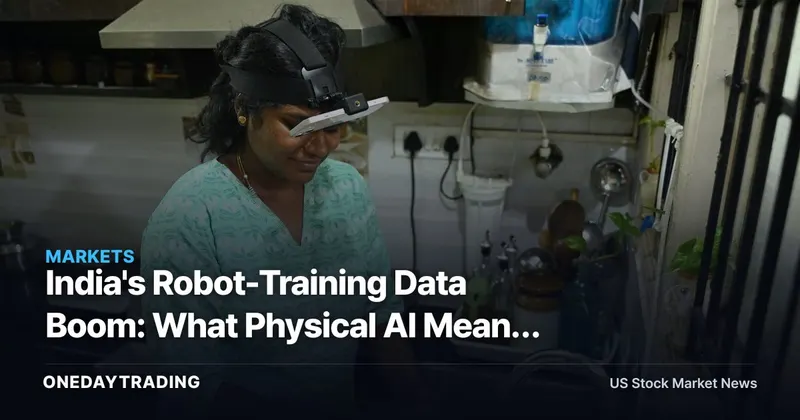
According to CNBC reporting, several companies in India have sprung up to supply video training data created by human workers performing routine tasks. That footage is used to teach robots operated by firms in the United States and China, giving India an entry point into the global AI race even without owning the frontier models or the robots themselves.
The mechanic matters: modern robots learn manipulation and routine chores through imitation learning, where models ingest large volumes of demonstration video showing how a human folds, sorts, picks or assembles. Unlike text data scraped from the web, this physical-task data barely exists at scale and has to be manufactured deliberately, which is exactly the gap Indian vendors are filling with lower-cost human labor.
Background and Context
Robotics has lagged language models partly because it lacks an internet-sized corpus of real-world action. Humanoid programs at major US technology firms and Chinese manufacturers have leaned on simulation and teleoperation to close that gap, but human-demonstrated video remains a critical and expensive input. India's established IT-services and data-annotation base makes it a natural supplier, mirroring how the country earlier became the back office for software and BPO work.
Market and Stock Impact
- NVIDIA (NVDA): Benefits indirectly as the picks-and-shovels layer of physical AI; its robotics simulation and humanoid foundation-model platforms depend on more demonstration data flowing into training pipelines, which reinforces demand for its GPUs and robotics software.
- Tesla (TSLA): Its Optimus humanoid program is a direct consumer of physical-task data; cheaper, scalable demonstration video lowers a key bottleneck to training a robot for repetitive factory and household tasks.
- Robotics and automation names (e.g. ABB, Rockwell-type exposure): A maturing data supply chain shortens the path from prototype to deployable task robots, supporting the long-term automation capex thesis.
- IT-services and data vendors: India-listed and India-exposed annotation players capture incremental revenue, though most current robot-data startups appear to be private and not directly investable on US exchanges.
Investor Checkpoints
- Watch humanoid-robot progress updates from Tesla and other developers for references to training-data volume or imitation-learning milestones at upcoming earnings calls.
- Track NVIDIA commentary on robotics and its Isaac and humanoid platforms as a read on whether physical-AI demand is converting into revenue.
- Monitor whether established annotation firms publicly pivot toward robotics video, which would validate the market size.
- Note any shift from human-collected data toward synthetic or simulation data, which could compress the labor-arbitrage opportunity.
Outlook
The bull case is structural: robots cannot be trained without action data, that data must be created rather than scraped, and a low-cost supplier base lowers the cost curve for the entire humanoid push. The risk is that this is a thin, early, and largely private market with no disclosed revenue figures, and that synthetic data, teleoperation, or simulation could erode the human-labeled niche faster than expected. The investable conclusion sits one layer up, in the compute and platform owners whose demand grows regardless of which data vendor wins.
Market data check: NVDA
NVDA last traded near $199 (-0.52%). Our composite signal — blending price momentum and news flow — reads 🟡 neutral. Price momentum scores 46/100.
Data as of publication. Price via market feeds; for reference only, not investment advice.
📊 Analysis
Signal Neutral
Why A structural confirmation of physical-AI data demand with no disclosed figures or near-term catalyst, so the directional impact on listed names is indirect rather than a clear positive trigger.
This article was independently written by OneDayTrading from public reporting. Read the original (CNBC)