Summary
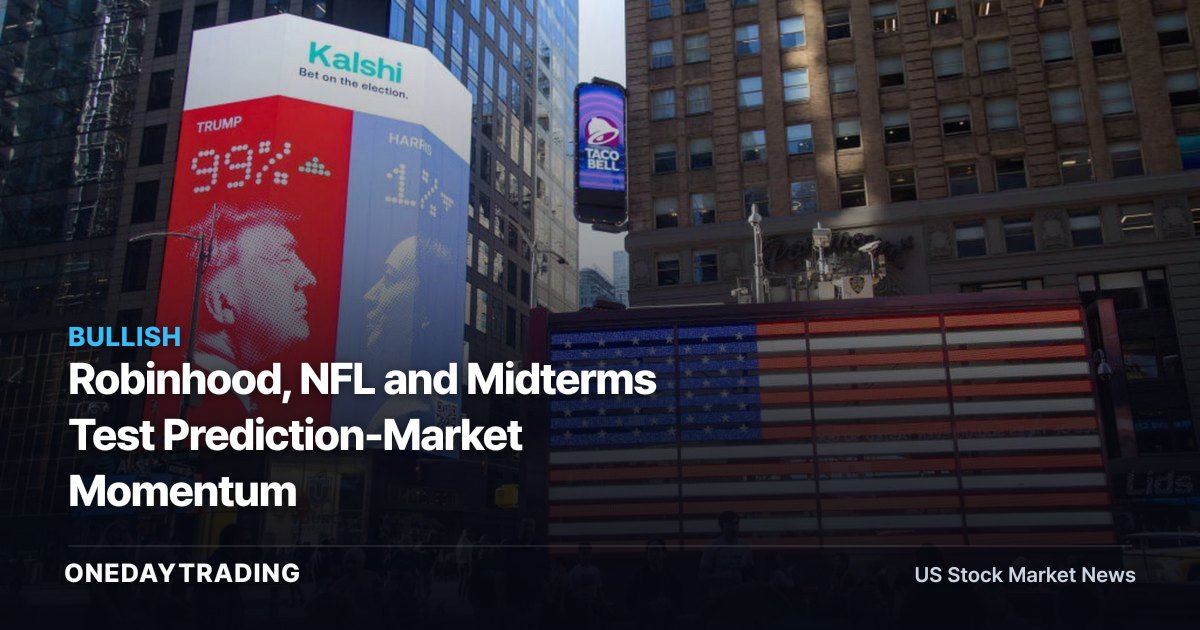
Robinhood and the prediction-market sector face a concentrated demand test in fall 2026, when NFL football and the U.S. midterm-election period coincide. According to CNBC, prediction markets were consistently generating billions of dollars in daily notional trading volume in fall 2026, while Robinhood was offering Rothera election contracts to its brokerage users.
For investors, CNBC’s reporting suggests that the central question is whether this combination can turn event-driven interest into durable platform activity. The evidence supports a constructive sector view, but outages, incorrectly resolved contracts and unresolved regulatory disputes make execution and trust essential counterweights.
The Full Story: Sports and Politics Converge in Fall 2026
A prediction market is a platform where participants trade event contracts tied to possible outcomes. According to CNBC, these markets entered the mainstream through contracts linked to the 2024 presidential election, and the start of the NFL season in September 2025 initiated a trading-volume surge.
Those two sources of attention now overlap. CNBC reported that the New England Patriots and Seattle Seahawks played a rematch of the 2026 Super Bowl as another NFL season began, while Labor Day marked the start of the midterm-election campaign season. The exact calendar dates of the NFL opener, the rematch and the midterm elections were not provided in the fact sheet.
According to CNBC, JB Mackenzie, Robinhood’s general manager for futures and prediction markets, described the environment as “a bit of a supercycle.” CNBC’s evidence supports a narrower investor interpretation: simultaneous sports and political calendars could create more opportunities for users to encounter event contracts, but the fact sheet does not establish how much revenue Robinhood earns from them.
Kalshi’s Volume Shows the Scale—and the Operational Stakes
According to CNBC, Kalshi recorded $2.3 billion in traded volume on Saturday, the first day of college football. That figure supplies the clearest measure of activity in the fact sheet, while prediction markets as a group were consistently producing billions of dollars in daily notional trading volume during fall 2026, according to CNBC.
Scale also raises the cost of operational failure. CNBC reported that Polymarket’s U.S. platform suffered an outage and refunded accounts that incurred losses because of it. CNBC also reported that Kalshi prematurely resolved a University of Michigan market as though Western Michigan had won, then corrected the result and paid out accordingly.
According to CNBC’s reporting, these incidents make reliability a relevant investor checkpoint alongside volume. High trading activity may indicate demand, but the fact sheet provides no platform market shares and therefore cannot show which operator captures that demand most effectively.
Robinhood and Rothera Extend the Election-Contract Channel
According to CNBC, Rothera was developed through a joint venture between Susquehanna International Group and Robinhood. Robinhood features Rothera’s election-related contracts for brokerage users, creating a direct connection between a listed financial platform and the fall 2026 prediction-market cycle.
CNBC’s reporting suggests that placement inside a brokerage could increase the visibility of election contracts among Robinhood users. It does not disclose contract volumes, user conversion, take rates or Robinhood revenue, so the balance-sheet effect cannot be quantified from the permitted evidence.
Political offerings are also expanding elsewhere. According to CNBC, Kalshi launched a midterm-elections hub in July 2026. CNBC reported that U.S. election-related event contracts had not become legal until one month before the 2024 presidential vote, making the 2026 preparation window longer than the one described for that election.
Sports-Focused Platforms Face a Make-or-Break Cycle
According to CNBC, Seni Thomas of EDGE Markets called the NFL cycle “the real key, make or break” for newer companies. The description fits a market in which Novig lists only sports event contracts and ProphetX launched in June 2026 with a sports-contract focus.
ProphetX provides a growth signal but not a complete financial picture. According to CNBC, CEO Dean Sisun said its revenue doubled from June through August and expressed a goal of reaching a four-to-five-times run rate by the end of 2026. The revenue doubling is reported performance; the four-to-five-times figure is management’s aspiration, not an achieved result.
According to CNBC’s evidence, the missing baseline matters because the fact sheet does not give ProphetX’s revenue before or after the doubling. Investors can therefore treat the statement as evidence of acceleration without inferring the company’s absolute scale or profitability.
Stock & Sector Ripple
- Robinhood: According to CNBC, Robinhood distributes Rothera election contracts through its brokerage, giving it direct exposure to prediction-market engagement during the fall 2026 sports and political calendar. The permitted facts do not quantify revenue, margins or customer acquisition from those contracts.
- Prediction-market platforms: According to CNBC, Kalshi’s $2.3 billion in traded volume on the first day of college football demonstrates substantial activity. CNBC’s reporting also shows that outages and resolution errors can expose platforms to refunds, corrective payouts and questions about trust.
- Sports-contract specialists: According to CNBC, Novig offers only sports event contracts, while ProphetX launched in June 2026 with the same broad focus. This concentration may amplify the importance of the NFL cycle, although the fact sheet provides no market-share comparison.
- Political event contracts: According to CNBC, Robinhood carries Rothera election contracts and Kalshi opened a midterm-elections hub in July 2026. The evidence establishes product expansion, but not the volume or revenue those political contracts will produce.
Bull vs Bear Scenarios
Bull case: According to CNBC, prediction markets entered fall 2026 with daily notional trading volume consistently in the billions, while Kalshi handled $2.3 billion in volume on the first day of college football. CNBC’s reporting supports the interpretation that overlapping NFL and midterm-election interest could sustain engagement across sports and political products, with Robinhood participating through Rothera.
Bear case: According to CNBC, Polymarket experienced an outage requiring refunds, while Kalshi had to correct and pay out a prematurely resolved University of Michigan contract. The fact sheet also leaves unresolved whether legal disputes will alter platforms’ regulatory status or operations, making any favorable investment conclusion conditional.
According to CNBC’s evidence, neither scenario can yet be translated into a precise earnings impact. The sheet provides trading volume for Kalshi and a relative revenue change for ProphetX, but no Robinhood prediction-market revenue, market shares, margins or platform-wide customer economics.
Investor Action Points
- Track operating continuity during the NFL cycle: According to CNBC, prior college-football activity produced both an outage at Polymarket’s U.S. platform and an incorrectly resolved Kalshi market. The next evidence should be whether platforms process and settle contracts without comparable incidents.
- Separate volume from monetization: According to CNBC, fall 2026 daily notional volume reached billions of dollars across prediction markets, and Kalshi recorded $2.3 billion on the first college-football Saturday. Investors still need company-level revenue and economic disclosures before assigning that volume directly to Robinhood earnings.
- Measure political-product adoption through November 2026: According to CNBC, Robinhood features Rothera election contracts and Kalshi launched its midterm hub in July 2026. The relevant checkpoint is disclosed activity in those political contracts, not the existence of the products alone.
- Monitor the regulatory outcome: According to CNBC, uncertainty remains over whether legal disputes will change prediction platforms’ regulatory status or operations. That unresolved question could determine whether current product expansion remains intact.
FAQ
Why is Robinhood connected to prediction markets?
According to CNBC, Robinhood and Susquehanna International Group jointly developed Rothera. Robinhood offers Rothera’s election-related contracts to users of its brokerage.
How large was Kalshi’s college-football trading volume?
According to CNBC, Kalshi recorded $2.3 billion in traded volume on Saturday, the first day of college football. The fact sheet does not provide Kalshi’s market share or a directly comparable figure for other platforms.
Are 2026 election contracts guaranteed to benefit prediction-market platforms?
No such outcome is established by the fact sheet. According to CNBC, platforms expanded election offerings ahead of the November 2026 midterm period, but their ultimate volume, revenue and regulatory status remain unquantified or unresolved.
📊 Analysis
Signal Bullish
Why CNBC’s reporting indicates that sustained prediction-market volume and broader sports and election offerings could support Robinhood engagement, although operational and regulatory uncertainty limits conviction.
This article was independently written by OneDayTrading from public reporting. Read the original (CNBC)