Key Takeaways
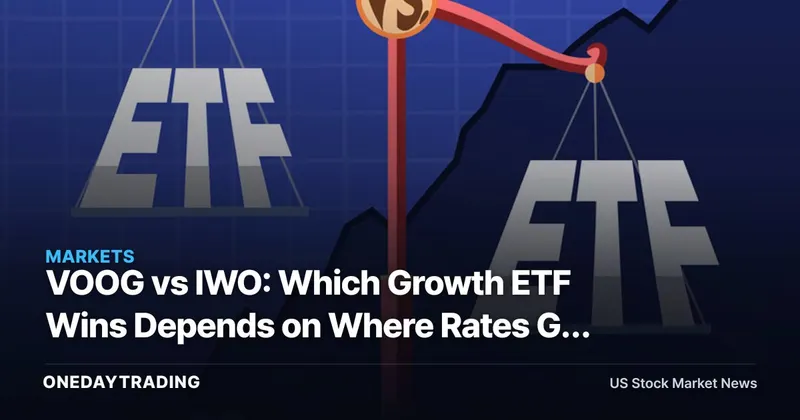
The VOOG versus IWO debate is not a style preference — it is a directional wager on the Federal Reserve. VOOG delivers mega-cap earnings durability in a higher-for-longer environment; IWO is a leveraged call on rate cuts, carrying disproportionate upside if the Fed pivots but outsized drawdown risk if it does not. Investors who treat this as a simple growth allocation are underpricing the macro exposure embedded in the small-cap fund.
What Happened
The comparison pits two distinct growth universes against each other. VOOG tracks the S&P 500 Growth index and is dominated by mega-cap technology — Apple, Microsoft, Nvidia, Amazon and Meta collectively anchor the portfolio. These companies generate prodigious free cash flow, carry minimal floating-rate debt and can sustain earnings growth largely independent of the credit cycle, even if their elevated multiples remain sensitive to changes in the discount rate. The fund benefits structurally from Vanguard's industry-leading low-cost structure, which compounds into meaningful return advantages over long holding periods.
IWO tracks the Russell 2000 Growth index, a universe of smaller, earlier-stage companies where a meaningful share of constituents carry negative trailing earnings. Small-cap growth businesses rely more heavily on external financing and floating-rate credit, which means Fed policy passes through directly to earnings rather than merely adjusting the valuation multiple. When the 10-year Treasury yield surged from 2022 through 2023, IWO bore the full weight of that tightening cycle through both multiple compression and genuine earnings deterioration in its cash-burning cohort.
Background & Context
Small-cap growth has historically generated superior long-run returns versus large-cap growth — but at substantially higher volatility and with sharper drawdowns in risk-off and tightening cycles. The Russell 2000 Growth index carries a persistent profitability drag: a structurally higher percentage of unprofitable companies creates systematic headwinds whenever credit tightens or risk appetite narrows. VOOG, by contrast, is anchored in businesses with fortress balance sheets and high operating margins; Apple's Services segment, Microsoft's Azure contracts and Nvidia's accelerator backlog each represent durable, high-margin revenue streams with pricing power that partially offsets inflation pressure through pass-through mechanisms.
Market & Stock Impact
- VOOG — Vanguard S&P 500 Growth ETF: Concentration in mega-cap tech insulates the fund from credit-cycle risk; the AI infrastructure supercycle sustains earnings momentum for Nvidia and Microsoft inside the index regardless of rate direction, making VOOG the lower-variance choice in a hold-steady rate environment.
- IWO — iShares Russell 2000 Growth ETF: Mechanically re-rates higher when the Fed begins cutting; historically the Russell 2000 outperforms during the initial easing phase as credit spreads tighten and growth expectations recover for the index's cash-burning constituents.
- Small-cap biotech and software within IWO: These sub-sectors carry the most duration sensitivity — valuations rest on distant cash flows discounted at high rates, so a 50-basis-point cut moves their implied fair values more than any operational improvement would.
- Inflation persistence risk: Sticky inflation that keeps the Fed on hold disproportionately pressures IWO by holding refinancing costs elevated; VOOG's dominant names hold pricing power sufficient to sustain margin through revenue pass-through.
- Relative valuation spread: If forward price-to-earnings on S&P 500 Growth is historically wide versus Russell 2000 Growth, the market is already pricing in large-cap dominance — meaning VOOG's upside is narrower if earnings growth decelerates at the index's top holdings.
Investor Checkpoints
- September 2026 FOMC meeting: Any shift in the dot plot toward rate cuts before year-end would mechanically favor IWO; updated projections are the primary catalyst to watch.
- 10-year Treasury yield at 4.0%: A sustained break below that level is historically the inflection point for meaningful Russell 2000 outperformance to begin — monitor weekly closes against that threshold.
- Russell 2000 earnings margin trends: Rising EBITDA margins for small-cap cohorts in the next reporting season signal that IWO's risk/reward is improving; continued margin contraction keeps the trade structurally dangerous.
- Mega-cap earnings guidance: Deceleration in Azure growth, iPhone unit volumes or Nvidia data center revenue would compress VOOG's dominant holdings and close the relative-valuation gap, warranting a reassessment of the allocation split.
Outlook
The bull case for VOOG is durable: the AI capital expenditure cycle sustains demand for the cloud and semiconductor leaders that dominate the index, low costs compound quietly over time and the fund's mega-cap earnings base provides a natural floor. The core risk is valuation — S&P 500 Growth multiples are elevated by historical standards, and any earnings miss from its top-five holdings carries outsized index-level damage given their weight concentration.
The bull case for IWO hinges on the Fed actually cutting — not just signaling it. If that pivot materializes in the second half of 2026, small-cap growth historically front-runs the move, rewarding investors who build positions before rate-cut conviction becomes consensus. The counter-scenario is a stagflationary delay: if credit spreads widen in a slowdown without a rate response, IWO's unprofitable cohort faces the worst possible combination of falling revenues and sustained high financing costs. The sequencing logic that emerges: VOOG as a core holding now, IWO as a deliberate tactical add once the first rate cut is delivered — not merely promised.
Market data check: VOOG
VOOG last traded near $79.99 (-0.30%). Our composite signal — blending price momentum and news flow — reads 🟡 neutral. Price momentum scores 48/100.
Data as of publication. Price via market feeds; for reference only, not investment advice.
📊 Analysis
Signal Neutral
Why Neither ETF holds a clear directional edge absent a resolved call on Fed policy — the comparative analysis is conditional on rate direction rather than a discrete bullish or bearish catalyst.
This article was independently written by OneDayTrading from public reporting. Read the original (Yahoo Finance)