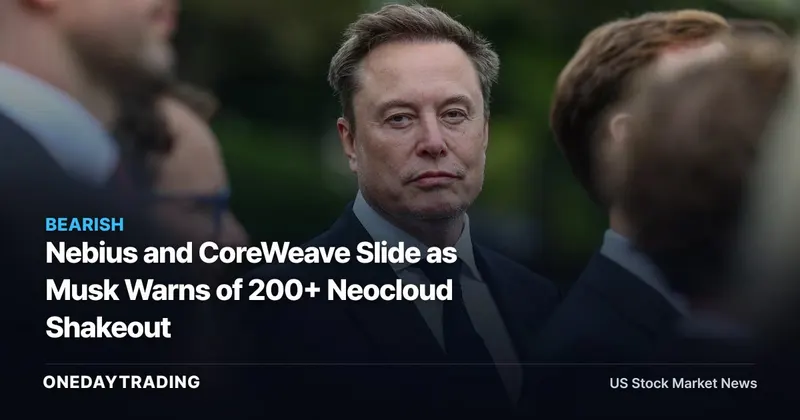
Elon Musk’s Warning Puts Neocloud Financing Under the Microscope
Nebius, CoreWeave and Iren fell on Monday after Elon Musk said more than 200 neocloud companies could collapse, CNBC reported on 2026-10-26. For investors, the sharper issue is not whether artificial-intelligence computing demand exists; it is whether individual providers can fund capacity long enough to convert that demand into durable returns.
A neocloud is a company that rents computing capacity. The group sits at the center of the AI infrastructure buildout, where access to capital, debt exposure and the ability to place future capacity with customers can separate companies even when they serve the same underlying market.
Nebius, CoreWeave and Iren Pare an Early Selloff
Nebius, CoreWeave and Iren each dropped more than 4% in early premarket trading on Monday, according to CNBC. The three stocks later recovered part of that decline and traded between 2% and 3% lower, showing that the initial reaction eased without disappearing.
The move extended an already difficult period. CNBC reported that CoreWeave and Nebius were down more than 30% over the past month, while Iren was down 40% over the same period. Those declines indicate that investors were questioning the sector before Musk’s post placed the consolidation risk in unusually direct terms.
Musk made the comments in a Sunday post on X while replying to Chamath Palihapitiya, founder of Social Capital. He wrote that “the 200+ neoclouds are going to see guppy-level death and consolidation.” The identities of all companies included in that count are unknown, as are the companies, if any, that ultimately could collapse or combine.
Capital Availability Is the Fault Line
The market debate now has two separate components: demand for computing capacity and the financing required to supply it. Treating those components as interchangeable risks missing the central tension. Strong customer interest does not by itself establish that every provider’s expansion will earn a long-term return, while tight capital does not prove that customer demand has weakened.
CoreWeave provides the clearest credit-market warning in the available evidence. Earlier this month, the spread on its five-year credit default swaps reached levels generally viewed as signs of distress, and its bond yields climbed. That does not determine CoreWeave’s operating outcome, though it makes financing conditions a necessary part of any assessment of its capacity plans.
Palihapitiya supplied the bear case for the next stage of the buildout. He forecast partially stranded compute and inventory in 2027 and said, “2027 will be a turbulent year because it will clear out a bunch of wrong/bad bets.” His scenario remains a forecast, not a confirmed outcome, and the long-term returns from the wider AI infrastructure buildout are unknown.
Demand Signals Push Back Against the Bear Case
Nvidia, an investor in several neoclouds, offers the strongest counterargument. Nvidia CEO Jensen Huang described demand for neocloud services as exceptionally strong and framed the constraint as insufficient capital relative to demand. In his words, “The demand of the capital is much greater than the availability of the capital.”
That distinction matters for the stocks. If demand remains intact while capital stays scarce, outcomes may diverge according to each provider’s debt burden and ability to finance additional capacity. This is an analytical inference from the reported statements, not confirmation that any operator will secure funding or produce acceptable returns.
Musk also has a competitive position in the discussion. He is CEO of SpaceX and Tesla, and SpaceX operates data centers, sells computing capacity and competes directly with neocloud providers. His warning therefore deserves attention as a market view from an industry participant, while its breadth should not be treated as a company-by-company credit assessment.
Company-Level Signals Matter More Than the Sector Label
- CoreWeave: The five-year credit default swap signal and higher bond yields put its financing profile at the center of investor concern. The relevant question is whether credit conditions change alongside evidence about customer demand and future capacity.
- Nebius: Chief revenue officer Marc Boroditsky distinguished the company from CoreWeave by saying, “we’re not carrying the kind of debt that they are.” He said Nebius would sell out its 2027 capacity if it brought that capacity online and suggested the same type of dynamic could apply in 2028. Whether that future capacity will sell out remains unknown.
- Iren: Co-CEO Daniel Roberts said customer demand had not changed, stating, “The demand is still there.” He also said 2028 was coming into focus in customer conversations. The stock’s 40% decline over the past month shows that those demand comments have not removed investor concern.
- Nvidia: Its investment relationships with several neoclouds connect it to the sector’s expansion. Huang’s comments support the demand side of the argument, while the unresolved question is whether capital availability can support that demand across the provider base.
Investor Checkpoints After the Neocloud Stock Declines
- Credit conditions: Track whether the distress signal in CoreWeave’s five-year credit default swaps and the rise in its bond yields persist or ease. These are the clearest reported indicators of financing pressure.
- Debt differentiation: Compare future disclosures with Boroditsky’s statement that Nebius does not carry the same kind of debt as CoreWeave. The current evidence establishes the executive’s claim, not a complete comparison of the companies’ finances.
- Capacity conversion: Test Nebius’s statements about 2027 capacity against evidence that capacity comes online and is sold. For Iren, assess whether customer conversations focused on 2028 translate into commitments rather than remaining expressions of demand.
- Demand versus capital: Reconcile Roberts’s unchanged-demand message and Huang’s strong-demand assessment with signs of available financing. A gap between those two variables is the central risk identified by the current debate.
What Could Change the Neocloud Thesis
The constructive scenario is straightforward: customer demand remains strong, capital becomes available, and providers bring capacity online without taking on financing burdens that undermine returns. Statements from Huang, Boroditsky and Roberts support the demand side of that scenario, including discussions of capacity extending into 2027 and 2028.
The bearish scenario is more selective than a simple collapse in AI demand. Financing pressure could force consolidation or expose capacity that fails to earn sufficient returns, consistent with the forecasts advanced by Musk and Palihapitiya. The evidence does not establish which companies would be affected or whether consolidation will occur.
The next decisive information must come from company-specific credit, debt, capacity and customer disclosures. Until those signals align, the sector’s headline demand strength cannot settle the return question, and the recent declines in Nebius, CoreWeave and Iren leave capital durability as the live test for investors.
📊 Analysis
Signal Bearish
Why Falling shares, distressed credit signals and uncertainty over capital access outweigh company assertions that customer demand remains strong.
This article was independently written by OneDayTrading from public reporting. Read the original (CNBC)