Summary
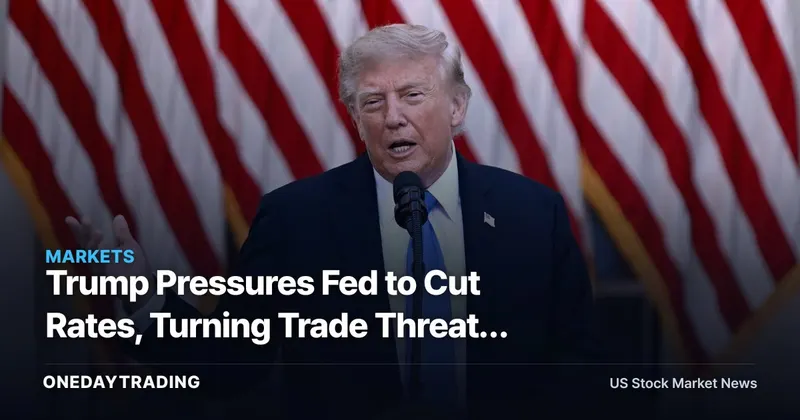
President Donald Trump is demanding that the Federal Reserve cut interest rates and has tied the request to a threat to end trade with countries that run surpluses against the United States. For investors, the immediate issue is not a guaranteed policy shift but whether political pressure changes the path of Treasury yields, the dollar and equity-market valuations.
The transmission runs from rates to multiples: lower borrowing costs can support long-duration stocks and rate-sensitive demand, while a trade cutoff would introduce a separate shock to global growth and corporate supply chains.
The Full Story
Trump’s statement creates a two-track market risk. The first track is monetary: the president wants the Fed to slash rates. The second is commercial: countries with U.S. trade surpluses could face restricted access to American trade. Those demands pull markets in opposite directions because easier money can lift asset prices, while a trade rupture can weaken earnings expectations.
The Federal Reserve is the U.S. central bank responsible for setting short-term interest rates and guiding financial conditions. Its independence matters because investors price future inflation and growth through the yield curve; a politically driven cut would not carry the same signal as a reduction based on economic data.
That distinction separates what the tape may price from what it does not. Traders can bid up rate-sensitive assets if they believe pressure increases the odds of lower policy rates. They cannot easily price the economic cost of an abrupt trade cutoff without knowing which countries, products or timelines would be affected.
Structural Background
Trade-surplus countries sell more to the United States than they buy from it, leaving American import demand as a key source of their export revenue. Ending trade with those partners would therefore hit foreign producers directly, but U.S. companies and consumers could also face fewer suppliers, higher replacement costs or weaker overseas demand.
Lower rates normally reduce discount rates used to value future cash flows, supporting high-duration growth shares. If the trade threat lifts inflation expectations or damages confidence, that valuation benefit can be offset by wider risk premiums and weaker profit forecasts.
Stock & Sector Ripple
- U.S. banks: A rate-cut campaign could pressure net interest margins if loan yields reset faster than deposit costs, even as cheaper credit supports loan demand.
- Long-duration technology: Lower Treasury yields can expand valuation multiples, but technology companies with globally distributed suppliers would face trade-exposure risk.
- Industrials and exporters: Restricted trade would threaten foreign sales and raise uncertainty around imported components, making order visibility more important than headline rate relief.
- Consumer companies: Cheaper financing may help housing, autos and discretionary purchases, while a trade cutoff could increase prices for imported goods.
Bull vs Bear Scenarios
The bullish case for equities is that political pressure accelerates rate cuts without materially disrupting commerce. In that outcome, lower yields could support valuation-sensitive sectors and improve refinancing conditions.
The bearish case is a credibility and supply shock: markets conclude that policy is being subordinated to politics while trade restrictions raise costs. Yields could fall because growth deteriorates, not because the outlook improves, leaving equity multiples vulnerable.
Investor Action Points
- Track Treasury yields and the dollar for evidence that markets are pricing easier policy or higher political risk.
- Watch the Fed’s next public communications for any change in its reaction function or emphasis on independence.
- For companies with cross-border supply chains, examine upcoming guidance for tariff, sourcing and demand assumptions.
- Compare rate-sensitive sectors with exporters; divergence will show whether investors prioritize cheaper money or trade damage.
FAQ
Why is Trump asking the Fed to cut interest rates?
President Donald Trump is demanding lower rates while linking the request to a threat to end trade with countries that maintain surpluses against the United States. The statement is political pressure, not a reported Federal Reserve decision.
What could lower rates mean for U.S. stocks?
Lower rates reduce the discount applied to future cash flows and can support long-duration equities, housing and other credit-sensitive demand. The benefit weakens if investors also price inflation, political interference or weaker earnings.
How could a trade cutoff affect markets?
Ending trade with surplus countries could reduce export revenue abroad and disrupt U.S. sourcing and consumer prices. The market impact depends on which countries and products are targeted, details not provided in the source report.
📊 Analysis
Signal Neutral
Why Trump’s demand could support rate-sensitive valuations but the linked threat to cut trade introduces offsetting growth, inflation and policy-credibility risks.
This article was independently written by OneDayTrading from public reporting. Read the original (CNBC)