Summary
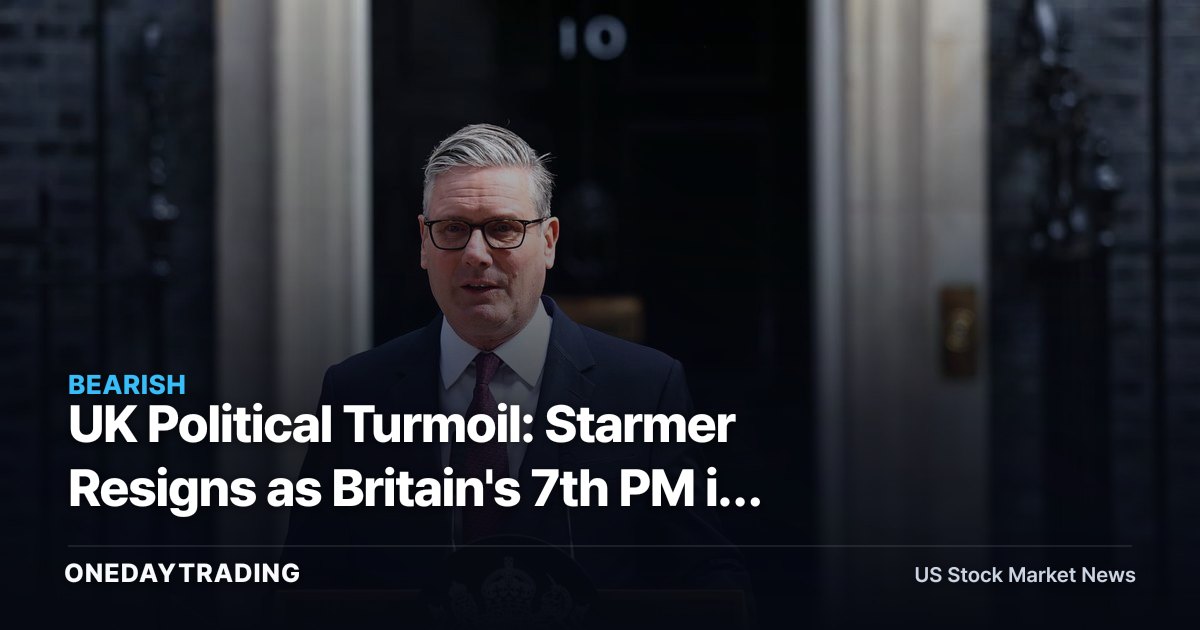
UK Prime Minister Keir Starmer has resigned, leaving Britain to install its seventh leader in just 10 years. For investors, the headline is less about any single politician and more about a structural risk premium: serial leadership churn complicates fiscal planning, unsettles the gilt market, and adds a discount to sterling-denominated assets that US retail investors hold through vehicles like the iShares MSCI United Kingdom ETF.
The Full Story
The resignation extends a remarkable run of instability. Seven leaders in a decade means the average UK government tenure has collapsed to well under two years, far shorter than the multi-year horizons that bond and equity markets prefer when pricing policy continuity. Each transition reopens questions on tax, spending, and the fiscal rules that anchor gilt issuance.
The immediate market channel is sterling and UK government bonds. Political vacuums tend to widen the term premium investors demand on gilts, because a caretaker or contested leadership cannot credibly commit to a medium-term budget path. A weaker pound is a double-edged sword: it lifts the foreign earnings of FTSE 100 multinationals when translated back into sterling, but it raises import costs and can keep inflation — and therefore Bank of England rates — stickier than peers.
Structural Background
Britain's post-2016 era has fused Brexit aftershocks, energy-price shocks, and repeated fiscal U-turns into a pattern where markets now treat UK leadership change as a recurring event rather than an exception. The 2022 gilt selloff around an unfunded mini-budget is the cautionary template: when fiscal credibility wobbles, yields can spike violently and force policy reversals within days. That memory keeps the bond market's tolerance for surprises unusually thin.
Stock & Sector Ripple
- EWU (UK equity ETF): Direct exposure to the FTSE basket; a weaker pound can flatter large-cap exporters even as domestic-facing names face softer consumer confidence.
- FTSE 100 exporters and miners: Energy, pharma and materials giants earn heavily in dollars, so sterling weakness cushions reported earnings — a relative haven within UK indices.
- UK domestic banks and homebuilders: Most sensitive to gilt-yield swings and rate expectations; volatility in funding costs and mortgage demand hits margins.
- US multinationals with UK revenue: Firms with meaningful British sales see currency-translation drag when the pound falls, a modest headwind to dollar-reported top lines.
Bull vs Bear Scenarios
Bull case: A swift, orderly succession that reaffirms existing fiscal rules could compress the political risk premium quickly, and UK valuations already trade at a persistent discount to US peers — leaving room for a relief rally if continuity holds.
Bear case: A protracted or contested transition revives 2022-style gilt stress, pushes yields higher, and pressures rate-sensitive domestic sectors. Sterling could overshoot to the downside before any new mandate restores confidence.
Investor Action Points
- Watch the 10-year gilt yield and GBP/USD in the first sessions after the resignation — sharp moves signal how markets are pricing the vacuum.
- Track the timeline and credibility of the succession process; a clear, fast handover is the key de-risking event.
- Distinguish FTSE exporters (currency-aided) from domestic banks and builders (rate-exposed) rather than treating UK equity as one bloc.
- Note the next Bank of England meeting and any emergency fiscal statement as catalysts that can confirm or break the trend.
Market data check: EWU
EWU last traded near $45.44 (-0.05%). Our composite signal — blending price momentum and news flow — reads 🟡 neutral. Price momentum scores 50/100.
Data as of publication. Price via market feeds; for reference only, not investment advice.
📊 Analysis
Signal Bearish
Why Serial leadership churn raises the political and fiscal risk premium on UK assets, pressuring sterling, gilts and UK equities until a credible succession restores continuity.
This article was independently written by OneDayTrading from public reporting. Read the original (CNBC)