Scott Bessent Keeps the Fed’s Next Move Open
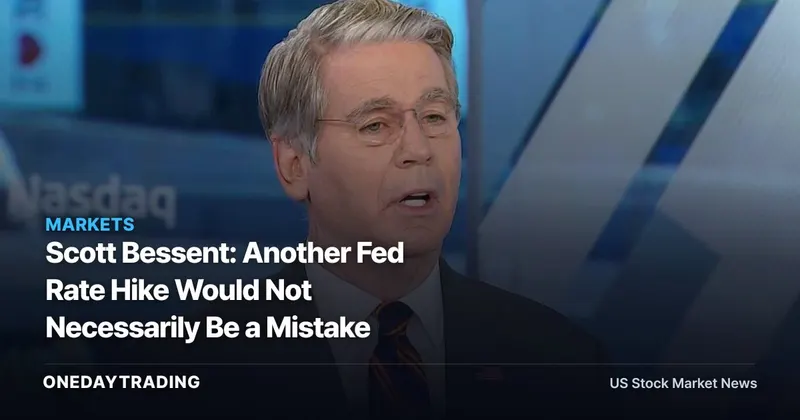
Scott Bessent’s message on 2026-10-28 leaves investors with a wider range of Federal Reserve outcomes, not a confirmed rate path. After the Fed kept interest rates unchanged at its October gathering, the Treasury secretary told CNBC that another increase would not necessarily constitute a policy mistake. The immediate implication for rates and equity valuation is uncertainty: neither the timing nor the magnitude of any future increase is known.
The statement matters because it resists a simple interpretation of the October decision as the end of rate increases. It also creates a clear distinction between a pause and a commitment to keep rates unchanged. The evidence supports the former; it does not establish the latter.
What Bessent Said After the October Decision
During the CNBC interview, Brian Sullivan asked whether future rate increases would amount to a monetary-policy error. Scott Bessent answered, “That’s not necessarily so.” His response did not endorse a particular increase, meeting, or policy outcome. It established only that he would not automatically classify another hike as a mistake.
The Federal Reserve had held rates unchanged at its October gathering. That decision followed an increase in borrowing costs in the previous month, the first such increase in three years. December is the next identified Federal Reserve meeting, making it the next scheduled point at which investors can compare Bessent’s open-ended stance with an actual central-bank decision.
A rate pause means the Federal Reserve leaves its policy setting unchanged at a meeting; it does not, by itself, settle what officials will do at the following gathering. That distinction is the central analytical point. Investors have a confirmed October hold and a possible future hike, with no supplied magnitude or timing for that possible move.
The Warsh-Trump Policy Tension
Donald Trump has repeatedly called for lower interest rates, while Bessent’s remarks preserved the possibility that a future increase could be defensible. The two positions are not identical, though Bessent said that he and Donald Trump believe Kevin Warsh is doing well. He described the chair as off to a good start and said he had strong confidence in him.
Bessent also framed Kevin Warsh’s task around full employment and stable prices. His comments therefore presented the chair’s role as a balancing exercise rather than a commitment to one predetermined direction. The fact sheet supplies no future policy decision, so confidence in the chair should not be read as evidence that rates will rise or fall.
Jerome Powell appears in the policy background as Kevin Warsh’s predecessor. Donald Trump pressed Jerome Powell over interest rates during Powell’s final months leading the central bank. That history explains why Bessent’s willingness to leave room for another increase is notable, while the available evidence does not establish a disagreement or a new administration policy.
Inflation, Iran and the Limits of the Rate Signal
CNBC identified the Federal Reserve’s annual inflation target as 2%, while Bessent called for an “open mind” about the “transitory nature” of the energy-price supply shock. Those words define the question facing investors without resolving it: whether the inflation pressure under discussion persists or fades. The fact sheet does not provide an inflation reading, a projected rate path, or a threshold that would trigger another move.
Scott Bessent said internal estimates indicated that Iran’s economy could contract by as much as 25% from March 2025 to March 2026, according to CNBC. He described the effort to isolate Iran’s economy as “very successful.” The estimate remains an estimate; whether the contraction reached that scale is unknown.
These comments broadened the interview beyond domestic monetary policy, although they do not supply a quantified connection between Iran’s estimated contraction and the Federal Reserve’s next decision. For investors, the disciplined reading is to keep the subjects separate unless subsequent evidence connects them: one is an uncertain estimate for Iran, while the other is an undecided U.S. rate outcome.
AI Debt and the Neocloud Divide
Bessent also said AI-related debt did not need to cause concern, though he said authorities “we monitor” it. He pointed to neoclouds, companies that provide specialized cloud infrastructure supporting artificial intelligence, as a small part of the wider ecosystem. He added that financing and deals were still getting done.
Tesla CEO Elon Musk warned on Sunday that more than 200 neocloud firms could face “guppy-level death and consolidation.” That warning concerns neocloud firms rather than Tesla’s operating results, and the fact sheet gives no outcome for any individual provider. It therefore cannot support a company-specific winner, loser, revenue effect, or balance-sheet conclusion.
The contrast is still analytically useful. Elon Musk emphasized the possibility of failure and consolidation across more than 200 neocloud firms, while Scott Bessent argued that the segment’s problems were not large enough to make the broader ecosystem problematic. Neither statement supplies firm-level financing terms or eventual outcomes, so the divide is one of risk assessment rather than verified results.
Bull and Bear Interpretations for Investors
Bull case: The October pause remains intact, Bessent expressed confidence in Kevin Warsh, and he said AI financing and deal activity continued. His expectation that third-quarter U.S. GDP data would be “strong” also provides a positive assessment of economic activity, subject to verification when the data are released Thursday.
Bear case: Another Federal Reserve increase remains possible after borrowing costs rose in the previous month. Bessent’s comments did not narrow the magnitude or timing of that risk, and Elon Musk’s warning raised the prospect of death and consolidation among neocloud firms. Those conditions prevent a clean positive reading for either rates or AI infrastructure finance.
Neutral reading: The strongest conclusion is that the range of outcomes remains open. A future hike has not been announced, the third-quarter GDP result was unavailable to Bessent, Iran’s estimated contraction is unconfirmed, and individual neocloud outcomes are unknown. Treating any of those items as completed would go beyond the evidence.
December and Thursday Are the Next Evidence Checks
- Federal Reserve: At the December meeting, check whether policymakers change rates or maintain the October setting. The fact sheet provides no basis for assigning a magnitude to any potential move.
- U.S. economy: Compare Thursday’s actual third-quarter GDP data with Bessent’s “strong” expectation. He explicitly said, “I haven’t seen it yet.”
- Inflation debate: Watch whether subsequent evidence supports Bessent’s view that the energy-related supply shock could have a “transitory nature,” while keeping the Federal Reserve’s 2% annual inflation target as the stated reference point.
- AI infrastructure: Look for firm-level evidence on financing, completed deals, failures, or consolidation before turning the warning about more than 200 neocloud firms into a sector-wide outcome.
The December Federal Reserve meeting is the decisive macro checkpoint because it can convert today’s open possibility into an observable policy choice. Until then, Bessent’s remarks argue against assuming that the October hold settled the direction of rates, while stopping well short of confirming another hike.
📊 Analysis
Signal Neutral
Why Bessent preserved the possibility of another rate hike without specifying its timing or magnitude, leaving investors without a confirmed policy direction.
This article was independently written by OneDayTrading from public reporting. Read the original (CNBC)