Summary
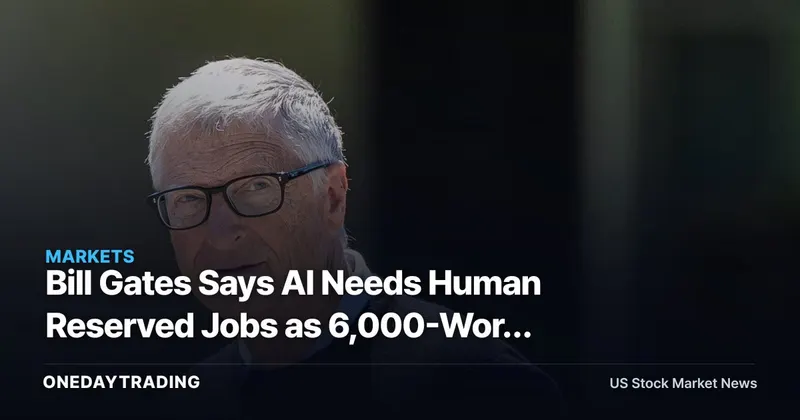
Bill Gates AI commentary matters for investors because the CNBC report frames artificial intelligence not only as a productivity engine, but as a labor-market shock that may require Human Reserved jobs and a coordinated global response.
Per CNBC's report provided on Aug. 26, 2026, Bill Gates wrote a 6,000-word memo saying unprecedented technology demands an unprecedented global response; the market read-through is policy risk for AI adoption, not just software upside.
The Full Story
Human Reserved jobs are roles deliberately kept for people even when artificial intelligence can perform parts of the work, a concept aimed at limiting the social damage from automation.
The investment issue is not whether AI can replace tasks; the CNBC item says Bill Gates is warning about the worst of AI upheaval, which moves the debate from model capability to labor absorption, regulation and corporate responsibility.
For AI platforms, enterprise software and automation vendors, the memo cuts both ways. Faster deployment can support revenue growth, but a political push for protected human work can slow customer rollouts, raise compliance costs and change how companies describe efficiency gains.
For employers, the balance-sheet channel is direct. If Human Reserved jobs become a serious policy or corporate-governance standard, companies may capture fewer near-term labor savings from AI, while spending more on retraining, job redesign and public accountability.
Structural Background
Bill Gates' 6,000-word memo, as described by CNBC, places AI upheaval in the category of systemic change rather than a normal technology cycle. That distinction matters because systemic change attracts governments, labor groups and cross-border institutions.
The source does not provide adoption rates, job-loss estimates or company-specific financial targets, so investors should avoid treating the memo as a numerical forecast. The harder signal is narrative: AI's next phase will be judged by social capacity, not only technical capability.
Stock & Sector Ripple
- AI software platforms: Human Reserved job proposals can lengthen enterprise sales cycles if customers need proof that automation projects preserve roles or fund retraining.
- Enterprise software: Productivity tools benefit when AI enters workflows, but revenue durability depends on whether customers see AI as augmentation rather than headcount reduction.
- Internet platforms: Large-scale AI deployment faces reputational and policy scrutiny when labor displacement becomes the central public issue.
- Staffing and workforce services: The labor market can shift toward reskilling, placement and job redesign if companies respond to AI upheaval with managed transition programs.
- Education technology: Training demand can rise if the Human Reserved framework pushes workers and employers to define which tasks stay human.
Bull vs Bear Scenarios
The bull case is that Bill Gates' Human Reserved jobs concept gives companies a more acceptable adoption path: AI improves productivity while employers preserve trust with workers, customers and regulators.
The bear case is that AI becomes a policy fight before the revenue base fully matures. If governments or large customers demand explicit labor protections, AI vendors can still grow, but deployment speed and margin assumptions face more friction.
Investor Action Points
- Track whether AI vendors discuss worker augmentation, retraining or human-supervised workflows in their next earnings calls.
- Watch enterprise software guidance for signs that customers are delaying AI projects because of workforce or compliance review.
- Monitor labor-policy language from major economies after CNBC's report on Bill Gates' 6,000-word memo.
- Separate AI revenue growth from AI margin expansion; Human Reserved jobs would affect the second more than the first.
FAQ
What are Human Reserved jobs in AI?
Human Reserved jobs are roles that society or companies preserve for people even when artificial intelligence can automate part of the work. CNBC reported that Bill Gates raised the concept in a 6,000-word memo about AI upheaval.
Why did Bill Gates say AI needs a global response?
Bill Gates said unprecedented technology demands an unprecedented global response, according to CNBC's description of the memo. The investor takeaway is that AI adoption can become a policy and labor issue, not only a product cycle.
How does AI labor risk affect software stocks?
AI labor risk affects software stocks by changing the pace and terms of customer adoption. If enterprises must protect Human Reserved jobs, AI software can still expand, but efficiency-driven margin assumptions become harder to underwrite.
📊 Analysis
Signal Neutral
Why The source describes a broad AI labor-risk framework from Bill Gates rather than a company-specific catalyst with clear positive or negative earnings impact.
This article was independently written by OneDayTrading from public reporting. Read the original (CNBC)