Key Takeaways
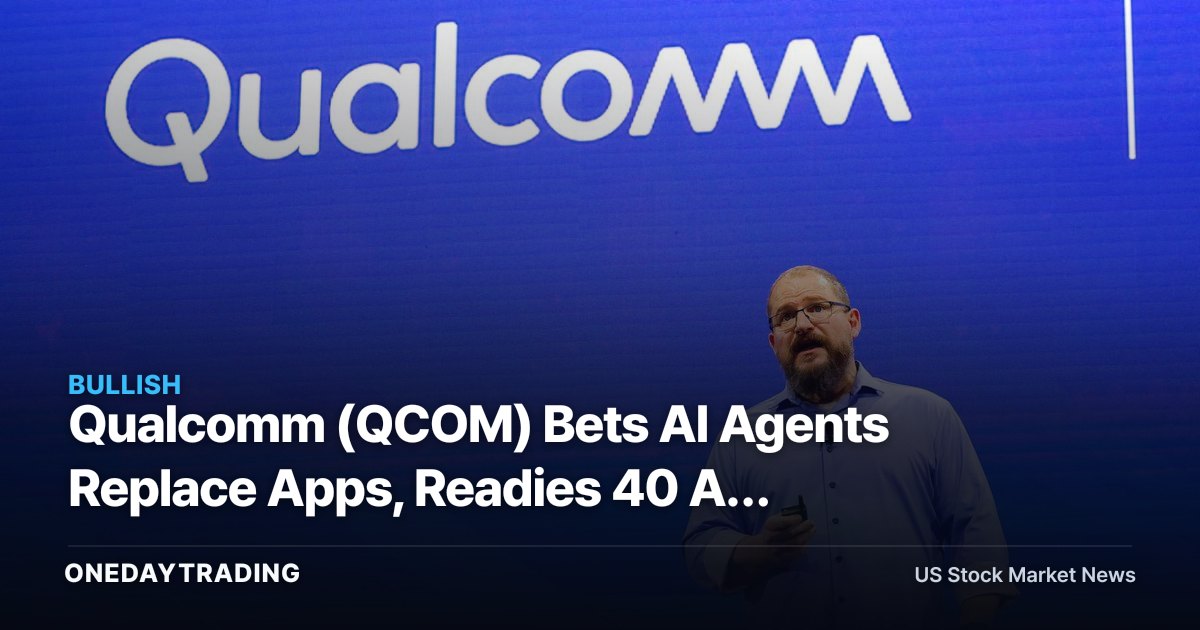
Qualcomm is positioning its Snapdragon silicon for a post-app world where AI agents, not tapped icons, become the primary user interface. CEO Cristiano Amon's claim that AI agents will replace apps and that smart glasses could one day rival the smartphone is a strategic signal: the company is hunting for the next high-volume edge-AI socket beyond a maturing handset market.
What Happened
Amon said he is bullish on AI agents supplanting traditional mobile apps as the way users interact with devices, with the chip giant working on 40 new AI-powered products. He singled out smart glasses as a category that could eventually grow as large as the smartphone itself.
The framing matters for Qualcomm's business model. The company's revenue has long leaned on smartphone application processors and modem-RF content, plus a high-margin licensing stream tied to handset units. An agent-first, multi-device future spreads that silicon demand across glasses, wearables and other edge endpoints that run AI inference locally rather than only in the cloud.
Background & Context
On-device AI is Qualcomm's core pitch: running language and vision models at the edge cuts latency, protects privacy and offloads cost from data centers. That argument plays to Snapdragon's NPU-equipped platforms and gives Qualcomm a differentiated story versus a smartphone cycle that has been flat. Diversifying into PCs, automotive and now AI wearables is the company's hedge against handset concentration and its dependence on a small number of flagship customers.
Market & Stock Impact
- Qualcomm (QCOM): A credible smart-glasses and agent-device ramp would add new silicon content per user and lengthen the edge-AI runway beyond phones, supporting the diversification thesis if the 40 products convert into design wins.
- Apple (AAPL): A double-edged read — Apple remains a key Qualcomm modem customer but is building its own modems, and an agent-first interface could pressure the App Store distribution model that anchors its services revenue.
- Meta Platforms (META): The most validated smart-glasses player; broad industry conviction on the category supports its AI-wearables roadmap and the ecosystem Qualcomm wants to supply.
- Arm (ARM): Rising edge-AI device counts expand licensable compute, though Arm and Qualcomm remain entangled in a contentious licensing relationship.
- Nvidia (NVDA): An edge-inference shift is a partial counterweight narrative to cloud-GPU demand, a variable for data-center AI spend if more inference moves on-device.
Investor Checkpoints
- Qualcomm's next quarterly results and guidance: watch IoT and automotive revenue lines and any disclosed smart-glasses or AI-PC design wins.
- Concrete unit or shipment commentary on the 40 AI devices — vision without volume timelines is just a roadmap.
- Apple modem-share trajectory, since lost handset content is the largest known headwind to QCOM's chipset segment.
- Whether agent-first interfaces gain real consumer traction, the demand assumption underpinning the entire thesis.
Outlook
The bull case is that Qualcomm owns the silicon layer of a multi-device edge-AI era and finally escapes its single-category dependence. The risk is timing and proof: smart glasses are still a nascent, low-volume category, agent interfaces remain unproven at scale, and Qualcomm faces Apple insourcing and Arm licensing friction. The roadmap is ambitious; the validation will be in shipped units and recurring chipset content, not in keynote claims.
Market data check: QCOM
QCOM last traded near $229.68 (+4.02%). Our composite signal — blending price momentum and news flow — reads 🟡 neutral. Price momentum scores 82/100 (firm).
Data as of publication. Price via market feeds; for reference only, not investment advice.
📊 Analysis
Signal Bullish
Why A diversification narrative into edge-AI devices and smart glasses expands Qualcomm's addressable silicon content beyond a flat smartphone market.
Tickers$QCOM$AAPL$META$ARM$NVDA
This article was independently written by OneDayTrading from public reporting. Read the original (CNBC)