What Changes
IBD Stock of the Day status is a screen, not new fundamental news, but the reason this category keeps surfacing matters. The bottleneck for AI is no longer just GPUs; it is the power and grid capacity needed to run them. Data center operators are signing multi-year capacity deals, and the companies that sell the generation and transmission hardware feeding those campuses are seeing order books extend well beyond a normal cycle.
A grid-and-power supplier like GE Vernova sits at that chokepoint. It sells gas turbines, grid hardware and electrification equipment — the exact gear utilities and hyperscalers need to connect new load. When a stock in this group trades in a defined buy zone, it usually reflects investors pricing in sustained backlog growth rather than a one-off demand spike.
By the Numbers
The source flags a technical buy zone but does not publish fresh figures, so the honest read is that this is a momentum and accumulation signal rather than an earnings event. For a fundamental confirmation, the metrics that matter are order backlog, book-to-bill, equipment margins and power-segment guidance — the lines that show whether AI-linked demand is converting into shippable, profitable revenue.
Winners & Losers
- GE Vernova (GEV) — direct beneficiary; turbines and grid equipment are the long-lead items gating data center power, supporting backlog visibility.
- Vertiv (VRT) — sells power and thermal management inside the data center; rising rack density lifts content per facility.
- Eaton (ETN) and nVent (NVT) — electrical distribution and switchgear demand scales with megawatts connected, not just chip count.
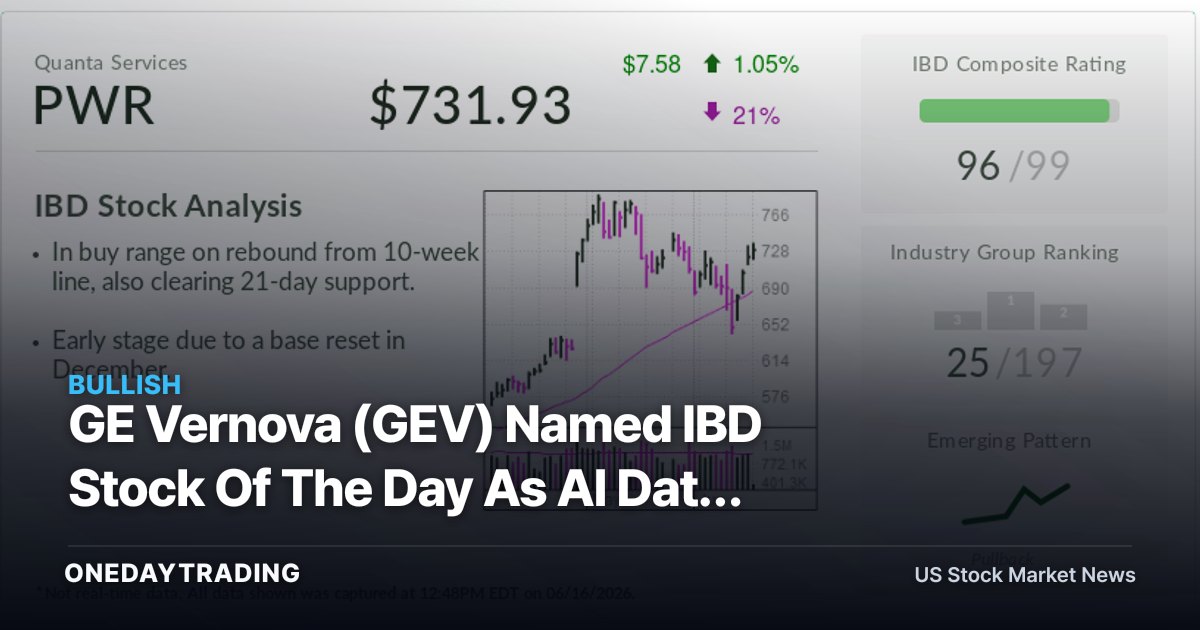
- Quanta Services (PWR) — builds the transmission lines that link new generation to load, a labor-intensive bottleneck.
- Independent power and utility names — gain pricing power as data centers compete for firm capacity.
Risk Check
- Valuation: power-infrastructure names have already re-rated on the AI narrative, so multiples leave little room for a demand wobble.
- Technical fragility: a buy zone fails fast if the broader market or rates turn, and this is a setup, not a guaranteed move.
- Lead times cut both ways: long backlogs delay revenue recognition and can mask near-term softness.
- Policy and permitting: grid connection queues and interconnection delays can throttle how fast orders ship.
Bottom Line
The AI build-out is increasingly a power story, and GE Vernova is positioned at the grid-and-generation layer that competitors cannot easily bypass — but a technical buy zone is an entry signal, not a fundamental green light, so the next backlog and margin update is what separates a durable trend from a crowded trade.
Market data check: GEV
GEV last traded near $1,048.86 (+6.77%). Our composite signal — blending price momentum and news flow — reads 🟡 neutral. Price momentum scores 95/100 (firm).
Data as of publication. Price via market feeds; for reference only, not investment advice.
📊 Analysis
Signal Bullish
Why AI data center electricity demand is a structural tailwind for grid and power-equipment suppliers, and the buy-zone signal points to continued accumulation.
Tickers$GEV$VRT$ETN$PWR$NVT
This article was independently written by OneDayTrading from public reporting. Read the original (Yahoo Finance)