Key Takeaways
A leadership crisis around U.K. Prime Minister Keir Starmer is a political-risk event, not an earnings event, so the cleanest market read-through runs through the pound, U.K. government bonds and broad U.K. equity exposure rather than any single company. For dollar-based investors, the practical exposures are currency-hedged and unhedged U.K. funds.
What Happened
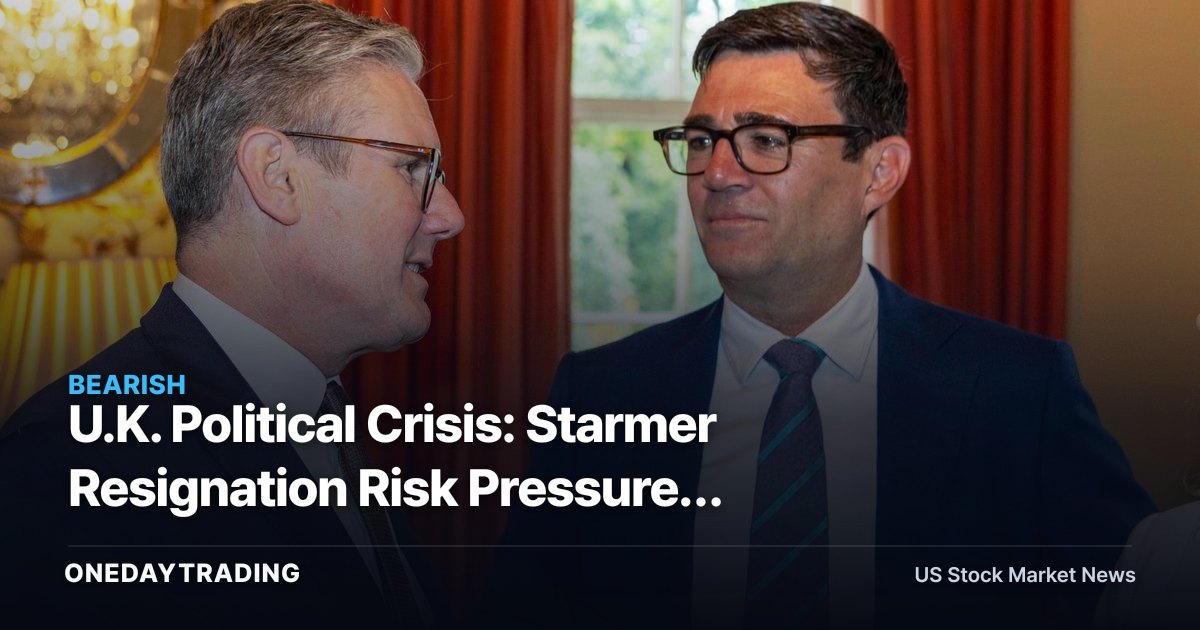
According to CNBC, a sharp internal dispute within Westminster has put Starmer on the verge of stepping down, with pressure building from inside his own party rather than from an opposition vote. The trigger is described as a war of words that escalated into a direct challenge to his position as leader.
The important nuance for markets is that this is intra-party pressure. A leadership contest inside a governing party can change the head of government without an immediate general election, which tends to compress the timeline of uncertainty but raises questions about policy continuity, fiscal direction and the makeup of the Treasury team.
Background and Context
Political transitions in the U.K. have historically transmitted to markets through the currency and the gilt market first. A change at the top reopens debate over budget plans, tax and spending priorities, and the credibility of fiscal targets, all of which feed directly into the pound and into U.K. borrowing costs. Equity sectors with the most domestic revenue exposure are the most sensitive; large multinationals listed in London often move inversely to sterling because foreign earnings translate to more pounds when the currency weakens.
Market and Stock Impact
- British pound (FXB): Leadership uncertainty typically pressures sterling because investors demand a higher risk premium until policy direction is clear; a weaker pound is the most direct expression of this headline.
- Broad U.K. equities (EWU): The iShares MSCI United Kingdom ETF skews toward large internationally exposed names, so a softer pound can partly cushion the index even as domestic confidence wobbles.
- Currency-hedged U.K. exposure (HEWU): A hedged vehicle strips out the sterling move, isolating the equity reaction and serving as a cleaner gauge of whether investors are pricing genuine economic damage.
- U.K. domestic-facing sectors: Banks, homebuilders and consumer names tied to U.K. demand carry the highest sensitivity to fiscal and rate expectations that a new leadership would shape.
Investor Checkpoints
- Whether the dispute resolves into a formal resignation and leadership contest, or de-escalates, since the path determines how long the risk premium persists.
- The sterling reaction against the dollar as the real-time barometer of market stress on this story.
- Any signal on continuity at the Treasury and existing budget plans, the channel most likely to move gilt yields.
- Whether a general election becomes part of the discussion, which would lengthen and deepen the uncertainty window.
Outlook
The bull case is that an internal handover is contained and brief, leaving fiscal policy broadly intact and allowing U.K. assets to recover any knee-jerk discount quickly. The risk case is that the contest drags on, spills toward election speculation, and forces a repricing of U.K. fiscal credibility that weighs on the pound and gilts together. With no company financials in play, position sizing here is a judgment about political duration, not corporate fundamentals, and the currency move is the first place that judgment will show up.
Market data check: EWU
EWU last traded near $45.46 (0.00%). Our composite signal — blending price momentum and news flow — reads 🟡 neutral. Price momentum scores 50/100.
Data as of publication. Price via market feeds; for reference only, not investment advice.
📊 Analysis
Signal Bearish
Why Leadership uncertainty and possible resignation raise the U.K. political risk premium, pressuring sterling and U.K.-exposed assets until policy direction clarifies.
This article was independently written by OneDayTrading from public reporting. Read the original (CNBC)