At a Glance
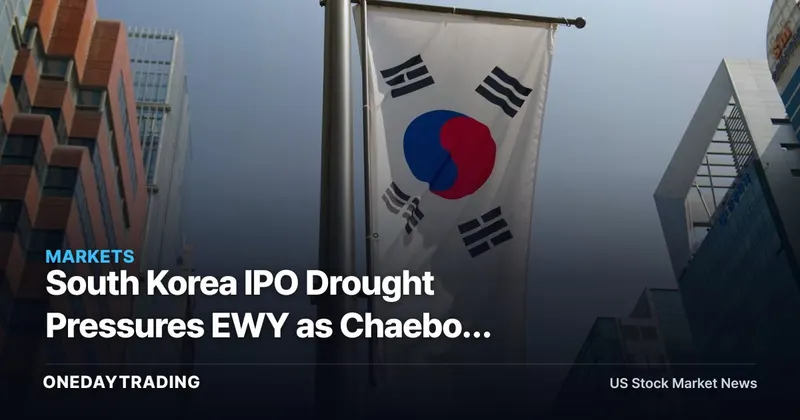
South Korea is producing fewer new listings than its Asian peers, a function of how its chaebol conglomerates are wired and how governance reforms are reshaping who actually benefits when a company goes public. For investors, the signal is less about any single deal and more about whether Korea can shed its long-standing valuation discount.
Why It Matters Now
A thin IPO pipeline cuts both ways. Fewer fresh listings means less new equity supply competing for capital, which can be marginally supportive for established Korean names already trading on public exchanges. But a stalled pipeline also signals that founders and controlling families see little upside in floating subsidiaries when minority shareholders often capture a smaller share of the value created.
The chaebol structure is the core friction. Cross-holdings, holding-company layers and family control mean that listing a crown-jewel unit can dilute the parent or expose the group to outside scrutiny. That dynamic sits directly against the government Value-Up push, which is meant to narrow the so-called Korea Discount by pressing companies to lift returns on equity, raise payouts and treat minority holders more fairly. When reform goals and ownership incentives pull in opposite directions, deal flow is the first casualty.
For global investors, the cleanest expression is the broad Korea complex rather than any one offering. Financial holding companies, which have been at the center of the Value-Up campaign through buybacks and dividend commitments, are the most direct read on whether reform momentum survives a weak listings backdrop.
FAQ
- Why are Korean IPOs lagging the region? Chaebol ownership structures and governance reforms reduce the incentive for controlling families to list units on terms that reward minority investors.
- Is a slow IPO market bearish for Korean stocks? Not uniformly. It limits new supply, but it also reflects structural governance issues that keep valuations depressed.
- What is the Korea Discount? The persistent tendency for Korean equities to trade below regional peers, blamed on weak shareholder returns and concentrated control.
- How do US investors access this theme? Through Korea ETFs and US-listed Korean ADRs spanning financials, industrials and e-commerce.
Related Stocks & Sectors
- EWY (iShares MSCI South Korea ETF) — the broadest proxy; a structurally weak listings market and reform progress both flow straight into it.
- SHG and KB (Korean financial holdings) — front-line Value-Up names where buybacks and payout policy directly test whether reform is real.
- CPNG (Coupang) — a Korea-exposed e-commerce leader that chose a US listing, underscoring why some firms bypass the domestic market entirely.
- PKX (POSCO Holdings) — a holding-company structure that embodies the chaebol layering at the heart of the discount.
What to Watch
- Concrete Value-Up disclosures from Korean financials — buyback size, payout ratio and ROE targets at the next earnings updates.
- Whether any marquee chaebol subsidiary files to list, a sign the incentive math is shifting.
- EWY relative performance versus regional Asia ETFs as a gauge of discount narrowing.
- Policy follow-through on governance rules, since reform durability is the key variable.
Overall Outlook
The bull case is that Value-Up forces a structural re-rating: sustained buybacks and higher payouts could erode the Korea Discount and eventually thaw the listings market. The risk is that ownership incentives prove stickier than policy, leaving reform as headline more than substance and the IPO channel constrained. With limited hard data in the near term, the financial holdings cohort offers the most measurable test of which scenario is winning.
Market data check: EWY
EWY last traded near $197.26 (+2.63%). Our composite signal — blending price momentum and news flow — reads 🟡 neutral. Price momentum scores 71/100 (firm).
Data as of publication. Price via market feeds; for reference only, not investment advice.
📊 Analysis
Signal Neutral
Why A weak IPO pipeline is a structural negative, but governance reform and reduced new-share supply provide a genuine offset, leaving the directional impact two-sided.
Tickers$EWY$SHG$KB$CPNG$PKX
This article was independently written by OneDayTrading from public reporting. Read the original (CNBC)