Donald Trump and NATO Put Escalation Risk in Focus
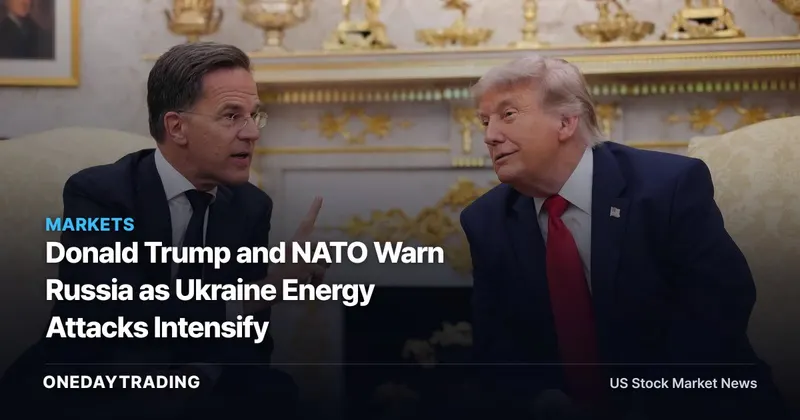
Donald Trump and NATO chief Mark Rutte issued a joint statement Thursday urging Russia to avoid actions that could expand the Ukraine war, including actions taken unintentionally. For investors, the relevant signal is diplomatic rather than company-specific: the statement calls for restraint and a peaceful resolution as rapidly as possible, while the supplied evidence identifies no direct impact on a U.S.-listed security.
The event is a coordinated warning from the U.S. president and NATO's chief against a wider war. Its significance rests on the gap between the message and observable conduct. Russia has stepped up attacks on Ukraine's energy infrastructure in recent weeks, according to CNBC, so the next meaningful evidence is whether attacks and their geographic reach change after the statement.
This distinction matters because diplomatic language is an expression of policy intent, not proof of de-escalation. The fact sheet does not establish whether Russia will act on the warning, what response it may provide, or whether the appeal will alter the course of the war. Those unanswered points prevent a directional market conclusion from the statement alone.
The Trump-Rutte Statement and Its Immediate Context
Trump and Rutte met Wednesday at the Mar-a-Lago club in Palm Beach, Florida. They described the meeting as “very impactful,” and discussed both the Ukraine war and the Iran war. Their subsequent statement focused on avoiding intentional or unintentional expansion of the Ukraine conflict and obtaining peace rapidly.
Donald Trump had met Vladimir Putin and Xi Jinping in Asia one week earlier, CNBC reported. That sequence places the Russia warning after direct engagement involving the Russian and Chinese leaders, though the fact sheet supplies no outcome from the trilateral meeting and no supported causal connection between that meeting and Thursday's statement.
Rutte brings nearly 14 years of experience as Dutch prime minister to his role as NATO chief. The supplied facts characterize him as a diplomat who has sought to reduce tensions within the alliance. Trump has called Rutte a “great leader” and NATO's “biggest asset,” while also describing Putin as a “friend.” Those quotations show the personal language surrounding the diplomacy; they do not demonstrate that any party has changed policy.
Ukraine Energy Damage Is the Hard Evidence
The physical evidence is concentrated in Ukraine's power system. Ukrainian officials said Wednesday that attacks damaged energy infrastructure and caused outages in five regions. The full extent of that damage and the number of people affected are unknown, limiting any attempt to translate the disruption into a quantified economic or market effect.
In Kryvyi Rih, attacks disrupted power supplies and stopped municipal electric public transport, according to Oleksandr Vilkul. This is the clearest operational consequence in the fact sheet: energy-system damage moved beyond infrastructure itself and interrupted a public transport service. No further measure of the disruption, duration, or affected population is available.
Russia's war in Ukraine has lasted nearly five years, according to CNBC. That duration provides context for why a fresh joint statement should be evaluated through subsequent actions rather than treated as a resolution. The immediate checkpoint is whether further reported attacks continue to damage energy assets, interrupt power, or halt essential services.
European Security Signals Beyond Ukraine
Friedrich Merz accused the Kremlin on Wednesday of escalating threats toward European security. He said, “Russia knows exactly what it wants. And Russia wants more than Ukraine.” The quotation represents Merz's assessment; the supplied evidence does not independently establish the broader intention he attributed to Russia.
The Kremlin has repeatedly denied seeking military confrontation with NATO countries. That denial stands against Merz's accusation and the Trump-Rutte warning, creating a clear dispute over the direction and scope of the security risk. Russia's Foreign Ministry had not responded to CNBC's request for comment as of Thursday morning, leaving Russia's specific reaction to the joint statement unknown.
For an international investor, the disciplined reading is that the evidence documents heightened official concern and continuing infrastructure damage, not a confirmed widening of the war. It also does not document a ceasefire, a negotiated framework, or a Russian commitment to the requested restraint. The next signal must therefore come from conduct or an attributable official response.
Market Read-Through Without Unsupported Tickers
- No evidence-supported stock beneficiary: The fact sheet names no listed company, contract, revenue stream, order, commodity price, or financial instrument that benefits from the statement.
- No evidence-supported stock loser: The reported energy damage is serious, but the supplied facts do not connect it to the earnings, assets, costs, or guidance of a U.S.-listed company.
- Macro relevance: The event concerns Russia, Ukraine, NATO, European security, and the possibility of war expansion. Those subjects can matter to investors, but this evidence provides no market move, rate, index, commodity, valuation, or sector-performance data from which to infer direction.
- Neutral classification: A call for rapid peace may represent a de-escalatory objective, while ongoing attacks and the absence of Russia's response preserve the risk. Neither side of that balance has produced a confirmed market outcome in the available record.
What Could Confirm or Break the Diplomatic Signal
- Russia's response: An attributable reply from Russia's Foreign Ministry or the Kremlin would show whether Moscow accepts, rejects, or otherwise addresses the request. No such response is established here.
- Actions around the war: Reports of whether Russia avoids conduct that could intentionally or unintentionally expand the conflict would test the joint statement against events.
- Ukraine's power system: Further official accounts should be checked for changes in infrastructure damage, regional outages, and transport interruptions. The current evidence does not establish the total damage or affected population.
- Peace efforts: A concrete development toward the rapid peaceful resolution sought by Trump and Rutte would carry more evidentiary weight than the statement itself. The fact sheet identifies no resulting agreement or outcome.
The Investor Bottom Line on Russia and Ukraine
The central tension is precise: Donald Trump and Mark Rutte have jointly asked Russia to prevent further expansion of the Ukraine war, while reported attacks have already damaged energy infrastructure and caused outages across five regions. The diplomatic message points toward restraint, but the operational evidence still points to disruption.
That combination supports a neutral, macro-level assessment rather than a bullish or bearish stock call. The constructive scenario requires observable restraint and progress toward the peaceful resolution requested Thursday. The adverse scenario is continued infrastructure damage or conduct that broadens the conflict. Until Russia responds or events establish a change, the statement is a checkpoint in the diplomacy—not evidence that the underlying risk has receded.
📊 Analysis
Signal Neutral
Why The statement raises the diplomatic focus on escalation risk, but the facts establish neither Russia's response nor a direct effect on any U.S.-listed stock or sector.
This article was independently written by OneDayTrading from public reporting. Read the original (CNBC)