Summary
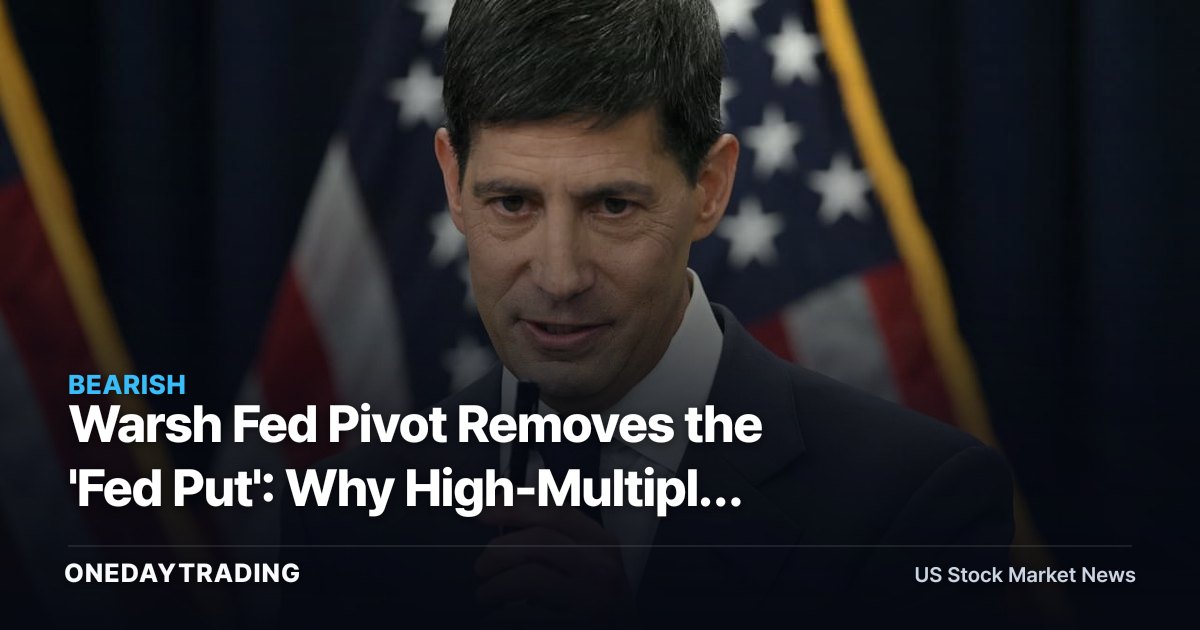
The core market signal from a Kevin Warsh-led Fed is the withdrawal of the implicit backstop investors have leaned on for over a decade — the so-called Fed put. If the central bank stops cushioning every equity drawdown with dovish guidance or liquidity, the assets that benefited most from that safety net are the ones most exposed to repricing.
The mechanism is duration and discount rates, not headlines: when the market can no longer assume rescue, risk premia widen and the highest-multiple, longest-cash-flow names absorb the most pain.
The Full Story
Warsh has long been a public skeptic of large-scale asset purchases and of the idea that monetary policy should respond to falling stock prices. A Fed that explicitly ditches that reaction function changes how every risk asset is priced, because a chunk of equity valuations over the past cycle rested on the belief that policymakers would intervene before losses compounded.
Removing that assumption does not require a single rate change. It raises the effective risk premium investors demand to hold volatile assets. The clearest victims are companies valued primarily on distant earnings — where a higher or more uncertain discount rate compresses present value fastest — and businesses that depend on cheap, abundant funding to operate.
Structural Background
The Fed put was never an official mandate; it was a behavioral pattern markets inferred from repeated interventions. That inference lowered perceived downside, encouraged leverage, and supported elevated multiples on unprofitable growth. Stripping out the implied backstop reintroduces genuine two-way risk, which historically widens the gap between cash-generative quality and speculative, story-driven names.
Stock & Sector Ripple
- Speculative growth baskets (ARKK): most exposed — these holdings price in years of future growth, so a higher discount rate and no rescue narrative hit valuations hardest.
- Mega-cap high-multiple tech (NVDA, TSLA): high beta and long-duration cash flows mean they amplify market moves; without a put, drawdowns are less likely to be quickly bought back.
- Small caps (IWM): rate-sensitive and funding-dependent, with thinner balance sheets that suffer when liquidity is no longer assumed to be backstopped.
- Regional banks and REITs: heavily tied to funding costs and the path of yields; a less accommodative reaction function raises tail risk on financing.
- Cash-rich, profitable defensives: relative beneficiaries, since their valuations rely less on a benign rate and liquidity backdrop.
Bull vs Bear Scenarios
Bear: A credible signal that the Fed will not rescue markets widens risk premia, deflates multiples on unprofitable growth, and increases volatility around any selloff because dip-buyers lose their policy anchor.
Bull (counter-scenario): A Fed disciplined about not chasing asset prices can anchor inflation expectations and lower long-term uncertainty, rewarding earnings quality over speculation. The key variable is whether the economy and corporate profits stay resilient — if growth holds, the repricing is a valuation reset, not a fundamental break.
Investor Action Points
- Track the next FOMC communication for any explicit language on the Fed's reaction to market stress — confirmation or walk-back of the no-put stance is the catalyst.
- Watch the 10-year Treasury yield and the equity risk premium; a sustained rise in either pressures long-duration equities first.
- Stress-test portfolio exposure to unprofitable, high-multiple names versus cash-generative balance sheets.
- Monitor credit spreads and small-cap funding conditions as the earliest read on whether liquidity is genuinely tightening.
📊 Analysis
Signal Bearish
Why A Fed signaling it will abandon the implicit market backstop widens risk premia and pressures the highest-multiple, most rate-sensitive equities.
Tickers$ARKK$TSLA$NVDA$IWM
This article was independently written by OneDayTrading from public reporting. Read the original (MarketWatch)