Summary
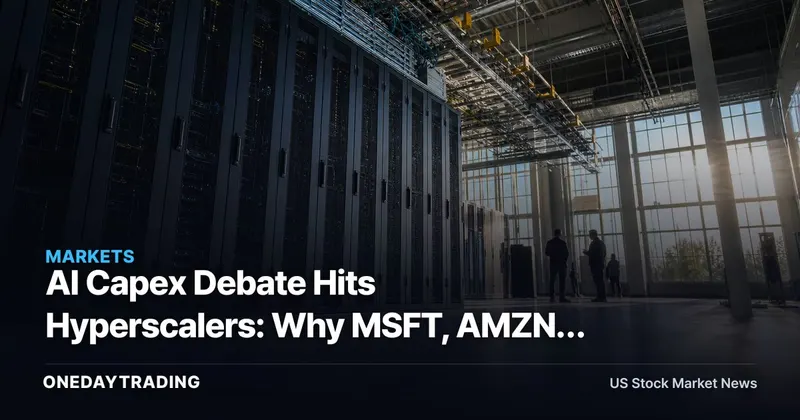
Most hyperscaler stocks have pulled back this year as investors question whether the AI capital-spending wave can sustain itself. The companies funding that wave — Microsoft, Amazon, Alphabet and Meta — are not pulling back. That gap between market skepticism and corporate conviction is the trade to understand.
The read for investors: the AI build-out is now a balance-sheet decision, not a hype cycle, and the stocks most exposed to it are being repriced on payback timing rather than demand.
The Full Story
The bear case is simple. Hyperscalers are pouring capital into data centers, accelerators and power at a pace that dwarfs prior infrastructure cycles, while the revenue that justifies it arrives later and less predictably. When spending runs ahead of monetization, free cash flow compresses and depreciation expands — and the equity market has spent this year docking multiples to reflect that.
Yet the operators keep committing. The logic from inside Big Tech is that under-building is the larger risk: capacity shortfalls cap cloud revenue, cede AI workloads to rivals, and are far harder to fix after the fact than over-building. Compute capacity has become the constraint on growth, so the spend continues even as the share prices that fund it weaken.
That is the core tension. The market treats AI capex as a cost; the spenders treat it as the price of staying in the game. Whoever is right determines whether this year's pullback was an entry point or the first leg of a longer derating.
Structural Background
This cycle differs from past tech build-outs because the buyers are among the most cash-generative companies on the planet, financing largely from operating cash flow rather than debt or dilution. That cushions downside but does not eliminate it: heavy capex flows straight into rising depreciation, which pressures reported margins for years even if demand holds. The unsettled question is the useful life and utilization of accelerators bought today.
Stock & Sector Ripple
- Microsoft (MSFT) — Azure growth depends on bringing capacity online; the spend defends cloud share but weighs on near-term free cash flow.
- Amazon (AMZN) — AWS is the profit engine, so AI capacity is strategic, but the capital intensity directly drags consolidated margins.
- Alphabet (GOOGL) — Funds AI infrastructure from a high-margin ad base, giving it room to spend without straining the balance sheet.
- Meta (META) — Spends heavily with no cloud rental revenue to offset it, making its capex the hardest for investors to underwrite.
- Nvidia (NVDA) — The direct beneficiary; hyperscaler capex is its order book, so any spending pause hits its revenue first.
Bull vs Bear Scenarios
Bull: demand for AI compute stays supply-constrained, utilization runs high, and cloud revenue inflects to validate the outlays — turning this year's weakness into a setup. Bear: monetization lags the depreciation curve, capex keeps climbing without matching revenue, and multiples compress further as free cash flow erodes. The swing variable is utilization — whether the chips bought now are fully used.
Investor Action Points
- Track each hyperscaler's next-quarter capex guidance against cloud revenue growth — the spread, not the absolute spend, is the signal.
- Watch free cash flow and depreciation trends, where rising AI investment shows up first.
- Use NVDA order commentary as a real-time read on whether hyperscaler demand is holding or cooling.
- Separate the spenders: Alphabet and Microsoft can fund from strong core businesses; Meta carries the heaviest scrutiny.
Market data check: MSFT
MSFT last traded near $372.97 (+5.71%). Our composite signal — blending price momentum and news flow — reads 🟡 neutral. Price momentum scores 95/100 (firm).
Data as of publication. Price via market feeds; for reference only, not investment advice.
📊 Analysis
Signal Neutral
Why The story frames a genuine two-sided debate — sustained hyperscaler conviction versus a market repricing AI capex risk — with no clear directional resolution.
Tickers$MSFT$AMZN$GOOGL$META$NVDA
This article was independently written by OneDayTrading from public reporting. Read the original (NASDAQ)