At a Glance
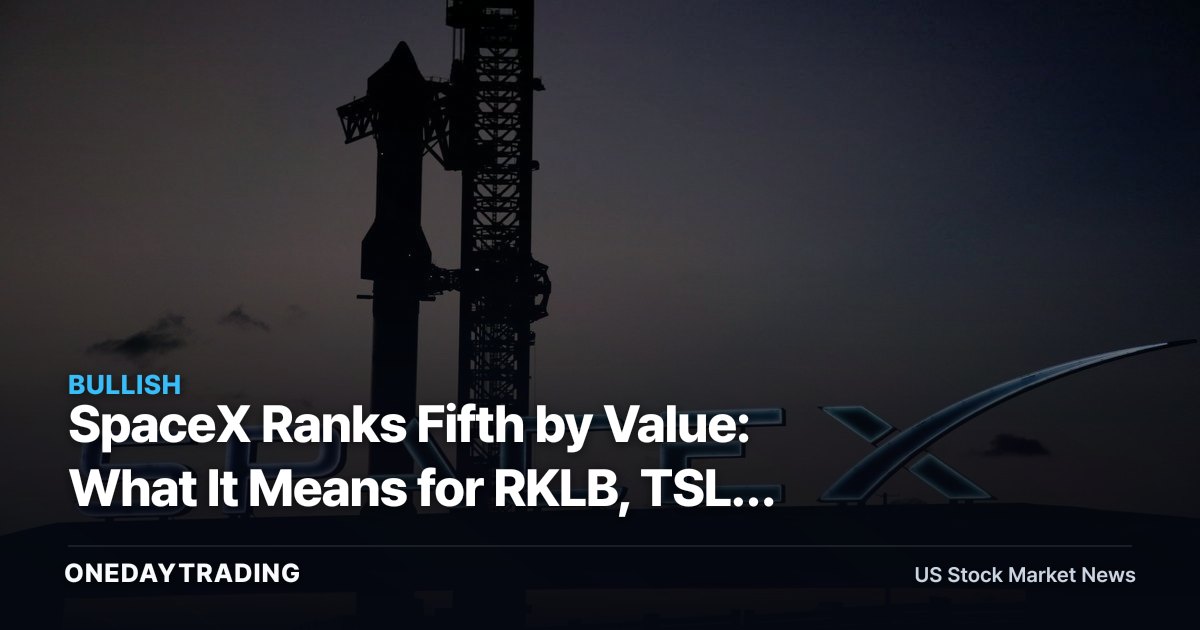
SpaceX has debuted as the fifth most valuable stock in the U.S. equity landscape, a striking marker for a company that is still privately held. According to options-derived probabilities, the climb to the number-three spot could take years rather than quarters. The data point matters less for SpaceX itself, which retail investors cannot buy, and more for the listed space and Musk-adjacent names that trade as proxies.
Why It Matters Now
The headline number reframes how the market sizes the commercial space economy. A fifth-place ranking puts SpaceX in the same conversation as the megacap leaders that dominate index weightings, yet it sits behind them by a wide enough margin that even optimistic options pricing implies a multi-year path to third. For investors, the read-through is that the launch-and-satellite theme is being valued like a structural growth story, not a niche.
Because SpaceX shares are inaccessible on public exchanges, capital that wants exposure tends to rotate into the few listed pure-plays and into Tesla, which functions as the liquid Musk proxy. Heightened attention on a SpaceX valuation milestone, plus recurring talk of a possible Starlink spin-off, can pull sentiment toward smaller launch and satellite companies whose revenue base is a fraction of the incumbent leaders.
The counterweight is that valuation rankings for a private firm rest on tender-offer marks and secondary trades, not the daily price discovery that public stocks face. That makes the fifth-place label a snapshot rather than a durable verdict, and it does little to change the actual cash flows of any listed name.
FAQ
- Can I buy SpaceX stock? No. SpaceX is private, so public investors typically use listed proxies or pre-IPO funds instead.
- Why only fifth and not first? The top public names still carry far larger market values, and options-implied odds suggest reaching third could take years.
- What is the nearest listed pure-play? Rocket Lab is the most direct listed launch-and-space peer; Tesla is the liquid Musk-linked proxy.
- Is a Starlink IPO coming? It is frequently discussed but not confirmed; any move would reset how the space theme is priced.
Related Stocks & Sectors
- RKLB — the clearest listed pure-play on launch and satellite demand; benefits from sector attention but at a far smaller revenue scale.
- TSLA — the liquid Musk proxy; sentiment around his ventures often spills into the shares despite no direct ownership link.
- NVDA, MSFT, AAPL — the megacap leaders SpaceX is now ranked against; the comparison underscores how concentrated top-of-market value remains.
- Aerospace and defense sector — incumbents face a fast-scaling private rival in launch and connectivity.
What to Watch
- Any concrete signal on a Starlink or SpaceX public listing, which would create a true tradable instrument.
- Next SpaceX secondary or tender-offer valuation marks that confirm or fade the fifth-place ranking.
- RKLB launch cadence and backlog in its upcoming earnings, the cleanest test of whether the theme has cash flow behind it.
- Whether megacap leadership concentration loosens, which would change the ranking math from the top.
Overall Outlook
The bull case is that a fifth-place valuation validates commercial space as a megacap-scale theme, drawing capital toward the handful of listed ways to play it. The risk is that the ranking is built on private marks, the path to third is measured in years, and none of it directly adds revenue to the proxies investors actually own.
Market data check: RKLB
RKLB last traded near $105.13 (-2.64%). Our composite signal — blending price momentum and news flow — reads 🟡 neutral. Price momentum scores 29/100 (soft).
Data as of publication. Price via market feeds; for reference only, not investment advice.
📊 Analysis
Signal Bullish
Why A SpaceX valuation milestone raises investor attention on the listed space theme and Musk-linked proxies, a sentiment tailwind for names like RKLB.
Tickers$RKLB$TSLA$NVDA$MSFT$AAPL
This article was independently written by OneDayTrading from public reporting. Read the original (CNBC)