Ferrari’s Guidance Raise Tests the Quality of Growth
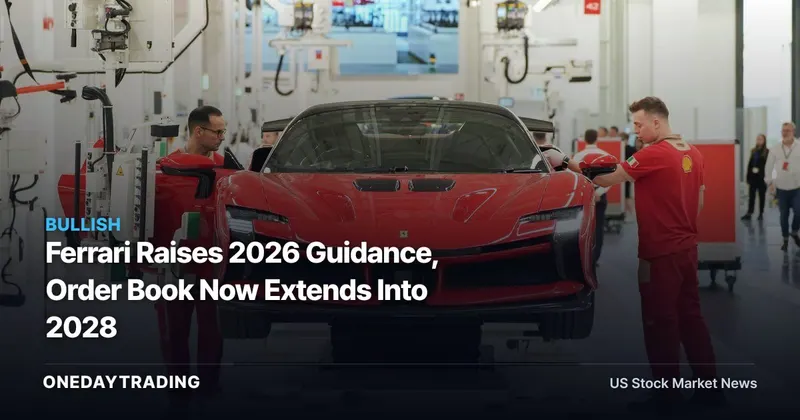
Ferrari raised its 2026 financial guidance after third-quarter revenue and adjusted earnings per share slightly exceeded Wall Street expectations, according to CNBC on 2026-11-03. The investor signal is constructive: stronger customer personalizations and lower currency headwinds are improving the outlook even as the automaker ships fewer vehicles.
The guidance raise is the second in consecutive quarters. Ferrari now expects 2026 revenue of 7.65 billion euros, compared with its previous guidance of 7.6 billion euros, while adjusted EBITDA guidance increased to 3 billion euros from 2.97 billion euros.
Adjusted EBITDA means earnings before interest, taxes, depreciation and amortization, a measure used to assess operating performance before financing and certain noncash costs. Ferrari also raised its 2026 adjusted EPS guidance to at least 9.85 euros from at least 9.68 euros.
Personalization Supports Ferrari as Shipments Decline
The central tension is between vehicle volume and the economics of each customer order. Ferrari shipped 10,170 vehicles during the first nine months of 2026, a decline of 318 vehicles compared with last year. Fewer shipments to the Americas and to China, Hong Kong and Taiwan led the decrease.
Despite that contraction, Ferrari attributed its improved guidance to stronger-than-expected customer personalizations, lower-than-anticipated currency headwinds and a second-place finish in the Formula 1 championship. Personalization is therefore the clearest supported explanation for why a lower shipment count did not prevent management from lifting its financial expectations.
The industrial free cash flow outlook adds another dimension. CNBC reported that Ferrari increased its 2026 guidance to up to 1.65 billion euros, replacing previous guidance of at least 1.55 billion euros. The changed wording matters: the new figure is an upper boundary, whereas the previous figure was a minimum, so the two amounts should not be treated as directly equivalent targets.
This combination makes the quality of the guidance increase more important than its size. The supported evidence points to customer choices, currency conditions and Formula 1 performance rather than shipment expansion. It does not establish how much each factor contributed, leaving investors without a precise bridge from lower volume to higher revenue, earnings and cash-flow guidance.
Ferrari’s 2028 Order Book Meets a Measured Market Reaction
Demand visibility remains the strongest counterweight to weaker shipments. CEO Benedetto Vigna said Ferrari’s order book extends into 2028 and that the company has 2 additional launches planned for the remainder of 2026. The specific models represented by those launches were not identified.
An order book reaching into 2028 indicates that customer commitments extend beyond the current guidance period. It does not by itself disclose the future delivery schedule, personalization content or financial contribution of those orders, so investors still need evidence that the backlog converts on attractive terms.
The initial share reaction captured that tension. Ferrari’s U.S. shares first declined after the results, then turned positive and gained 2% in premarket trading. The reversal suggests the guidance increase and extended order book eventually outweighed immediate disappointment over the scale of the raise during that session, though the exact share price was not provided.
Tom Narayan of RBC Capital Markets described the results as largely aligned with Wall Street expectations. He said some investors had hoped for a larger guidance increase, creating slight pressure, while characterizing the underlying results as healthy. That assessment frames the stock debate: the direction of the revisions was favorable, while the magnitude did not exceed every expectation.
The exact third-quarter revenue, adjusted earnings per share and LSEG consensus estimates were not supplied. Those omissions prevent a calculation of the earnings surprise and limit any judgment about whether the premarket move fully reflected the reported beat.
What Ferrari Investors Should Check Next
- Guidance conversion: Compare subsequent reported performance with Ferrari’s 2026 revenue guidance of 7.65 billion euros, adjusted EBITDA guidance of 3 billion euros and adjusted EPS guidance of at least 9.85 euros.
- Cash generation: Track whether industrial free cash flow approaches the new guidance of up to 1.65 billion euros and how Ferrari explains the shift from the previous minimum-based outlook.
- Shipment discipline: Check whether the decline of 318 vehicles through the first nine months of 2026 persists and whether weakness remains concentrated in the Americas and China, Hong Kong and Taiwan.
- Customer value: Look for evidence that personalization continues to support the financial outlook when vehicle shipments are lower. A reduced contribution would weaken the mechanism behind the latest raise.
- Backlog execution: Follow the 2 remaining 2026 launches and whether Ferrari continues to report an order book extending into 2028.
The bullish case rests on repeated guidance increases, stronger personalizations, reduced currency pressure and long order visibility. The risk is that lower shipments persist while personalization, currency conditions or Formula 1 contributions become less supportive. Ferrari’s next results must show that the raised outlook converts into reported earnings and cash flow, not merely that demand remains booked years ahead.
Market data check: Ferrari N.V.
Ferrari N.V. last traded near $420.81 (+4.40%). Our composite signal — blending price momentum and news flow — reads 🟡 neutral. Price momentum scores 85/100 (firm).
Data as of publication. Price via market feeds; for reference only, not investment advice.
📊 Analysis
Signal Bullish
Why Higher guidance across revenue, adjusted EBITDA, adjusted EPS and industrial free cash flow is a positive catalyst, tempered by lower shipments and expectations for a larger increase.
This article was independently written by OneDayTrading from public reporting. Read the original (CNBC)