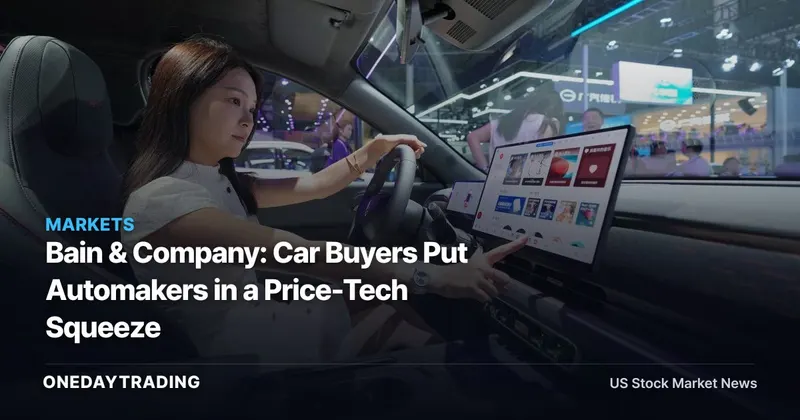
Bain & Company Puts the Auto Investment Question in Plain View
Bain & Company’s latest Global Automotive Consumer Survey shows automakers facing a two-part demand test: buyers want competitive prices and better technology. In a CNBC Markets article whose URL is dated 2026-10-20, the regional split is clear enough to matter for investors, even though the evidence does not identify individual manufacturers or models.
The investment tension lies between differentiation and affordability. Technology can help a manufacturer win consideration, while price remains the leading purchase priority across major Western markets. That combination may raise the commercial value of useful features without establishing that customers will pay enough for them to improve returns.
Regional Priorities Split Between Technology and Price
The Global Automotive Consumer Survey is Bain & Company’s measure of the considerations consumers emphasize when buying a vehicle. CNBC Markets reported that tech and features were a leading purchase consideration for 58% of Chinese consumers in the latest survey, placing those attributes ahead of price.
CNBC Markets also reported that price was the top consideration for 68% of U.S. consumers and 62% of European consumers in the latest survey. The figures define different starting points: technology leads the stated hierarchy in China, while affordability leads in the U.S. and Europe.
This distinction should not be converted into a simple technology-versus-price divide. The confirmed evidence establishes rankings of purchase considerations, not the amount buyers will pay for any feature. For investors, the key issue is whether technology changes brand choice while competitive pricing limits how much of that value an automaker can capture.
China’s European Export Growth Raises the Competitive Stakes
Vehicle flows provide a physical measure of the competitive pressure surrounding the survey. The China Passenger Car Association cited customs figures showing that China’s vehicle exports to Italy more than doubled to 209,258 units in January-August.
The same source showed that China’s vehicle shipments to the U.K. rose about 86% to 365,672 units in January-August. Those totals demonstrate expanding shipment volumes into two European markets; they do not disclose the manufacturers, models, selling prices or profitability behind the vehicles.
The transmission mechanism is competitive choice. More incoming vehicles can broaden the set of options presented to customers, while openness to unfamiliar brands can reduce the protection historically supplied by customer allegiance. The evidence supports scrutiny of competitive positioning, not a conclusion about which manufacturer has already gained or lost revenue.
Brand Loyalty Is No Longer a Complete Defense
More than a third of customers in Western markets are open to new brands entering the market, according to Bain & Company’s latest survey. That finding matters because Stricker said European manufacturers had built their business model for decades around brand loyalty.
Customers most interested in autonomous-driving technology are also more willing to change manufacturers for better functionality. This connects technology directly to customer mobility: a feature gap may influence not only product selection within a brand, but also whether the buyer remains with that manufacturer at all.
Helen Liu, Bain’s Asia automotive head and a partner, said Western manufacturers need to “up their game.” Her description of Chinese and Western manufacturers as “climbing different mountains” captures the asymmetry: emerging Chinese players need stronger brand standing, while Western incumbents need stronger technology offerings. Competitive prices remain a requirement across both challenges.
The Central Debate: Can Features Pay for Themselves?
- Differentiation versus inclusion: Better functionality may attract buyers, while mass-market customers may expect advanced driving technology to be included rather than sold at a substantial premium. Adoption therefore does not by itself establish monetization.
- Brand strength versus switching: Established recognition can still influence consideration, yet openness to new entrants weakens the assumption that past loyalty will automatically protect future demand.
- Shipment growth versus economic quality: The Italy and U.K. figures document vehicle volumes. They do not reveal prices, price changes, product mix, costs or returns, so investors cannot infer financial success from units alone.
- Regional differences versus convergence: Current survey priorities differ across China, the U.S. and Europe. Buyers with greater interest in autonomous-driving technology show more willingness to switch, creating a condition under which the Western purchase hierarchy could change.
What the Evidence Supports for Autos, Not Individual Stocks
- Western auto manufacturers: The sector faces a potential need to improve technology while preserving competitive pricing. The financial impact depends on whether stronger functionality wins buyers without pricing vehicles out of consideration.
- Emerging Chinese manufacturers: Rising shipments to Italy and the U.K. establish expanding vehicle flows, while Helen Liu’s assessment identifies brand standing as their separate challenge.
- Automotive technology strategies: Interest in autonomous-driving functionality is associated with greater willingness to switch manufacturers. That makes feature quality relevant to customer retention as well as acquisition.
No specific automaker or vehicle model is identified in the available evidence, so assigning the read-through to a U.S.-listed stock would overstate what the facts establish. The survey also provides no vehicle prices or price changes from which to calculate company-level revenue or margin effects.
Investor Checkpoints After the Bain & Company Survey
- Next consumer survey: Check whether technology rises as a purchase consideration in the U.S. and Europe and whether price retains its current lead in both markets.
- Next shipment update: Compare subsequent China-to-Italy and China-to-U.K. vehicle volumes with the reported January-August figures, keeping units separate from assumptions about profitability.
- Manufacturer disclosures: Look for evidence showing whether advanced functionality is included in vehicles or carries a premium, because that distinction determines whether technology supports monetization or primarily adds competitive requirements.
- Brand-switching indicators: Track whether openness to new brands translates into purchasing behavior, particularly among buyers most interested in autonomous-driving technology.
The present evidence has firm boundaries. The survey dates, sample size and methodology are not supplied, and the specific years underlying the January-August export comparisons are not identified. Stricker’s first name and title are also unavailable. Evelyn Cheng contributed to the CNBC Markets story, which remains the sole source represented here.
The Auto Outlook Depends on Closing Two Different Gaps
The constructive case is that manufacturers can use better technology to win buyers whose brand preferences are becoming less fixed. The risk is that competitive prices become the entry ticket while customers resist paying separately for the functionality that influenced their choice.
That leaves the sector with a demanding capital-allocation question: whether spending to close a technology or brand gap produces commercially valuable demand. The next decisive evidence will not be another broad promise about features. It will be whether subsequent surveys show shifting priorities, whether shipment gains persist, and whether manufacturer disclosures demonstrate that better functionality can coexist with competitive pricing.
📊 Analysis
Signal Neutral
Why Stronger demand for technology creates differentiation opportunities, while price sensitivity and weakening brand loyalty could constrain automakers’ returns.
This article was independently written by OneDayTrading from public reporting. Read the original (CNBC Markets)